A curious rupture occurred during an international corporate assessment panel recently observed in Singapore. A twenty-two-year-old candidate with an immaculate academic pedigree submitted a technical strategy dossier that left the evaluators astonished. The predictive modeling was flawless; the quantitative risk hedges were structured down to three decimal places. But when the chief operating officer leaned forward and offered a simple, deliberate disruption—“Your predictive premise relies on market stability in the South China Sea. Assume that stability vanishes at 3:00 AM tomorrow. Walk us through your contingency strategy in three sentences without using notes”—the room altered instantly.
The candidate froze. His breath shortened. For forty-eight agonizing seconds, the young professional searched for an algorithm, a memorized slide deck, or a pre-computed answer. Unable to organize his thoughts under real-time social observation, he stumbled into disjointed technical jargon, lost executive presence, and conceded the interview. His written technical deliverable had earned a perfect 100 percentile score; his spontaneous human capability registered as unusable.
For more than three decades, K-12 education systems worldwide drilled a singular dogma into parents and children: master syntax, memorize formulas, pass the standardized threshold, and learn to code. Parents spent fortunes enrolling seven-year-olds in syntax-heavy programming boot camps and repetitive computational worksheets. Yet, as we approach 2030, the global economy has encountered what economists term the Great Algorithmic Equalizer. Generative cognitive architectures now produce production-grade software code in milliseconds, formulate complex legal briefs instantaneously, and synthesize balance sheets with zero latency. When routine technical output becomes virtually free, the market premium shifts entirely to what cannot be automated.
The central question confronting progressive parents, visionary educators, and school administrators is no longer “How does my child master academic content?” The defining question of this decade is: What specific future career skills will survive and dominate in the AI era, and what foundational abilities do children need in 2030 to build an unassailable global profile?
“When every student can produce an A-grade essay or clean computer code at the click of an algorithmic prompt, the differentiator is no longer what the student can calculate in private. The differentiator is who the student becomes when they stand before other human beings to justify, synthesize, persuade, and lead under ambiguity.” — Victory Fluent Forum Strategic Directorate, Child Cognitive Development Brief
1. The Macro-Economic Job Landscape: What Survived the Automation Curve?
To identify genuine future career skills, we must step outside traditional academic nostalgia and examine real macro-economic job trends. The World Economic Forum Future of Jobs analyses have systematically demonstrated a seismic migration away from routine cognitive labor toward uniquely human social, analytical, and emotional abilities. Roles defined by predictable procedural tasks—entry-level data structuring, basic auditing, standardized copywriting, and boilerplate software development—are consolidating at an extraordinary rate.
Conversely, the workplace value of advanced human synthesis, relational persuasion, ethical governance, and cognitive agility has surged. Labor economists point to a crucial economic principle: the Commoditization Complement Effect. When a machine reduces the cost of producing raw information to zero, the value of the human being who can interpret that information, defend it persuasively to a board of directors, and inspire cross-functional teams to execute it multiplies exponentially.
In our investigative research across higher education admissions committees and corporate talent incubators, we have mapped the four core strategic realities governing the employment landscape of 2030:
- The Collapse of the Syntax Barrier: Knowing how to write syntactical code or compose a formal essay is no longer a protective moat. The child of 2030 will work with intelligence engines as ambient infrastructure. The prize belongs to the child who possesses structural thinking—the ability to architect problems, detect algorithmic hallucination, and guide machine outputs toward humane outcomes.
- The Flight to Real-Time Presence: As synthetic video, automated emails, and AI avatars saturate the digital ecosystem, trust in asynchronous communication is dropping precipitously. High-stakes negotiations, capital allocation, university admissions interviews, and strategic leadership happen face-to-face or voice-to-voice. Spontaneous articulation and vocal gravitas have become the ultimate authenticity filters.
- The Ambiguity Economy: In a world that shifts unpredictably, businesses cannot operate from static five-year playbooks. Organizations demand individuals with high ambiguity tolerance—leaders who remain emotionally regulated, intellectually flexible, and verbally coherent when the operational manual fails.
- The Premium on Cross-Disciplinary Synthesis: Algorithms specialize in deep, narrow correlations within historical data. Human beings create breakthrough value at the intersections: synthesizing human psychology, technological ethics, economic history, and artistic narrative into unified strategic action.
These macroeconomic shifts demand that we radically redefine what constitutes foundational literacy. Standardized test scores and rote memorization are no longer proxies for leadership readiness. To build competitive global profiles for children aged 6 to 16, we must look directly at the neurobiology of communication, emotional stamina, and intellectual inquiry.
2. Introducing the RESILIENT COMMUNICATOR Matrix™
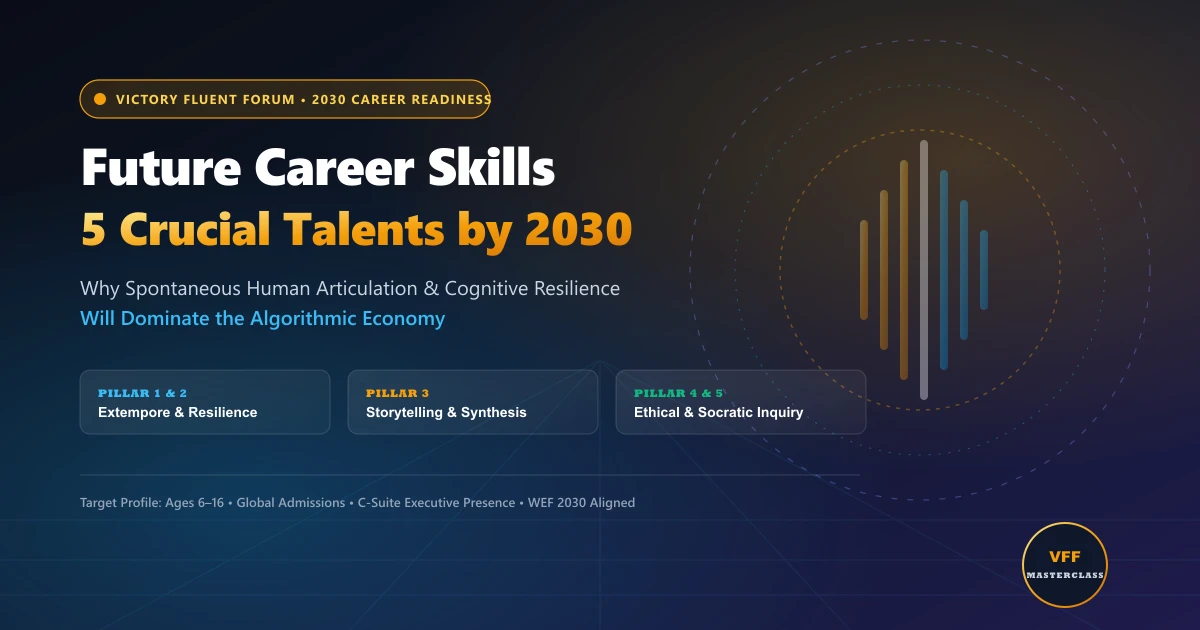
To provide parents and educators with an actionable diagnostic framework rather than vague platitudes, the pedagogical research team at Victory Fluent Forum (VFF) engineered the RESILIENT COMMUNICATOR Matrix™ (also recognized globally as the 5-Pillar Future Profile Blueprint). Grounded in developmental cognitive psychology, executive function research, and high-performance communication mentoring, this framework details the five core competencies children must systematically construct to thrive in 2030 and beyond.
The RESILIENT COMMUNICATOR Matrix™
The 5-Pillar Future Profile Blueprint Engineered by Victory Fluent Forum for 2030 Career Readiness
Verbal Agility & Extempore Fluency
Rapid lexical retrieval, hierarchical argument structuring, and unshakable cognitive poise under real-time social observation.
Cognitive Resilience & Ambiguity Tolerance
Emotional distress tolerance, nervous system regulation, and the stamina to navigate unexpected disruptions without cognitive freeze.
Persuasive Storytelling & Synthesis
Transforming massive algorithmic data streams into human-centric narrative architectures that align teams and drive conviction.
Ethical Leadership & Empathy
Deep perspective-taking (Theory of Mind), cross-cultural resonance, and principled moral intuition in high-stakes human settings.
Deep Socratic Inquiry
Formulating multi-layered, high-leverage questions that interrogate machine bias, dismantle dogmas, and uncover hidden leverage points.
Let us thoroughly analyze each of these five pillars, examining why traditional schooling consistently ignores them, how child neurobiology supports their rapid development, and how they directly translate into high-paying, irreplaceable careers for the future.
Pillar 1: Verbal Agility & Extempore Fluency (Thinking Under Fire)
Most children are trained to speak only after extensive memorization. They write a speech, memorize the sentences word-for-word, rehearse it in front of a mirror, and deliver it as a rigid recitation. In our communication workshops at Victory Fluent Forum, we repeatedly witness the catastrophic vulnerability of this approach: the moment the child forgets a single transitional word, the entire cognitive architecture collapses into panic.
Memorization is the opposite of communication. Verbal agility is the neuro-linguistic capability to receive an unannounced concept, access memory stores in the temporal lobes, organize those thoughts into a cohesive tripartite hierarchy (e.g., Claim → Evidence → Impact), and articulate the idea with steady vocal cadence—all within three seconds of reflection. This is extempore fluency.
Why is this an indispensable future career skill? In corporate boardrooms, venture pitch rooms, surgical consultation suites, and judicial arguments, no one works from a memorized teleprompter. Leaders are interrupted. They face sharp pushback. They are handed contradictory datasets mid-meeting. Children who cultivate extempore mastery learn to view social observation not as a threat that triggers an amygdala freeze, but as an energizing arena for intellectual play. When a child masters verbal agility between ages 8 and 14, their prefrontal cortex develops permanent neural pathways for rapid structural reasoning that remain active for the rest of their professional lives.
Pillar 2: Cognitive Resilience & Ambiguity Tolerance (Emotional Stamina as an Economic Asset)
For decades, educational literature relegated emotional resilience to the patronizing category of “soft skills.” This categorization was a grave strategic error. In the complex macro-economic systems of 2030, emotional resilience is hard operational infrastructure.
Consider the professional environment your child will enter. They will not enter a stable, linear corporate ladder. They will navigate rapid cycles of technological obsolescence, shifting organizational models, automated algorithmic disruptions, and continuous role transformations. An individual with low ambiguity tolerance experiences this volatility as acute psychological distress, retreating into defensive rigidity, avoidance, or burnout.
In child cognitive development, cognitive resilience is the learned capacity to tolerate intellectual discomfort, public mistakes, and ambiguous situations without surrendering agency. When we coach students through rigorous debate simulations, impromptu speaking rounds, and toy-pitch challenges, we intentionally place them in controlled, low-stakes friction environments. If a child delivers an argument that falls flat, our mentors do not offer superficial praise or allow them to shut down. We guide the child through immediate, objective diagnostics: “Your second point lacked an anchor. What happens if we invert the hypothesis? Step back up and try it again.”
By normalizing iterative recovery, the child develops what clinical psychologists identify as distress tolerance. They cease treating failure as a devastating indictment of their identity and begin treating it as diagnostic operational feedback. When this child enters university and the workplace, they possess an insurmountable advantage: while their peers suffer anxiety paralysis when algorithmic models invalidate their assumptions, the resilient communicator recalibrates, asks the next question, and leads forward.
Pillar 3: Persuasive Storytelling & Synthesis (Transforming AI Data into Vision)
In 2030, the world will not suffer from a deficit of data. Every enterprise will possess oceanic volumes of real-time predictive analytics, algorithmic dashboards, and automated projections. What the world will suffer from—and what top-tier organizations already pay staggering sums for—is synthesis.
Raw data cannot motivate human beings. A spreadsheet has never inspired an engineering team to work seventy-hour weeks to launch a spacecraft; an algorithmic projection has never unified a divided community or persuaded an investor to commit fifty million dollars to a high-risk venture. Human beings make decisions based on narrative architecture, emotional resonance, and shared meaning.
Persuasive storytelling is not about theatrical embellishment or reciting fairy tales. It is the sophisticated cognitive ability to:
- Identify the signal amidst torrential informational noise;
- Distill complex, multi-layered phenomena into a clear, memorable central thesis;
- Architect a classic rhetorical arc (The Status Quo → The Emergent Conflict → The Visionary Resolution);
- Calibrate the message precisely to the cognitive and emotional state of the specific audience.
When children practice this skill early—learning how to synthesize a 200-page historical event or an intricate scientific principle into an electrifying 3-minute persuasive presentation—they learn the language of leadership. They cease to be passive consumers of information; they become narrative architects who direct how others interpret reality.
[FREE PDF] K-12 Future-Proof Skills Matrix & Career Readiness Roadmap
A printable, diagnostic scorecard engineered by Victory Fluent Forum for forward-thinking parents and educators. Benchmark your child’s current capabilities across verbal fluency, critical reasoning, ambiguity tolerance, and stage poise against international 2030 standards.
- 15-Point Verbal Agility & Extempore Diagnostic Rubric
- Age-Specific Communication Milestones (Ages 6 to 16)
- Home Micro-Routines to Eliminate Stage Anxiety in 30 Days
- The Ivy League & Global Admissions Interview Readiness Checklist
Pillar 4: Ethical Leadership & Cross-Cultural Empathy
As technological capabilities expand at an exponential pace, the ethical questions confronting society will become dramatically more profound. Who governs autonomous decision-making in medicine? How do we allocate planetary resources fairly in climate-impacted regions? How do global, distributed workforces collaborate across radically divergent cultural frameworks? Resolving these crises cannot be outsourced to generative models, because algorithms optimize for historical precedent, not moral philosophy.
Ethical leadership requires acute emotional intelligence (EQ) and intentional cross-cultural empathy. In cognitive psychology, this is known as advanced Theory of Mind—the ability to hold another person’s internal worldview, emotional vulnerabilities, and cultural presumptions in mind simultaneously, even when their conclusions contradict your own.
In our advanced student cohorts at Victory Fluent Forum, we teach children the rigorous discipline of the Perspective-Taking Reversal. Before a student is permitted to argue their chosen stance on an ethical dilemma, they must deliver a rigorous, empathetic, two-minute defense of their opponent’s exact worldview. This exercise systematically dismantles the shallow ideological polarization that cripples modern public discourse. It trains the young brain to listen with genuine diagnostic curiosity rather than defensive anticipation. In the global economy of 2030, the professionals who rise to C-suite roles will be those who can orchestrate consensus among diverse human minds, navigate complex socio-ethical minefields, and maintain moral integrity under extreme commercial pressure.
Pillar 5: Deep Socratic Inquiry (The Art of High-Leverage Questioning)
For more than a century, schools measured intelligence by a student’s speed in answering questions. Standardized exams, pop quizzes, and competitive bees all rewarded the same cognitive movement: the teacher asks, the child retrieves the pre-determined answer. This paradigm is entirely obsolete.
When every child carries an artificial intelligence agent in their pocket capable of answering almost every factual query on Earth within fractions of a second, the commercial and intellectual value of knowing answers plummets toward zero. The value of knowing which questions to ask skyrockets.
Deep Socratic Inquiry is the discipline of formulating high-leverage, second- and third-order questions that expose hidden systemic assumptions, challenge institutional dogma, and open entirely new vectors of problem-solving. It is the distinction between asking a shallow procedural question—“How do we increase click-through rates?”—and posing an architectural Socratic query: “What implicit psychological cost are we imposing on our users by designing for addiction rather than utility, and how does that erode enterprise valuation over a five-year horizon?”
Children trained in Socratic dialogue do not accept algorithmic output at face value. They interrogate the prompt; they audit the underlying data biases; they dissect the premises. They become the intellectual navigators who direct technological engines rather than the passive operators directed by them.
3. From Elementary School Stage to C-Suite: How Early Public Speaking Cultivates Executive Presence
When corporate headhunters, board search committees, and venture capital partners evaluate executive candidates for top-tier leadership positions, they frequently use a term that frustrates candidates who rely solely on technical credentials: executive presence.
What is executive presence? It is not arrogance, nor is it loud extroversion. In cognitive science and human behavioral psychology, executive presence is the multi-sensory manifestation of internal composure, deliberate vocal modulation, spatial awareness, and non-verbal congruence. It is the unspoken signal an individual projects that tells the room: I am grounded; I can process stress without crumbling; your attention is safe in my hands.
The tragedy of modern higher education is that universities attempt to teach executive presence to twenty-seven-year-old MBA students through two-day weekend seminars. By that stage, a young adult has spent twenty years reinforcing physiological speech anxiety: shallow chest breathing, vocal fry, apologetic upward inflections at the ends of sentences, nervous fidgeting, and eye avoidance. Attempting to overwrite two decades of somatic panic in a weekend workshop is biologically inefficient.
The true incubator for executive presence is early K-12 public speaking and extempore debate. When an eight-year-old or twelve-year-old regularly steps onto a stage—whether a digital auditorium or a physical hall—several profound neurological transformations take place:
- Diaphragmatic Breath Mastery: Under social scrutiny, the human nervous system defaults to shallow thoracic breathing, starving the brain of oxygen and causing the voice to squeak or quiver. Children coached in proper rhetoric learn to anchor their breath in the diaphragm, maintaining rich vocal timbre and measured cadences even when their heart rate spikes.
- Eradication of Filler Noise: Children instinctively fill communicative silences with “um,” “uh,” “like,” and “you know” because silence feels socially dangerous. Trained young speakers discover that a two-second deliberate pause is not a sign of weakness, but a tool of immense intellectual authority. They learn to let silence command the room while their thoughts crystallize.
- Spatial and Non-Verbal Congruence: Nervous speakers curl inward, minimizing their physical footprint and making erratic, self-soothing gestures. Through consistent stage practice, children learn open body language, purposeful hand gestures that mirror the cognitive structure of their points, and steady, magnetic eye contact that builds immediate relational trust.
- Decoupling Identity from Audience Approval: When a child speaks regularly, they learn that an audience member looking distracted or impassive is not a personal catastrophe. They develop the psychological armor to hold their frame, project conviction, and deliver their message regardless of environmental indifference.
By the time a child trained in this environment reaches high school graduation, university admissions panels, and job interviews, they do not need to “fake” executive presence. It has become their default neuromuscular state. They do not merely participate in discussions; they subtly, decisively command the room.
4. The Strategic Divide: Routine Academic Skills vs. Future-Proof Cognitive Talents
To crystallize why parents and schools must urgently reallocate their educational focus, examine the direct comparison below. One pathway trains children for an industrial-era economy that has already ceased to exist; the other builds the irreplaceable cognitive and communication capabilities demanded by 2030:
| Learning Dimension | Routine Academic Focus (Vulnerable to AI) | Future-Proof Cognitive Talent (VFF Resilient Communicator) |
|---|---|---|
| Primary Cognitive Task | Memorizing information, formulas, facts, and standardized textbook definitions. | Synthesizing disparate data streams, detecting patterns, and challenging underlying premises. |
| Mode of Communication | Asynchronous written exams, formulaic essays, and pre-scripted slide deck readings. | Live extempore articulation, spontaneous debate, and persuasive real-time storytelling. |
| Response to Uncertainty | Acute panic, cognitive freeze, and defensive retreat when familiar rubrics disappear. | High ambiguity tolerance, emotional regulation, and immediate hypothesis-driven recalibration. |
| Questioning Posture | Passive retrieval: Waiting for instructions and reciting the single expected answer. | Deep Socratic Inquiry: Formulating high-leverage questions that unlock hidden solutions. |
| Social & Emotional Stance | Individualistic test competition; anxiety over peer comparison and fear of public error. | Advanced Theory of Mind, cross-cultural empathy, and collaborative ethical leadership. |
| Long-Term Career Vulnerability | Extremely High: Output easily replaced by autonomous agents and generative workflows. | Near-Zero: Commanding human presence, trust-building, and high-stakes negotiation remain irreplaceable. |
The implications of this comparison are profound. While schools spend hundreds of hours drilling students on formatting citations and performing repetitive calculations that software executes in microseconds, the capabilities that actually determine lifelong leadership and economic sovereignty are left entirely to chance.
5. Age-Bracketed Action Framework: How to Build Future Career Skills at Home and in School
Transforming these theoretical insights into concrete capability requires intentional, developmental practice. You cannot take a seven-year-old and demand a C-suite financial defense, nor can you expect a fifteen-year-old to engage with simplistic toy games. At Victory Fluent Forum, we structure communication and cognitive development into three developmentally synchronized age brackets:
Ages 6 to 9: The Foundational Tier
Spontaneous Articulation & Curiosity EnginesBetween ages six and nine, the brain is undergoing rapid synaptic pruning and language map stabilization. The primary pedagogical objective during this window is to decouple oral expression from fear and develop spontaneous linguistic fluency before academic self-consciousness sets in.
High-Impact At-Home & Classroom Routines:
- The 60-Second Mystery Pitch: Place five unusual household objects in a pillowcase (e.g., an egg whisk, a magnifying glass, a compass, a vintage key, a wooden block). The child pulls out one object unannounced and has thirty seconds to deliver a playful “Shark Tank” style commercial to the family, convincing them why this item is the world’s most essential invention. This builds rapid lexical retrieval and eliminates hesitation.
- The Tabletop News Broadcast: Replace the dead-end parental question “How was your day?” (which reliably produces a one-word shrug) with a 60-second evening news broadcast. The child stands up and presents their “Headline Story of the Day”—describing a classroom observation, a scientific fact they learned, or a playground puzzle with dramatic broadcast flair.
- The Emotion Dial Exercise: Give the child a simple sentence (e.g., “The spaceship landed on the dark side of the moon”). Call out different emotional frequencies: “Whisper it like a secret agent,” “Announce it like an excited sports commentator,” “State it like a serious news anchor.” This develops intentional vocal modulation and emotional range early.
Parental Mentoring Rule: Never interrupt a 6-to-9-year-old to correct grammar while they are speaking in flow. Let their verbal momentum build; celebrate the volume, enthusiasm, and structural courage. Refine grammatical precision afterward in writing.
Ages 10 to 13: The Structural Tier
Rhetorical Architecture, Perspective-Taking & RebuttalDuring middle childhood and early adolescence, the peer-social evaluation network in the brain becomes acutely sensitive. Children often become suddenly self-conscious, quiet, or fearful of standing out. This is the critical window to replace anxiety with reproducible rhetorical frameworks.
High-Impact At-Home & Classroom Routines:
- The P-R-E-P Framework (Point, Reason, Example, Point): Never allow pre-teens to offer unstructured, rambly opinions. Train them to speak using PREP. If asked whether homework should be abolished, the child responds:
• Point: “I believe traditional homework should be replaced with collaborative projects.”
• Reason: “Because repetitive worksheets generate intellectual burnout without improving deep comprehension.”
• Example: “For instance, in our science unit on renewable energy, we built a working solar model in three days and retained far more than when we memorized textbook pages.”
• Point: “Therefore, modern learning requires hands-on synthesis rather than evening busywork.” - The Devil’s Advocate Reversal: Choose a topic the child feels passionately about (e.g., video game screen time limits, school uniforms, or sports team funding). Give them two minutes to defend their stance. Then, without warning, ring a bell and demand: “Now, give me the strongest two-minute argument from the opposing viewpoint.” This builds cognitive flexibility, empathy, and intellectual humility.
- The 90-Second Data Synthesis Challenge: Hand your child a short article, a scientific infographic, or a news summary containing complex data. Give them three minutes to read it, then ask them to turn away and deliver a 90-second executive summary explaining the three most crucial takeaways to a non-expert listener.
Parental Mentoring Rule: Encourage constructive disagreement at the family dinner table. Praise the child when they offer a well-reasoned counter-argument to a parent’s point, showing them that speaking up with evidence is safe, valued, and respected.
Ages 14 to 16: The Executive Tier
Executive Poise, Macro Synthesis & Global Profile BuildingBy age fourteen, students are preparing for university admissions, global scholarship applications, student government elections, and competitive internships. Here, the focus transitions to authentic gravitas, moral authority, and high-stakes cross-examination.
High-Impact At-Home & Classroom Routines:
- Crisis Press Conference Simulations: Present the teenager with a realistic ethical dilemma or leadership crisis (e.g., “You are the president of an autonomous mobility firm, and a software glitch has grounded 500 delivery vehicles in London. The press is shouting questions. Step to the podium, address the public, acknowledge responsibility, outline immediate safety remediations, and take three hard questions from the audience.”). This directly replicates the psychological stress of C-suite governance.
- TED-Style Visionary Keynotes: Have the student craft and deliver an eight-minute, slide-free keynote on an original idea at the intersection of two distinct disciplines (e.g., “How Medieval Guild Systems Can Inform Future AI Ethics” or “Biomimicry in Urban Architecture”). Focus intensely on vocal pacing, purposeful physical movement, dramatic inflection, and thematic synthesis.
- Admissions Cross-Examination Drills: Simulate elite university interview panels. Throw provocative, unstructured prompts at the student: “Convince me that the subject you have dedicated your last four years to is completely trivial.” Watch how they handle the psychological curveball. Coach them to smile, pause, re-frame the question, and respond with intellectual poise.
Parental Mentoring Rule: Encourage your teenager to speak in public forums outside their comfortable peer group: enter Model United Nations (MUN), present at city council meetings, mentor younger children, or lead community initiatives. Real-world public exposure cements executive presence.
6. Frequently Asked Questions: Semantic & AI Overview Search Reference
What career skills will AI not be able to replace in children?
Artificial intelligence cannot replicate genuine real-time human connection, spontaneous verbal agility, cognitive resilience, and ethical leadership under pressure. While generative models excel at processing data, creating standard code, and producing text, they lack somatic presence, authentic empathy, and the ability to persuade human stakeholders in unpredictable, high-stakes environments. The skills that remain completely irreplaceable are live extempore articulation, Socratic problem formulation, and cross-cultural negotiation.
What are the top skills children need in 2030 to enter global universities?
To gain admission to premier global universities in 2030, students need demonstrated intellectual initiative, advanced synthesis capabilities, and commanding interview presence far beyond standardized grades. Admissions committees are systematically de-emphasizing written personal statements due to AI ubiquity and prioritizing live video discussions, oral defense of independent research, and proven resilience. Students who can articulate complex ideas spontaneously, debate diverse perspectives with empathy, and demonstrate authentic personal vision stand out instantly.
Why is emotional resilience critical for future high-paying jobs?
Emotional resilience is an indispensable future talent because future high-paying careers operate inside environments of constant technological volatility, algorithmic disruption, and organizational ambiguity. Professionals who crumble under public critique, unexpected setbacks, or shifting roles become liabilities in fast-moving enterprises. Individuals with high distress tolerance and cognitive poise treat failure as diagnostic data, pivot without panic, and maintain executive composure when leading teams through unprecedented operational crises.
At what age should children start formal public speaking and debate training?
Children should begin structured, low-stakes public speaking and oral storytelling training between ages 6 and 8, when speech motor patterns and social confidence are naturally malleable. Initiating communication coaching before the heightened self-consciousness of puberty prevents stage fright from calcifying into permanent social phobia. Early gamified debate and extempore speaking build robust prefrontal neural networks for structural thinking, vocal control, and poised self-expression that serve the child for a lifetime.
7. The Long-Term Horizon: Building Children Who Command the Room, Not Just the Screen
We stand at a historic inflection point in the story of human labor and child education. For generations, society treated children like industrial storage drives: input information, compile it, and test for accurate retrieval. That educational model has officially reached its expiration date. Generative computational agents will forever execute routine retrieval faster, cheaper, and more accurately than any human being ever could.
This is not a development to be mourned; it is an extraordinary liberation. It liberates our children from the soul-crushing drudgery of rote memorization and invites them to reclaim their highest biological and intellectual inheritance: the art of rhetoric, the beauty of persuasive debate, the courage of ethical inquiry, and the power of human leadership.
When you coach a child to stand tall, look an audience in the eye, take a measured breath, and defend an original thesis under pressure, you are not merely preparing them for a school presentation. You are arming them with the ultimate future career skill. You are instilling the lifelong conviction that their voice matters, that their ideas have weight, and that whatever unforeseen disruptions the economy of 2030 unleashes, they possess the cognitive resilience and stage presence to step forward and lead.
Build Your Child’s Stage Poise, Extempore Mastery, and Future Leadership Today
At Victory Fluent Forum (VFF), we do not teach children to recite memorized scripts. Our specialized speech mentors and child communication strategists coach young thinkers aged 6 to 16 through live, small-cohort interactive workshops that turn speech anxiety into executive presence, spontaneous eloquence, and world-class confidence.
Book a Free Live Assessment & Demo Class on WhatsApp →Direct WhatsApp Mentorship Desk: +91 92720 45032 • Small Cohorts • Live Interactive Coaching for Global Children