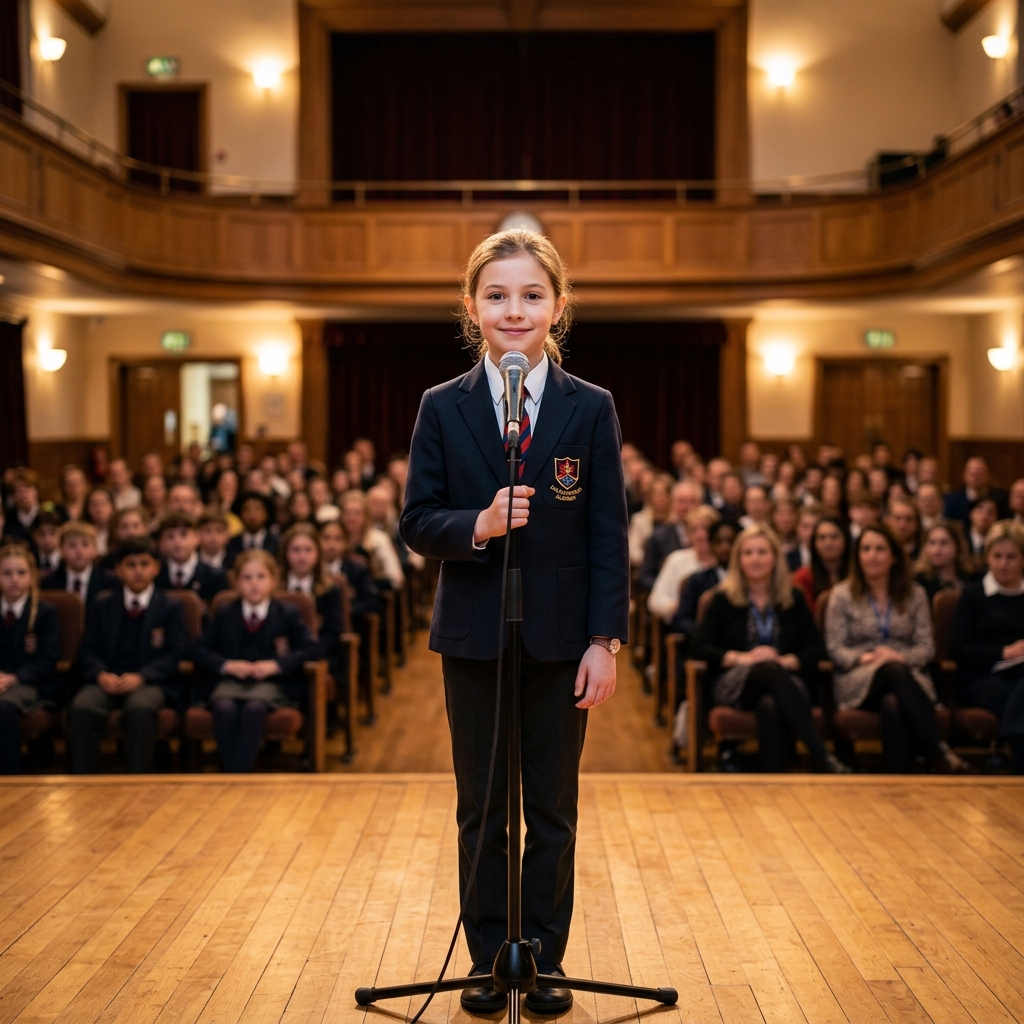
Free Assessment & Quick Navigation
Use the techniques below to help your child overcome stage fright before the next school assembly. For a personalised approach, our mentors offer a free diagnostic session: Book Free Speaking Assessment
School assembly morning. Your child was fine at breakfast. Then the familiar dread arrives: a stomach ache that appears from nowhere, a voice that grows smaller, eyes that start to fill. You have reassured them. You have reminded them how well they practised. None of it lands.
If this sounds like your household, you are not alone — and more importantly, you are not dealing with a broken child. Stage fright in 10-year-olds is one of the most common and most misunderstood childhood experiences. After working with hundreds of children through school presentations and assemblies over nine years, the Victory Fluent Forum Academic Team has observed one clear pattern every time: most children are not afraid of speaking. They are afraid of making a mistake in front of people who are watching them.
That distinction changes everything about how our educators help them.
Quick Answer: How to Stop Stage Fright in 10-Year-Olds
Stage fright in 10-year-olds is caused by the brain's threat-detection system misreading an audience as danger. To stop it before a school assembly:
- Practise gradually — mirror first, then family, then small groups, then the stage
- Use Box Breathing (inhale 4s → hold 4s → exhale 4s → hold 4s) to reset the nervous system
- Teach bullet-point fluency, not word-for-word memorisation
- Replace "Don't be nervous" with "Let's get ready and excited together"
- Build a 7-day daily practice routine in the week before the assembly
Stage Fright vs. Shyness: Key Differences Every Parent & Teacher Must Know
One of the most frequent questions parents ask during our VFF intake sessions is: "Is my child shy, or do they just have stage fright?" Understanding the difference is crucial because treating stage fright like shyness (or vice versa) can lead to ineffective coaching and unnecessary frustration.
| Dimension | Shyness (Trait) | Stage Fright (Situational Anxiety) |
|---|---|---|
| Core Definition | Personality trait involving discomfort in unfamiliar social settings. | Situational performance panic triggered specifically by being evaluated by an audience. |
| Social Behavior | Prefers small groups or quiet individual activities consistently. | Often extremely talkative and social at home or with close friends. |
| Physical Signs | Quiet voice, avoiding eye contact, standing in background. | Trembling hands, stomach cramps, sudden sweating, vocal freezing. |
| Parent Observation | "My child hesitates to greet new people or order food at restaurants." | "My child acts out full plays at home, but froze when holding the mic in assembly." |
| Teacher Insight | Rarely raises hand voluntarily in class discussions. | Participates eagerly in group desks, but panics when standing at the whiteboard. |
Why Does Stage Fright Happen in 10-Year-Olds?
Children around the age of 10 enter a developmental phase where social awareness intensifies sharply. They begin forming clear judgements about peer approval, comparing themselves to classmates, and worrying deeply about how others perceive them. This is entirely normal — it is the brain developing social intelligence.
The problem is that this heightened social awareness collides directly with situations like school assemblies, class presentations, and debate competitions. (If your child is preparing for inter-school debate tournaments, see our expert guide on 7 Winning Debate Speech Openings for Kids That Impress Judges). The result is performance anxiety: not a character flaw, not a lack of intelligence, but an evolutionary survival response running at precisely the wrong moment, widely documented by psychological studies on adolescent public speaking at Harvard Business Review.
The Biology Behind the Fear
When a child stands before a crowd of staring faces, the brain's amygdala — its early-warning system — fires an alert. It cannot distinguish between thirty friendly classmates and a genuine threat. In response, it triggers the fight-or-flight cascade, flooding the body with adrenaline and cortisol.
The physical symptoms parents and teachers see are exactly what this chemistry produces:
- Racing heartbeat (blood pumping to the limbs, ready to flee)
- Shallow, rapid breathing and a tight throat
- Cold or shaky hands, sweating palms
- Going completely blank — the thinking brain partially shuts down under stress
- An overwhelming impulse to run off stage or stay silent
VFF Academic Team Insight
"When children learn that the butterflies in their stomach are the body gearing up — not shutting down — their anxiety changes shape. The VFF Academic Team does not try to remove the feeling. Our educators teach children to redirect it. That single shift can cut visible stage anxiety by half within two weeks."
At this age, children are also acutely aware of something adults sometimes underestimate: the audience is watching specifically for mistakes. That fear of being publicly wrong is often more powerful than the fear of the stage itself. Understanding this helps parents and teachers respond to the right problem.
The Science of Stage Fear: What Really Happens Inside
Researchers refer to the brain's stress response in high-stakes social situations as the amygdala hijack — a term popularised by psychologist Daniel Goleman. In this state, the amygdala overrides the prefrontal cortex (the seat of logical thinking, memory recall, and language processing). This is why a child who rehearsed perfectly at home can go completely blank the moment they reach the microphone.
It is not poor preparation. It is neurochemistry. And this matters enormously, because many parents and teachers inadvertently blame the child — or ask them to "just concentrate." That advice is biologically impossible at peak anxiety.
| What You See | What Is Actually Happening | The Right Response |
|---|---|---|
| Child freezes on stage | Amygdala hijack — prefrontal cortex temporarily offline | Let them pause, breathe, and begin with one rehearsed opening line |
| Voice shakes or disappears | Shallow breathing and cortisol-induced throat tightness | Daily diaphragm breathing practice; humming before speaking |
| Child forgets the speech entirely | Stress hormones disrupt short-term memory recall | Teach bullet-point outlines, never word-for-word memorisation |
| Child cries or refuses to go on | Avoidance response — anxiety has peaked before the stage | Gradual exposure over days; guide gently, never force |
| Stomach aches on assembly morning | Gut-brain axis responding to stress signals in the body | Light warm breakfast; breathing exercises before leaving home |
Quick Tip — The Memory Trick
Teach your child to memorise a structure, not a script. If they forget one word from a memorised speech, panic sets in. If they know three bullet points — their three ideas — they can always find their way back, even mid-freeze. Structure is panic-proof. Scripts are not.
Is Stage Fright Normal in Children Aged 8–12?
Absolutely — and this deserves a direct, honest answer, because many parents spend months wondering whether something is "wrong" with their child.
Stage fright is among the most commonly reported fears in childhood. Developmental psychology consistently shows that social anxiety peaks during middle childhood (roughly ages 8 to 13) as children develop theory of mind — the ability to imagine what others are thinking about them. At 10, this ability is sophisticated, which is exactly why a 10-year-old is far more prone to performance anxiety than a 6-year-old who simply walks up and speaks without overthinking it.
An Important Truth for Parents
The fact that your child feels nervous before an assembly does not mean they will always feel this way. It means they are developmentally on track, they care deeply about doing well, and they need structured support — not pressure, and not avoidance. Every child develops confidence at a different pace. Most children become noticeably more comfortable with consistent, low-pressure practice over four to six weeks.
10 Proven Techniques to Stop Stage Fright Before Assembly
These techniques are not generic lists compiled from the internet. They come from direct observation in practice rooms, classrooms, and school auditoriums — watching what actually works when a child walks to the microphone, and what consistently fails despite good intentions.
Box Breathing — The 30-Second Nervous System Reset
Box Breathing is the single most reliable way to interrupt the fight-or-flight response before it peaks. Teach your child: inhale for 4 seconds → hold for 4 → exhale slowly for 4 → hold for 4. Repeat three times. This activates the parasympathetic nervous system — the body's "rest and calm" mode — within under a minute. Practise it every night at bedtime so it becomes automatic. On assembly morning, the technique will feel familiar rather than effortful.
Gradual Exposure — Smallest Stage First
The most durable confidence is built in deliberate, incremental steps. Never start with the school assembly. Start with the mirror. Then speak to one family member. Then a small group of two or three. Then perhaps a video call. The actual stage becomes just the next step on a ladder they have already been climbing. Gradual exposure retrains the amygdala to read the stage as familiar rather than threatening — and familiarity is the opposite of fear.
Bullet-Point Fluency Instead of Script Memorisation
Script memorisation is one of the most common and most damaging mistakes in children's public speaking preparation. When a child memorises a speech word-for-word, one forgotten sentence triggers a complete mental shutdown. Instead, teach them to know what they want to say, not exactly how they said it during practice. Use three to five short bullet points. Practise saying the same ideas in different words each session. This builds genuine fluency — not robotic recall.
The Friendly Face Technique
Before going on, teach your child to scan the audience for one familiar, friendly face — a teacher they trust, a best friend, or a sibling seated in the front rows — and deliver their opening lines directly to that one person. This shrinks the audience psychologically from "a crowd of judges" to "one conversation." Once they have started speaking, anxiety almost always reduces. Beginning is the hardest part; the friendly face solves it.
The Power Pose — 2 Minutes Before Going On Stage
Expansive, upright posture signals safety to the brain. Two minutes before stepping on stage, have your child stand tall — feet shoulder-width apart, hands on hips or arms stretched wide, chin slightly raised — and breathe slowly. This posture directly affects how confident a child feels and sounds. It is the deliberate opposite of the hunched, arms-crossed, chest-collapsed posture that anxiety naturally produces. Try it at home and watch the difference.
Reframe the Story — "Excited, Not Scared"
Physiologically, excitement and anxiety feel almost identical — the same racing heart, the same heightened alertness. The only difference is the story the brain tells about those sensations. Teach your child to say: "I am not nervous. I am excited. My body is getting ready." This is not toxic positivity — it is cognitive reframing backed by behavioural research. When children relabel nervousness as readiness, their performance measurably improves. The feeling does not disappear; it changes meaning.
Voice Warm-Up — 5 Minutes Before Speaking
A cold voice shakes. A warmed voice carries. Five minutes before assembly, run three simple warm-ups together: (1) Hum a familiar tune for 60 seconds — this relaxes the vocal cords and opens the chest cavity. (2) Repeat "Ba-Ba-Ba, Ma-Ma-Ma, Pa-Pa-Pa" briskly three times — this activates the lips and tongue. (3) Read one paragraph aloud from any book in a clear, projecting voice. These steps take under five minutes and prevent the thin, shaky voice that anxiety reliably produces.
The Daily Storytelling Habit
Build speaking confidence long before any assembly by making storytelling a daily family ritual. Each evening at dinner, ask your child to tell one story from their day — no interruptions, no corrections. Give them a full sixty seconds. This trains the brain to organise thoughts while speaking, builds natural speaking stamina, and normalises an audience in the safest possible environment. Over weeks, the dinner table becomes a stage they have already mastered every single day.
Mirror Practice — Seeing Your Own Confident Face
Most children have never seen themselves speak. In the absence of that visual reference, they imagine they look awkward or terrified — which intensifies self-consciousness. Daily mirror practice (two minutes per day in the week before assembly) is revelatory. Children begin to adjust naturally — making eye contact with their own reflection, slowing their pace, lifting their chin — without being prompted. They stop imagining the worst and start seeing what the audience actually sees: a child who is trying and doing well.
The Morning Confidence Ritual — Assembly Day
On the morning of the assembly, replace the anxiety spiral with a structured eight-minute ritual. Step 1: Three affirmations said aloud in the mirror — "I am prepared. I am ready. My voice matters." Step 2: Review three bullet points together — not the full speech. Step 3: One complete round of Box Breathing. This structured routine replaces the chaotic internal monologue that typically derails children before they even reach school. Eight minutes of intention produces a measurably calmer child walking through the school gate.
Parent Tip — What Not to Say
Avoid "Don't be nervous," "There's nothing to worry about," and "You'll be perfectly fine." These dismiss the feeling without addressing it. Instead try: "I can see you're feeling nervous — that makes complete sense. Let's do our breathing together and go through your main points one time." Acknowledgement followed by action is far more effective than reassurance alone.
Confidence-Building Activities for 10-Year-Olds
Beyond the ten techniques above, certain structured activities build stage confidence over weeks and months. They work because they create speaking experience in low-stakes settings — no grades, no audiences of thirty, no assembly pressure. Lower stakes, regular practice, incremental progress.
Activity 1 — The 1-Minute Impromptu Challenge
Give your child a random, fun topic — "Why pineapple should be on pizza" or "If I were a superhero for a day" — and a one-minute timer. They must speak continuously without stopping, pausing, or starting over. Do this three times per week. It builds fluency under time pressure, teaches real-time thought organisation, and removes the paralysis of having "too much to think about" that often causes freezing on stage.
Activity 2 — The Audience Ladder
Create a progressively growing speaking audience each week. Week 1: the mirror. Week 2: one parent. Week 3: both parents. Week 4: one sibling or friend. Week 5: a small group of three or four. By the time the school assembly arrives, your child has already spoken to five different audiences of increasing size. The stage is simply the next rung on a ladder they have been climbing for a month.
Activity 3 — The Family Storytelling Slam
Once per week, host a family storytelling session. Each member gets two minutes to tell the most interesting thing they encountered that week — funny, surprising, or strange. The child participates as an equal, not a subject under evaluation. Seeing adults also pause, search for words, and laugh at themselves normalises imperfection powerfully. Children who grow up seeing adults speak imperfectly and still be heard develop far more robust speaking courage.
Activity 4 — The Intentional Compliment
Ask your child to give one specific, genuine compliment to a family member or teacher each day — delivered clearly, with eye contact, without mumbling. This appears trivially simple, but it trains a critical public speaking skill: speaking with intention and making the listener feel the message. Children who practise intentional daily communication develop natural stage presence long before they ever stand at a microphone.
Teacher Tip — In the Classroom
Create a low-stakes "speaking minute" three times per week: no grades, no corrections, just a child sharing a short opinion or observation about anything. Make applause the absolute norm rather than the exception. A classroom where speaking is consistently celebrated — never mocked, never corrected mid-sentence — is the single most powerful environment for reducing stage fear across an entire cohort over a term.
The 7-Day Stage Confidence Plan (Before Assembly)
If your child has an assembly within the next week, follow this day-by-day plan. Each session takes ten minutes. Consistency matters far more than duration.
Write 3 bullet points. Speak them aloud once, relaxed. No pressure, just exploration.
Deliver the 3 points to the mirror. Notice your posture. Make eye contact with yourself.
Speak to one parent. They listen fully. At the end, give one genuine compliment only.
Humming, tongue twisters, one full run-through with clear voice projection and pausing.
Deliver to both parents plus one sibling or friend. Three listeners make it feel real.
Wear the uniform. Full run-through: voice, posture, eye contact, opening and closing line.
Affirmations + Box Breathing + bullet review. 8 minutes total. Then go and enjoy it.
5 Mistakes Parents Make That Accidentally Increase Stage Fright
Forcing the child on stage without preparation
Pushing an anxious, unprepared child on stage "to face their fear" almost always backfires. The uncontrolled experience confirms the fear rather than dismantling it. Preparation and gradual exposure, not sudden force, build lasting confidence.
Making them memorise the entire speech word-for-word
Script memorisation creates a house of cards: one forgotten word collapses the entire structure. Bullet-point fluency is dramatically more reliable under real performance pressure. Know the ideas, not the exact sentences.
Correcting the child mid-practice run
Constantly interrupting practice to fix grammar, tone, or pace teaches the child to anticipate criticism while speaking — which is exactly what they fear from the audience. Give structured, specific feedback only at the end of each full run-through.
Dismissing the anxiety rather than acknowledging it first
"You'll be fine, stop worrying" tells a child that their very real physical experience is either exaggerated or unimportant. Acknowledge the feeling — "I can see this feels scary" — then redirect with a practical action. Acknowledgement always comes before redirection.
Leaving all practice to the night before
One late-night rehearsal the evening before the assembly is not preparation — it is panic dressed up as practice. Confidence is built through repetition spread over time, not intensity compressed into one session. Ten minutes daily for seven days produces dramatically better outcomes than two hours on one evening.
The Pre-Assembly Confidence Checklist
Give this checklist to your child the evening before the assembly and review it together on the morning. It replaces the chaotic anxiety spiral with a purposeful routine.
Evening Before Assembly
- Review your 3 bullet points — once only, then put them down
- Lay out your school uniform and any props or notes needed
- Do one relaxed run-through — mirror or parent, your choice
- Get 8–9 hours of sleep (rest is essential for memory and calm)
- Write down one thing you are looking forward to tomorrow
Morning of Assembly
- Eat a light, warm breakfast — avoid high-sugar foods that spike and crash
- Say your 3 affirmations aloud in the mirror with eye contact
- Do one complete round of Box Breathing (4-4-4-4, three times)
- Glance at your 3 bullet points — do not re-rehearse the whole speech
- Find your friendly face in the audience before you begin speaking
- Remember: a pause on stage is not a mistake — it is a powerful speaker's tool
After the Assembly — The Recovery & Growth Ritual
- Ask your child: "What is one thing you did well today?"
- Give specific praise — not "You were great!" but "I loved how clearly you said your opening line."
- Let them express how they felt — do not immediately analyse the performance
- If it did not go perfectly, say: "That took real courage. You went on stage. That is what matters."
- Celebrate with something they enjoy — effort always deserves recognition
Parent vs. Teacher Action Plan
| Role | This Week | This Month | Long-Term Goal |
|---|---|---|---|
| Parent | Start the 7-day plan. Do Box Breathing together each evening. | Begin a weekly family storytelling habit at the dinner table. | Enrol in a structured public speaking programme for children. |
| Teacher | Introduce a 60-second daily speaking activity — ungraded. Applaud every attempt. | Run a no-stakes mini-assembly in class with peers only before the real event. | Integrate oral communication into subject assessments consistently across the year. |
| School Counsellor | Identify children with high assembly anxiety before the event — approach them privately. | Run a small-group confidence workshop using gradual exposure principles. | Recommend specialist communication coaching where persistent anxiety is observed. |
Frequently Asked Questions
Stage fright in 10-year-olds is triggered by the brain's amygdala detecting a crowd of staring eyes as a potential threat. This causes an involuntary fight-or-flight response that floods the body with adrenaline — producing a racing heart, shaky hands, and memory blanks. At age 10, children are also at peak social awareness, meaning peer judgment feels extremely high-stakes. This combination is very common and not a sign of weakness or poor preparation. It responds well to structured, gradual practice and consistent encouragement.
Yes — it is one of the most commonly reported anxieties during middle childhood. Between ages 8 and 12, children develop a sophisticated awareness of social comparison, and performing in public activates deep worries about peer perception. The good news is that this fear is highly responsive to structured practice and positive reinforcement. It is not something children simply "grow out of" on their own — but it is absolutely something they grow through with compassionate, consistent support.
There is no fixed timeline, and it would be dishonest to promise one. Some children show noticeable improvement after just two or three structured practice sessions. Others need four to six weeks of consistent daily effort before their confidence visibly changes. What matters far more than speed is consistency — ten minutes of daily practice every day for a week is worth significantly more than a single two-hour session the night before. Every child develops confidence at a different pace, and respecting that pace is essential to long-term success.
No — not without preparation and not through sudden pressure. Forcing an anxious, unprepared child on stage usually confirms their fear rather than reducing it. The experience becomes memorable for the wrong reasons. A far more effective path is gradual exposure: mirror practice, then one family member, then a small group, then the real stage. When children feel genuinely ready rather than pushed, their first experience on a real stage is often transformative. Gentle encouragement plus structured practice always outperforms pressure alone.
The most effective daily exercises, in order of impact: (1) Box Breathing — 4-4-4-4 seconds, three rounds, every morning; (2) Mirror Practice — two minutes of speaking to their reflection with a clear, projected voice; (3) The Daily Storytelling Habit — one story at dinner, no interruptions; (4) The 1-Minute Impromptu Challenge — random topic, speak for 60 seconds without stopping; (5) Morning Affirmations — three confidence statements said aloud before school. None of these requires more than ten minutes, but done consistently over two to four weeks, they produce real, measurable results.
Explore More from Victory Fluent Forum
| Article | Who It Is For |
|---|---|
| Stage Fear in Children: The Complete Parent Guide to Curing Speech Anxiety | Parents of all ages, School counsellors |
| The Quiet Child: Building Confidence in Introverted Students | Parents of shy or quiet children |
| How to Improve Public Speaking Skills in Children: Complete Guide | Parents, Teachers, Trainers |
| Overcome School Stress and Stage Fear: 5 Grounding Exercises | Students aged 8–14, Teachers |
| Public Speaking for Kids: The Complete 2026 Guide | Parents, Homeschool families |
Final Thoughts: Stage Fear Is Not the Enemy
After years of working with children before school assemblies, the most important lesson is also the simplest: stage fright is not the problem. Avoidance is.
A child who feels nervous and still walks to the microphone is already building the most important skill a communicator can have — the willingness to act in spite of the fear. The ten techniques in this guide will reduce the intensity of that fear. Daily practice will reduce it further. Structured coaching will give it direction and shape. But the first, most important step is always choosing to show up.
That decision begins with a parent or teacher who helps a child believe that showing up is already enough.
You do not need your child to be a TED speaker by Friday. You need them to know that their voice is worth hearing, that nervousness is just energy waiting to be channelled, and that every child who has ever stood at a school assembly microphone felt exactly what your child is feeling right now — and spoke anyway.
Start with the breathing. Start with the bullet points. Start with day one. The confidence will follow.
— Victory Fluent Forum Academic & Research Team
Is Your Child Ready for the Stage?
At Victory Fluent Forum, we specialise in transforming anxious, reluctant speakers into confident, stage-ready communicators. Our Public Speaking Programme for children aged 6–16 is built around the same gradual exposure, breathing, and structured coaching principles outlined in this guide — delivered in a warm, small-group environment by experienced mentors.
VFF is a premium communication academy incubated under Symbiosis Launchpad 30 (SSPU Pune). With 9+ years of teaching experience and hundreds of successful school assembly coaching sessions, our team of trained educators is dedicated to building confident young communicators.
Programme Options (Mon–Fri Daily Classes):
1:5 Group Plan
1:1 Essential Plan
1:1 Intensive Plan
7-Day Learning Commitment Policy
To protect our mentors' dedicated time, satisfaction policy claims are strictly conditional on 100% attendance in the first week and all daily assignments submitted on time. Serious learners only.