100 Best Public Speaking & Speech Topics for Kids
Age-wise Topics + Hook Templates + Practice Guide
Premium Lead Magnet Pack

How to Use This Speech Blueprint

Selecting a speech topic is just 10% of the battle. The remaining 90% is delivery, structure, and finding a voice that connects with your audience. This guide provides a curated roadmap to transform your child's speaking capability.

For Parents: Use this checklist of age-appropriate topics to help your child find a subject they are genuinely passionate about. Do not force them to speak on complex topics if they are in elementary school; look for easy subjects where they can inject story and personality. Use the checklists on Page 22 to practice at home.

For Students: Review the hook templates on Page 19 and the structuring guidelines on Page 20. Try opening with an imaginative scenario or a surprising fact rather than a generic introduction. Fill out the speech worksheet on Page 21 to structure your ideas.

The Golden Rule of Public Speaking

Confidence is a muscle. If your child struggles with stage fear, begin by playing simple 1-minute speaking games at dinner before practicing their school presentations. Make speaking fun first, competitive second.


Simran Bagwan Avatar
Prepared By:

Simran Bagwan

Founder & Lead Mentor, Victory Fluent Forum

M.A. English | M.Ed | TESOL Certified. Expert in helping K-12 students develop speaking confidence and future-ready skills.

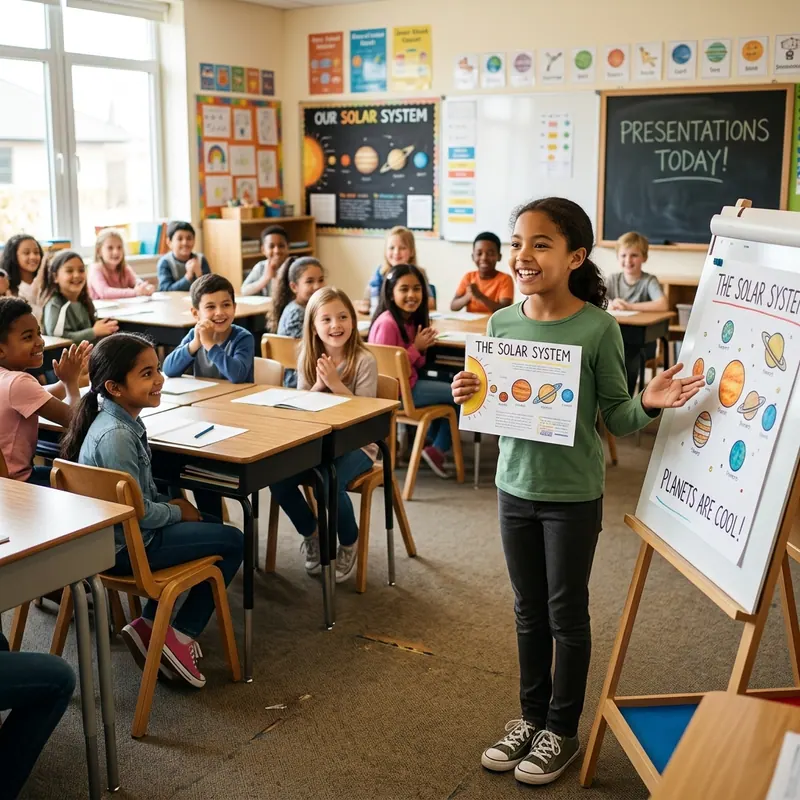
Grades 1-3 Visual

Lower Primary: Grades 1–3

Focus Areas: Simple expressions, descriptive speaking, and physical confidence.

Speech Topics (1–6)

At this age, speech should focus on sensory details and familiar concepts.

Speak with Your Whole Body

For Grades 1-3, encourage gestures. Encourage them to show how big their superhero is or mimic animal movements. This builds expression habits.

Speech Topics (7–12)

Encourage personal narratives and imaginative "what-if" scenarios.

Projecting Your Voice

Practice the "throw your voice" game: Have your child stand 10 feet away and speak loudly enough that you can hear their whispers. This helps them projection clearly without shouting.

Speech Topics (13–18)

Encourage story-telling around nature, pets, and childhood rules.

The Smile Technique

Smiling during a speech releases endorphins that reduce anxiety. It also shifts the vocal tone to be warmer and more relatable, immediately appealing to judges.

Speech Topics (19–25)

Complete list for early primary school speech events.

Graduation to the Next Stage

Once a student can speak confidently on these basic items, they are ready to add reasoning structures (Grades 4-5 topics), introducing logical 'Why' explanations.

Grades 4-5 Visual

Intermediate Primary: Grades 4–5

Focus Areas: Logical transitions, structure, and engaging storytelling.

Speech Topics (26–31)

Topics focus on building opinions and describing experiences with reasons.

Transition Words

Teach your child transition words: "First, Furthermore, On the other hand, Finally". This structures their ideas so listeners can easily follow along.

Speech Topics (32–37)

Encourage historical empathy and basic science descriptions.

Eye Contact Strategy

Have your child look at three distinct spots in the room: far left, center, and far right. Practice holding eye contact with a wall picture for at least 3 seconds before moving.

Speech Topics (38–43)

Focus on creative imagination, dreams, and values.

The Power of Personal Stories

Topics like 'My favorite family tradition' are highly successful in speech competitions. Personal anecdotes are unique, prevent script memorization, and feel authentic.

Speech Topics (44–50)

Concluding list for intermediate school competitions.

Pause for Effect

Teach your child not to fear silence. Pausing for 2 seconds after a major point allows the audience to digest the message and projects control over the stage.

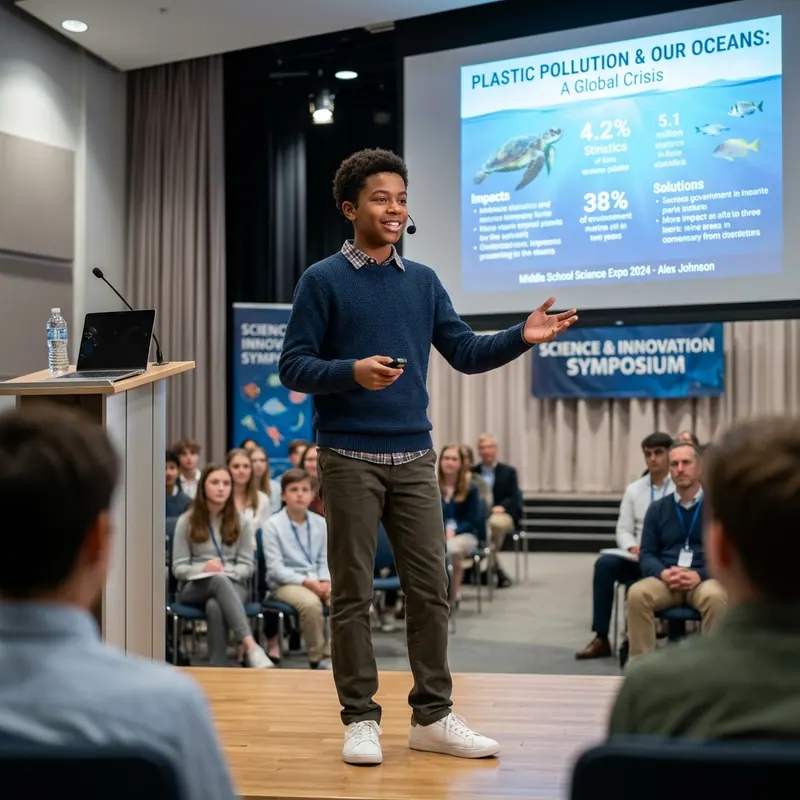
Grades 6-8 Visual

Middle School: Grades 6–8

Focus Areas: Debate reasoning, counter-arguments, and voice modulation.

Speech Topics (51–56)

Introduction to analytical and controversial topics suitable for debate.

Building Strong Arguments

Encourage middle schoolers to use the "Point-Evidence-Explanation" framework. Don't just make claims; support them with logical facts or expert studies.

Speech Topics (57–62)

Address personal development, social issues, and student life.

Mind Your Gestures

Avoid the "penguin stance" (hands glued to sides) or "fig leaf" (hands clasped in front). Keep elbows bent, hands open, and use gestures only to emphasize keywords.

Speech Topics (63–68)

Persuasive topics regarding lifestyle, transit, and mental health.

Vocal Modulation

Vary your voice. Speak faster to convey excitement; slow down and lower your pitch to emphasize serious points. A flat, robotic voice loses attention quickly.

Speech Topics (69–75)

Final topics for middle school speakers, focusing on global concepts.

Ready for Advanced Debate

Middle schoolers should start referencing statistics and historical precedents. The transition to high school requires mastering complex rhetorical appeals (ethos, pathos, logos).

Grades 9-12 Visual

High School & Beyond: Grades 9–12

Focus Areas: Critical analysis, persuasive hooks, and professional presentation posture.

Speech Topics (76–81)

Advanced, high-concept topics for university prep and competition levels.

Ethos, Pathos, Logos

High school speakers must balance Aristotle's rhetorical triangles: **Ethos** (establishing personal credibility), **Pathos** (connecting emotionally), and **Logos** (logical facts and structures).

Speech Topics (82–87)

Analyze technological futures, urban logistics, and emotional intelligence.

Strategic Pauses

Use a "dramatic pause" right before sharing a shocking fact. This signals the audience to pay close attention and makes the information memorable.

Speech Topics (88–93)

Address politics, rhetoric, and modern ecological threats.

Designing Visual Aids

If using slides, apply the 10/20/30 rule: Max 10 slides, max 20 minutes, minimum 30pt font. Slides should supplement your speech, not serve as a reading script.

Speech Topics (94–100)

Complete list for high school level public speaking and rhetoric.

The Final Polish

Stand with feet shoulder-width apart, hands relaxed. Record a video of your practice to identify filler words (like "um", "ah", "like") and eliminate them.

20 Powerful Speech Hooks

A speech must grab attention in the first 10 seconds. Use these templates.

1. The Imagination Hook ("Imagine if...")

Template A:
"Imagine if you woke up tomorrow and [insert unexpected scenario]..."
Template B:
"Close your eyes. Imagine standing on [insert location] with nothing but..."
Template C:
"What if I told you that in ten years, [insert future prediction]..."
Template D:
"Imagine a world where no one ever had to [insert problem]..."
Template E:
"Imagine holding [insert object] that has the power to change..."

2. The Narrative Hook ("Let me tell you a story...")

Template A:
"On a cold Tuesday morning in [year], [person] did something that changed..."
Template B:
"I will never forget the day I stood in front of [audience/place] and..."
Template C:
"It was exactly [time] when the phone rang, bringing news that..."
Template D:
"A young child once stood at the edge of [place], looking down at..."
Template E:
"Three years ago, I made a mistake that taught me why..."

The VFF Speech Structure Formula

How to build a compelling 3-minute speech without memorizing script texts.

1

The Hook (15-20 Seconds)

Start with a strong opening (Story, Question, Shock, or Imagination hook). Never start with "Hello, today my topic is..." Start with impact.

2

The Bridge (15 Seconds)

Connect your hook to the core message of your speech. Explain why the audience should care about this topic today.

3

The 3 Main Points (1.5 - 2 Minutes)

Deliver three clear points. Use the PREP method (Point, Reason, Example, Point) for each. This makes your arguments solid and memorable.

4

The Call to Action & Conclusion (30 Seconds)

Summarize your core message. Tell the audience exactly what action they should take or what thought they should hold. End with a memorable final line.

The Rule of Three

Human brains remember information grouped in threes. Structuring your body into precisely three main points ensures your audience retains the key takeaways of your presentation.

My Speech Planning Worksheet

Draft your speech outline using this structured template.

Point 1: Point -> Reason -> Example
Point 2: Point -> Reason -> Example
Point 3: Point -> Reason -> Example

Practice & Stage Confidence Checklists

Parent Practice Checklist

Evaluate your child's delivery at home:

Eye Contact

Held eye contact for 3+ seconds with family members or markers without looking at floors/walls.

Pacing & Speed

Spoke calmly and controlled. Paused at commas and periods, avoiding rushed delivery.

Vocal Range

Varied their volume and pitch to match the mood of points, avoiding a flat, robotic tone.

Post Body Posture

Stood tall with feet balanced. Avoided swaying back and forth or fidgeting hands.

Filler Words Count

Used fewer than 3 filler words (like "um", "ah", "like") during the entire presentation.

Student Confidence Checklist

Pre-speech checks before you step on stage:

The Anchor Stance

Place your feet firmly shoulder-width apart. Imagine your feet are anchored to the wooden stage floor.

The Balloon Breath

Take 3 deep breaths, breathing into your stomach like filling a balloon. This calms rapid heartbeats.

Focus Markers Selection

Select three friendly faces or visual markers at the back of the room to focus on.

Ready Position Hands

Hold hands relaxed at waist level, ready to gesture, rather than inside pockets or clasped tight.

Positive Self-Talk

Tell yourself: "My audience is excited to hear my ideas, and I am ready to share them!"

Unlock Your Child's Vocal Leadership

Every child has a powerful voice inside them. At Victory Fluent Forum, we provide the structured mentorship to help them project it with confidence.

Free Public Speaking Evaluation

Book a 1-on-1 assessment session with our lead mentors. We evaluate:

  • Speech Delivery & Vocal Tone
  • Physical Confidence & Stage Presence
  • Impromptu Structured Thinking (PREP Model)
  • Customized age-appropriate topic roadmap
Book Free Speech Assessment