1. The Reality of Class 6 Admission Interviews: The Emotional Hook
At 8:45 on a chilly Saturday morning, eleven-year-old Riya sat on a polished teak bench outside the Principal’s office of a prestigious international day school. Her uniform collar was starched to perfection. Her report card held an unbroken row of A1 grades. And in her head, she was silently cycling through the exact four-line script her parents had coached her to memorize for three solid weeks:
"Good morning respected Principal and teachers. My name is Riya Sharma. I am 11 years old. I study in Class 5. My father is an executive software engineer and my mother is a loving homemaker. My hobbies are reading storybooks and playing badminton. Thank you."
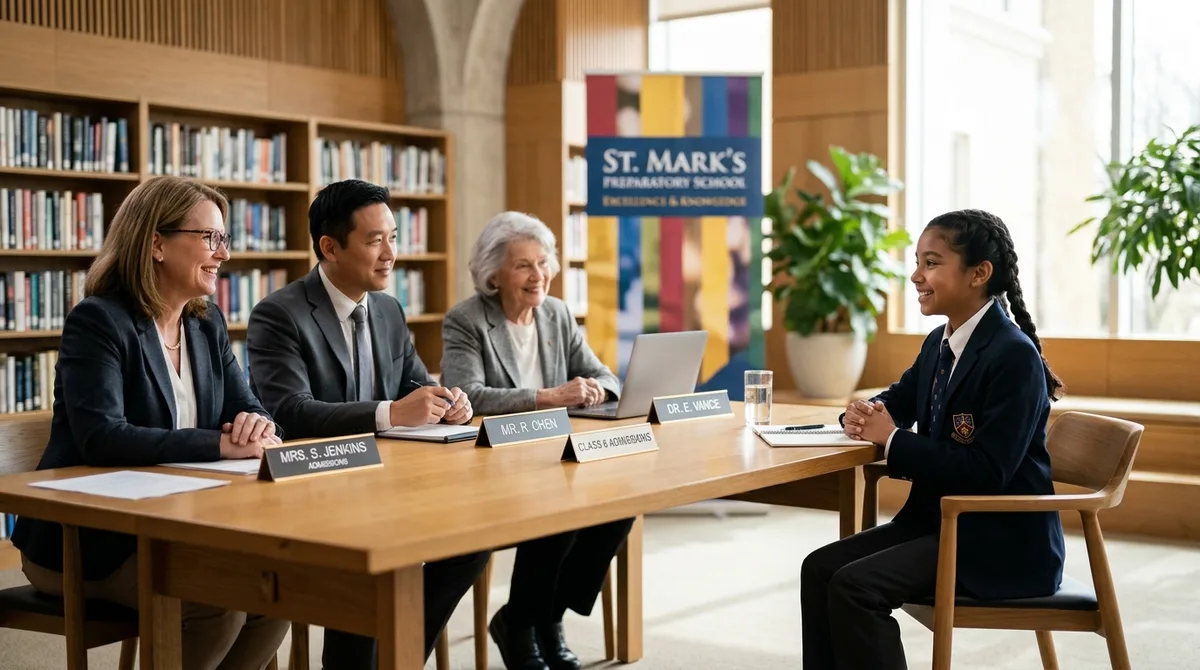
Two minutes later, Riya sat before a three-member admission panel consisting of the School Principal, the Head of Middle School, and the Lead School Counselor. The Principal smiled warmly, adjusted his reading glasses, glanced briefly at her file, and looked directly into her eyes:
"Riya, we can already see all your stellar test scores right here on paper. Tell us something about yourself that isn't written on your marksheet."
The color drained from Riya’s cheeks. Her fingers began twisting the hem of her blazer. Her eyes frantically darted toward her mother seated two feet to her left. Her trained script had collapsed because the question did not follow the mechanical formula she had drilled. In that five-second silence, the interview shifted from an easy coronation into an excruciating endurance test.
This scene is not an isolated mishap; it is the universal tragedy of modern school admissions. Every academic year, thousands of brilliant, articulate children freeze, stammer, or sound like hollow audio recordings during their middle school admission rounds.
Why Class 6 Admission Is a High-Stakes Developmental Leap
Parents often enter Class 6 admissions assuming the evaluation mirrors kindergarten or primary school entry. In Class 1 or Class 2, interviewers look for basic phonetic milestones, cheerful smiles, polite nursery rhymes, and social sociability. But Class 6 is middle school. It represents the psychological transition from guided childhood to emerging young adulthood.
Top-tier private, boarding, and international schools (whether following CBSE, ICSE, Cambridge IGCSE, or IB MYP curricula) face an overwhelming supply-demand imbalance: for every 40 seats in Class 6, they receive 400 to 900 applications. Because written entrance exams filter out academic non-qualifiers, nearly every child who reaches the interview room already possesses high test scores.
The admission panel’s mandate is not to test whether your 11-year-old knows grammar definitions. Their mandate is to diagnose:
- Intellectual Curiosity: Does this student have an organic hunger to learn, or do they only study under parental surveillance?
- Emotional Poise & Adaptability: How does the child react when presented with an unfamiliar conversational prompt? Do they crumble, seek parental rescue, or pause thoughtfully and think on their feet?
- Social & Collaborative Instinct: Will this child enhance the classroom culture? Can they listen, share credit, empathize with classmates, and resolve disagreements peacefully?
- Authentic Voice vs. Coached Scripting: Is the child speaking from genuine personal interest, or are we listening to an adult’s rehearsed script puppeted through an 11-year-old’s mouth?
The Fatal Flaw of the 1990s Scripted Introduction
School admission panels interview between 25 and 45 children per day during peak admission seasons. By 11:30 AM, panel fatigue is acute. When applicant after applicant recites: "My name is... My father is... My mother is... My hobbies are...", interviewers mentally check out within the first 12 seconds.
Modern adjudicators immediately penalize rote introductions for three core reasons:
- It wastes precious cognitive airtime: The panel already has your parents' professions, your age, and your previous school printed on the admission dossier right in front of them. Repeating demographic facts demonstrates zero conversational value.
- It signals intellectual passivity: Mentioning generic hobbies like "reading and badminton" without a concrete personal angle sounds unconvincing and generic.
- It creates catastrophic brittleness: A memorized script leaves the child completely defenseless the moment the panel interrupts or rephrases the question.
The 100-Point Adjudication Rubric: How Elite Panels Score Class 6 Applicants
To succeed, parents and students must understand the quantitative grading sheet resting on the interviewer's clipboard. Below is the standardized adjudication rubric synthesized from our evaluation of 1,500+ school admissions:
| Evaluation Dimension | Weight | What Scores Maximum Marks (Top 5%) | What Triggers Immediate Penalties |
|---|---|---|---|
| 1. Content Architecture & Spark | 25 Points | Structured flow (P.A.S.S.); connects academic curiosity to a specific real-world example; clearly articulates personal drive. | Rote recitation of parents' resumes; list of generic hobbies with no personal depth; abrupt, disorganized rambling. |
| 2. Conversational Fluency & Cadence | 25 Points | Natural pace (115–125 wpm); thoughtful 2-second micro-pauses; complete, grammatically sound sentences; expressive vocal pitch. | Staccato monotone memorization; excessive filler words (um, uh, like); rushed breathless delivery; mumbling below 55 decibels. |
| 3. Non-Verbal Poise & Presence | 25 Points | Warm, steady eye contact sweeping all panelists; grounded sitting posture; resting hand steeple; genuine, unforced smile. | Staring down at lap; looking sideways at parents for reassurance; foot swinging; nervously picking fingernails or hair. |
| 4. Psychological Maturity & Fit | 25 Points | Demonstrates growth mindset; acknowledges mistakes with grace; shows authentic enthusiasm for school's specific clubs/culture. | Arrogance or dismissiveness toward previous teachers; complete panic when stumped; reciting rehearsed adult PR responses. |
2. The VFF "P.A.S.S." Intro Methodology: Our Original Framework
At Victory Fluent Forum, we spent six years analyzing speech patterns in high-scoring vs. rejected admission interviews. The result of that research is our proprietary P.A.S.S. Intro Methodology—a 45-second conversational architecture engineered specifically for the 10-to-12-year-old developmental window.
The P.A.S.S. method is not a rigid script to be memorized like multiplication tables. It is an intellectual compass. When a child internalizes the four modular stages, they can effortlessly deliver a magnetic self-introduction in 45 seconds, regardless of whether the interviewer asks "Tell me about yourself", "Walk me through your journey", or "Introduce yourself to the committee".
Each component is calibrated for optimal cognitive absorption by the admission panel, balancing academic rigor, authentic individuality, peer value, and institutional alignment.
Name, current school, and an academic subject linked to a 'Why'.
One tangible, screen-free curiosity, project, or reading journey.
Team sports, arts, or peer collaboration demonstrating community fit.
Specific forward-looking hook aligning with this school's ethos.
Deconstructing the Four Pillars of P.A.S.S.
P — Present Identity & Academic Spark (Target: 10 Seconds / ~22 Words)
The opening sentence must accomplish two things immediately: deliver the child’s name with resonant clarity and establish an academic spark.
Never allow a child to say merely: "My favorite subject is Science." Why? Because 80% of applicants claim science or math. A winning applicant adds the Spark Trigger:
- Weak: "My favorite subject is History."
- Winning Spark: "I have a deep fascination with History, especially understanding how ancient civilizations designed clean water systems along the Indus Valley."
In twelve words, the child has communicated reading comprehension, intellectual curiosity, and real-world connection. The panel sits up immediately.
A — Active Passion / Curiosity (Target: 12 Seconds / ~28 Words)
Middle school interviewers are terrified of admitting students who spend six hours every afternoon hypnotized by iPad screens. In this segment, the child highlights an active, tactile, or intellectual pursuit.
It could be building complex Lego mechanisms, sketching wildlife, tending a kitchen balcony herb garden, reading historical fiction, or coding simple interactive text adventures in Scratch. The secret is specificity. Specificity proves authenticity; generalizations sound coached.
S — Social & Team Contribution (Target: 12 Seconds / ~28 Words)
Schools are communities. A student who has top marks but cannot cooperate with peers is a liability in group projects, sports houses, and boarding dormitories.
In the third sentence, the student demonstrates that they know how to participate in a team. This can stem from competitive swimming, playing goalkeeper in football, acting in the school choir, managing the classroom library register, or participating in extempore speech workshops. It signals: "I will enrich your campus culture."
S — Stance for the Future (Target: 11 Seconds / ~24 Words)
The closing sentence bridges the child’s present world with the prospective school. Flattery fails here; specificity succeeds.
Never say: "I want to join your school because it is the number one school in the city." Every child says that. Instead, reference an actual facility or philosophy: their inter-school debate society, the middle-school robotics lab, the annual literary festival, or their focus on environmental sustainability.
3. 5 Ready-to-Use Winning Self-Introduction Scripts
Every child possesses a distinct personality archetype. A high-energy sports enthusiast should not deliver the same introduction as a contemplative book-lover or a code-building STEM thinker.
Below are 5 fully calibrated, word-for-word self-introduction scripts. Each script contains pronunciation markers, pause notations `[Pause - 1s]`, delivery cadence cues, and expert adjudicator commentary explaining why it wins top marks.
Academics, Basketball & Environmental Action
Historical Fiction, Creative Writing & School Theater
Problem-Solving, Maker Curiosity & Science Quizzing
Quiet Focus, Chess Strategy & Observational Depth
Athletics, Discipline, House Spirit & Resilience
4. Top 8 Tricky Interview Questions Asked After the Introduction
The self-introduction sets the tone; the follow-up interrogation seals the admission decision. Once an applicant delivers their 45-second P.A.S.S. opening, seasoned interviewers deliberately pose unpredictable questions to test whether the student's fluency was an authentic reflection of their mind or merely an optical illusion manufactured by over-coaching.
Here are the top 8 tricky questions asked by school admission panels, accompanied by word-for-word winning student responses and adjudicator commentary.
5. Body Language & Non-Verbal Matrix: The 70% Hidden Evaluation
In psychology, Albert Mehrabian’s communication research established that in face-to-face evaluations, the spoken words account for a fraction of the impact, while vocal resonance and non-verbal posture carry the vast majority of subconscious credibility.
When an 11-year-old enters an interview room, the adjudicators have already formed an intuitive baseline evaluation within the first seven seconds—long before the child speaks their first syllable.
Below is the comprehensive non-verbal diagnostic matrix comparing behaviors that damage an interview versus behaviors that project calm, authentic leadership:
| Evaluation Phase | Flawed / Anxious Non-Verbal Cues | Masterclass / Poised Non-Verbal Cues | Psychological Panel Perception |
|---|---|---|---|
| 1. Door Entrance & Knock | Pushing door open without knocking; timid peek around the doorframe; shuffling feet loudly; slouching shoulders. | Two crisp knocks; opening door halfway; standing tall; making immediate eye contact and asking with a warm smile: "Good morning, may I come in?" | Projects personal accountability, emotional readiness, and natural courtesy. |
| 2. Approach & Sitting | Rushing straight to the chair and collapsing into it before being invited; perching on the extreme edge with knees shaking. | Walking at a steady, unhurried pace; standing beside the chair; waiting for the Principal to say: "Please sit down"; responding: "Thank you, Sir/Ma'am". | Demonstrates executive patience, physical composure, and respect for formal protocol. |
| 3. Hand Placement & Fidgeting | Twisting uniform hem; cracking knuckles; stroking blazer buttons; nervously sliding palms across thighs. | Hands resting gently in lap or forming a relaxed conversational steeple on the table; fingers still and grounded. | Calm hands signal a calm nervous system. Interviewers immediately relax in response. |
| 4. Eye Contact Distribution | Staring down at shoes; fixating solely on the friendliest panelist; repeatedly looking sideways at parents for rescue cues. | The Triangle Sweep: maintaining warm eye contact with whoever is speaking, and sweeping across all three panelists during longer answers. | Demonstrates social maturity, inclusion, and independence from parental hovering. |
| 5. Vocal Resonance & Projection | Throat voice; mumbling; trailing off at the end of sentences; nervous high-pitched squeak below 50 decibels. | Diaphragmatic chest resonance; crisp end-consonants; steady projection (65–70 dB); natural conversational pauses. | Sounds articulate, authoritative, and emotionally secure. |
| 6. The "Micro-Pause" Reaction | Blurting out answers instantly without thinking; or freezing in panic for 10 seconds while looking paralyzed. | Taking a deliberate 2-to-3-second diaphragmatic breath; nodding gently to acknowledge the prompt; beginning with a composed voice. | Signals intellectual maturity. Panelists value thoughtful reflection over rushed chatter. |
| 7. Exit Protocol | Bolting toward the door the second the interview ends; leaving chair pushed back haphazardly. | Standing up smoothly; smiling; offering a heartfelt parting: "Thank you for your time today"; gently tucking chair back in; walking out calmly. | Leaves an enduring, indelible impression of character and home refinement. |
6. Parent Role & Coaching Dos and Don'ts: The 7-Day Home Drill
In 90% of school admission interviews, parents are seated inside the room alongside the child. This is where many admissions are won or lost—not because of the child’s performance, but because of parental interference.
The single most damaging parental error is prompting, nodding, or answering on behalf of the child when they hesitate. The moment an 11-year-old pauses and a parent chimes in with: "Remember, beta, tell Sir about your coding competition!", the panel instantly makes two mental notes: (1) The child lacks independent initiative, and (2) The family is likely to be overly demanding and difficult for teachers to manage.
Parental Behavioral Matrix: What to Do vs. What to Avoid
- DO: Sit with tall, relaxed, encouraging posture. Keep your hands resting in your lap. Look forward toward the panel, not anxiously staring down at your child’s face.
- DO NOT: Nudge the child with your elbow, whisper reminders, clear your throat pointedly, or sigh audibly when the child makes a minor grammatical slip.
- DO: When the Principal addresses you directly, answer with warmth, brevity, and genuine alignment with the school’s educational values.
- DO NOT: Dominate the conversation by rattling off family achievements or monopolizing the interview with unsolicited resumes.
The 7-Day Mock Interview Blueprint (10 Minutes Daily)
True interview confidence cannot be crammed the night before. It requires low-stress, incremental nervous-system adaptation. Follow this exact 7-day preparation schedule at home:
Have your child record just the 'P' segment of P.A.S.S. on a smartphone voice-recorder app. Listen together. Check: Did they state their name clearly? Did they attach a genuine intellectual "Why" to their favorite subject? Repeat 3 times until conversational.
Spend 10 minutes helping your child identify one tangible, screen-free project they enjoyed this year (building a model, reading a specific book series, tending plants). Practice articulating that project in exactly two sentences.
Ask your child to recount a time they helped a classmate or participated in a sports team. Frame this into 25 words that demonstrate school culture fit and team spirit.
Close the bedroom door. Have your child practice knocking twice, entering with a warm smile, asking permission to enter, walking to the chair, waiting for seating permission, and practicing grounded hand placement.
Ask your child two random questions from Section 4 (e.g., "What will you do if you are not selected?"). Enforce a strict rule: they must take a visible 2-second breath and nod before speaking their first word.
Ask an uncle, aunt, neighbor, or family friend to act as the "School Principal". Have the child enter the living room in their interview attire and complete a full 5-minute simulated interview. This breaks the familiarity bias.
No rehearsals. Inspect shoes and clothes for comfort. Remind your child: "The school will be lucky to have you. Just be your genuine, curious self." Early dinner, restful sleep, and positive emotional anchoring.
7. Frequently Asked Questions
Below are detailed, accessible answers to the five most critical questions parents and students ask regarding Class 6 school admission self-introductions:
Q1: How long should a Class 6 school interview self-introduction be?
A Class 6 school admission self-introduction should last strictly between 40 and 60 seconds (approximately 80 to 110 words). Middle school admission panels interview dozens of applicants daily and experience cognitive fatigue; a crisp, structured 45-second introduction following the P.A.S.S. framework commands immediate respect without dragging.
Q2: Should the child speak in complex English vocabulary?
No. School admission interviewers look for authentic conceptual clarity, natural conversational cadence, and correct sentence grammar rather than forced, thesaurus-heavy vocabulary. When an 11-year-old forces memorized high-level words like "quintessential" or "perspicacious", it immediately signals over-coaching. Natural fluency and expressive warmth score highest.
Q3: What should a child do if they forget a line or blank out during the interview?
The child should pause gracefully, take a slow diaphragmatic breath, smile warmly at the panel, and use a polite reset script: "Pardon me, may I take a moment to rephrase that?" Admission adjudicators actively reward emotional poise and composure under pressure far more than robotic perfection.
Q4: How do interviewers evaluate parents during the admission process?
Interviewers observe family dynamics, parental temperament, and mutual respect. Panels check whether parents support the child without interrupting, listen attentively, foster emotional resilience rather than excessive academic pressure, and demonstrate authentic alignment with the school's educational philosophy.
Q5: How can a shy 11-year-old practice overcoming interview fear?
Overcoming interview fear requires progressive low-stakes micro-speaking drills: practicing 45-second introductions in front of a mirror, recording voice notes on a smartphone, conducting dinner-table mock questions with relatives, and enrolling in small-group cohort coaching capped at 5 students to build conversational agility.
8. Transform Your Child's Communication: The VFF Masterclass Difference
Every 11-year-old child possesses a rich interior world—filled with humor, unexpected insights, deep curiosities, and boundless creative energy. When children freeze, mumble, or sound like mechanical robots during admission interviews, it is never because they lack intelligence. It is simply because nobody has ever coached them in the delicate art of conversational rhetoric and emotional poise.
At Victory Fluent Forum (VFF), we do not teach children to parrot lines. We train young minds to think critically, articulate ideas with poise, and command any room they enter.
Our flagship live programs in Public Speaking for Kids and Creative Writing & Critical Thinking operate on an uncompromising educational principle: cohorts are strictly capped at just 5 students per batch. In these intimate, high-trust digital studio environments, children receive individualized mentorship from certified speech adjudicators, mastering spontaneous articulation, voice modulation, and stage presence.
Book a 1-on-1 Speech & School Interview Evaluation
Is your child preparing for competitive Class 6 school admissions? Schedule a complimentary 30-minute private evaluation session with Mrs. Simran Bagwan (Lead Academic Mentor, M.Ed, TESOL). We will evaluate your child's vocal projection, spontaneous answer logic, and body language—and provide an individualized 30-day confidence roadmap.
Explore more educational guides: Master our companion resource on Voice Modulation Exercises for Kids or explore Group Discussion Topics for Students.