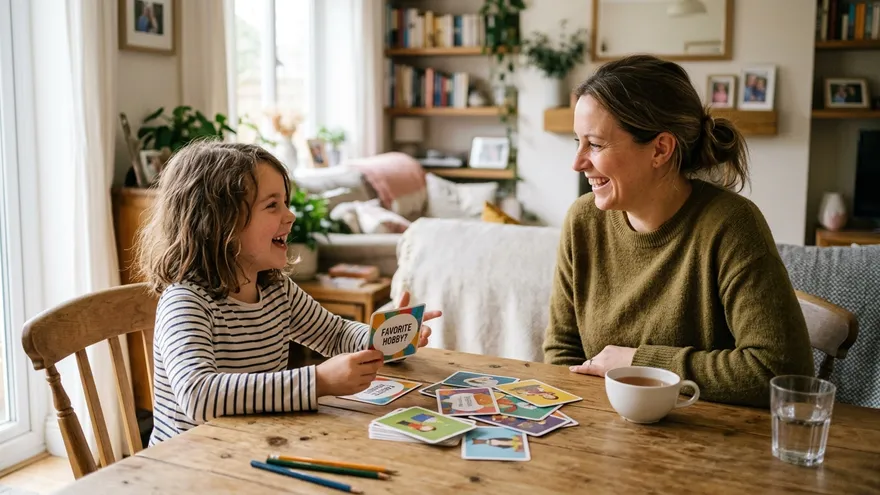
At-a-Glance: How to Improve English Speaking for Children at Home
The Core Reason: If your child understands English, reads well, and performs well in grammar exercises but hesitates during conversation, the issue is not a lack of intelligence or vocabulary. It is simply a lack of practice using familiar words and sentence patterns in real-time conversation. Recognizing grammar rules during a quiet written test is a passive skill; comfortable speaking requires low-pressure opportunities to express thoughts out loud without fear of correction.
The Practical Solution: Replace grammar correction drills with a daily 15-minute Fluency Loop. Prioritize conversational momentum over perfection, use conversational "recasting" instead of mid-sentence interruption, and replace stressful school questions with shared micro-games.
Every afternoon, parents experience the exact same moment of quiet concern.
Your child brings home their report card. Their English exam marks are strong. They read stories without trouble. When you speak to them in English, they understand every word. But when someone asks: "Tell me about your day," they suddenly look down, pause, and whisper: "Nothing." Or they quickly switch back into their home language.
The natural reaction for most caring parents is to buy more grammar workbooks, assign flashcards, or remind the child: "Please speak in English! Why aren't you speaking?"
Yet this well-intentioned pressure almost always produces more hesitation. When learning how to improve english speaking for children, the starting point is understanding an essential educational principle:
This practical guide provides an experience-led blueprint for parents. You will discover why translation lag happens, how to establish a 15-minute daily home routine, how to respond to mistakes without creating anxiety, and 12 engaging home activities that help hesitant children discover their natural voices.
Why a Child Can Know English but Still Struggle to Speak
When a child understands spoken English and reads fluently but hesitates to speak, parents often wonder whether the child lacks interest or confidence. In reality, the issue is how language skills develop.
The Gap Between Receptive and Productive Language
Children process language in two distinct ways:
- Receptive Skills (Listening and Reading): In reading and listening, the words, grammar, and context are already provided. The child’s job is simply to recognize the pattern and understand the meaning. This requires minimal effort and happens at the child's own pace.
- Productive Skills (Speaking and Writing): In spontaneous speech, no words are provided. The child must independently formulate an idea, choose appropriate words, assemble them into a sentence, and pronounce them aloud—all while engaging with another person in real time.
When children spend most of their academic day quietly listening to lessons and filling out worksheets, their receptive skills grow strong, while their speaking muscles remain largely unpracticed. When suddenly put on the spot, hesitation is a natural reaction.
Why Spoken Conversation Feels Risky
Spoken conversation is social and immediate. Unlike a written notebook, there is no eraser. If a child has experienced frequent correction, teasing from peers, or public pressure to perform, they may begin to associate speaking English with evaluation rather than simple human connection. The hesitation you observe is often self-protection.
What English Fluency Actually Means for a Child
Before helping your child learn how to speak english fluently, it is helpful to establish realistic, child-centered expectations. Adult corporate standards of eloquence do not apply to children aged 6 to 14.
Fluency for a child does not mean:
- Using complicated vocabulary words from an advanced dictionary.
- Speaking with an artificial or affected accent.
- Speaking with 100% flawless grammatical accuracy on every turn.
- Talking rapidly without pausing.
Real childhood fluency means communicative flow and comfort. It is the ability to connect thoughts into sentences without distressing hesitation, to share stories, feelings, and opinions clearly, and to comfortably self-correct when a sentence gets tangled. A child who says, "Yesterday we went to the playground... wait, it started raining, so we ran inside and ate pancakes!" is demonstrating authentic fluency. They paused, self-repaired, and kept the conversation moving.
The Fluency Loop: How Children Build Spoken Confidence
Children do not gain confidence after they master speaking; they master speaking because they were given the emotional safety to speak imperfectly first. At Victory Fluent Forum, we organize this growth into The Fluency Loop.
The Fluency Loop
CONFIDENCE → SPEAKING → LOW-PRESSURE FEEDBACK → EASIER RECALL → MORE CONFIDENCE
When a child feels safe, they are willing to try. By speaking aloud regularly, sentence patterns become more familiar. When parents respond with interest rather than criticism, the child experiences a sense of communicative success. This encourages them to speak more often, continuing the loop.
Where Conversations Often Break Down
Well-meaning parents often interrupt this loop by correcting mistakes mid-sentence. For instance, when a child excitedly says: "He don't have the ball!" and the parent immediately responds: "Not 'don't', say 'doesn't'!", the loop stops. The child hears: You made a mistake. Over time, the child learns that speaking leads to correction, so they revert to safe, one-word replies.
The Mental Translation Trap
For bilingual and multilingual children, one of the most common causes of speech hesitation is internal translation. While growing up bilingual is a tremendous lifelong cognitive gift, relying heavily on word-for-word translation during live conversation creates noticeable friction.
| The Mental Translation Habit (Hesitant) | The Direct English Pathway (Fluent) |
|---|---|
| 1. Formulates the full idea in mother tongue | 1. Visualizes the concept or action directly |
| 2. Searches for individual English translations | 2. Draws on familiar, high-frequency English phrases |
| 3. Checks grammar rules before uttering the sentence | 3. Assembles simple, clear sentence patterns |
| 4. Worries about potential grammatical errors | 4. Speaks immediately to convey the meaning |
| 5. Result: Long pauses, second-guessing, or silence | 5. Result: Natural conversational momentum |
To help children move past this habit, encourage them to keep their English thoughts simple. When a child attempts to translate intricate adult phrasing from their native language into English, their active vocabulary may fall short. Remind your child that simple, clear English sentences are far more effective than complicated sentences trapped in translation.
For parents who want to help their child build descriptive phrasing without memorizing lists, our guide on how to improve English vocabulary for kids through storytelling shares narrative techniques that connect words directly to vivid mental images rather than translated dictionary definitions.
Fluency Practice vs. Accuracy Practice: The Crucial Difference
Most home speaking friction occurs because parents mix two entirely different goals: Fluency Practice and Accuracy Practice. When both are attempted at the same time, communication suffers.
| Dimension | Fluency Practice (Conversational Flow) | Accuracy Practice (Grammar & Structure) |
|---|---|---|
| Primary Objective | Keep communication moving; express ideas comfortably. | Learn correct rules, tenses, and sentence mechanics. |
| Parent Role | Active listener, curious conversation partner. | Teacher, guide, reviewer. |
| Handling Errors | No interruptions; model correct usage naturally (recasting). | Explicit review, explanations, and revisions. |
| Child’s Focus | Sharing meaning, humor, opinions, and stories. | Form, grammatical conventions, and clarity. |
| Best Setting | Dinner table, afternoon walks, car rides, play. | Study desk, homework review, structured reading. |
When your primary goal is nurturing spoken english for children, keep casual family time focused on fluency. Let accuracy practice have its own separate, calm space during study sessions. Never turn dinner table conversations into a grammar quiz.
The 15-Minute Daily English Speaking Routine
Short, daily conversational moments are far more effective than long, exhausting weekend study sessions. A predictable, enjoyable 15-minute routine creates familiarity and builds speaking confidence. Here is a practical structure you can adapt to your family's evening schedule:
The 15-Minute Home Speaking Routine
Phase 1: The 2-Minute Low-Stakes Warm-Up
Parent Action: Offer a fun choice question with no wrong answers.
Child Action: Choose an option and share one simple reason.
Example Prompt: "Would you rather have shoes that let you jump over houses, or a hat that lets you speak to birds?"
Helpful Note: Avoid asking about tests or chores during warm-up. Keep the tone light and welcoming.
Phase 2: The 3-Minute Visual Trigger
Parent Action: Point out an interesting picture, a funny photograph, or a household object.
Child Action: Describe three things they see or invent a quick observation.
Example Prompt: "Look at this cartoon dog wearing a raincoat. Where do you think he is walking to?"
Helpful Note: Accept informal, enthusiastic descriptions instead of insisting on formal full sentences.
Phase 3: The 5-Minute Connected Conversation
Parent Action: Ask an open-ended question and practice active listening.
Child Action: Share thoughts, opinions, or explanations in multi-sentence flow.
Example Prompt: "If we could redesign your bedroom together, what is the first change you would make?"
Helpful Note: Let the child do most of the talking. Aim to listen more than you speak.
Phase 4: The 3-Minute Story Retelling
Parent Action: Prompt the child to describe an event using simple sequence markers: First, Next, Then, Finally.
Child Action: Organize ideas chronologically.
Example Prompt: "Tell me what happened during your science experiment today using First, Then, and Finally."
Helpful Note: Keep the pace breezy; focus on the story outline rather than every tiny detail.
Phase 5: The 2-Minute Encouragement
Parent Action: Mention one specific idea or phrase your child used well.
Child Action: Finish the session feeling capable and heard.
Example Prompt: "I loved how you used the word 'mysterious' when describing that comic book character today!"
Helpful Note: Keep praise sincere and specific. Avoid tagging on critiques like 'now do that in school'.
Speak First, Correct Later: The Art of Conversational Recasting
One of the most effective techniques parents can adopt is conversational recasting. In language teaching, recasting means you acknowledge what your child is saying, validate their message, and repeat the sentence naturally with correct grammar—without stopping the conversation to point out the error.
Here is how the two approaches compare in everyday practice:
Child: "Yesterday my friend goed to the sports club and he buyed two drinks."
Parent: "Don't say 'goed'. It's 'went'. And 'buyed' is wrong—say 'bought'. Now say the whole sentence again properly."
Result: The child feels corrected, loses their train of thought, and hesitates to continue.
Child: "Yesterday my friend goed to the sports club and he buyed two drinks."
Parent: "Oh, he went to the sports club? That sounds fun! And he bought two drinks? What kinds did he get?"
Child: "Orange juice! Because it was super hot outside."
Result: The child hears the correct forms ("went", "bought") modeled naturally, feels heard and respected, and happily continues talking.
Also consider how to transform the classic one-word conversational dead-end:
Parent: "What did you do at school today?"
Child: "Nothing."
Parent (Playfully): "Nothing? Not even one interesting thing? No one spilled paint in art class?"
Child (Smiling): "Well... during recess we played a game."
Parent: "What game was it?"
Child: "Dodgeball, but with two soft balls at the same time."
Result: By showing playful curiosity instead of interrogation, the parent invites the child to share details naturally.
12 English Speaking Activities Kids Can Do at Home
Children practice language best through games, curiosity, and storytelling. Here are 12 practical, low-pressure activities you can enjoy at home:
1. The 60-Second Object Detective
How to Play: Select an everyday household object (e.g., a stainless steel water bottle, a key, an alarm clock). Set a gentle timer for 60 seconds. The child describes the object's color, weight, materials, and imagined uses.
Example Prompt: "Tell me everything you notice about this wooden spoon—how it feels, what it's made of, and two silly things it could be used for besides cooking!"
What It Practises: Calling up descriptive words quickly without getting stuck.
Easier Option (Ages 6–8): Give them two starter words (e.g., "smooth", "heavy").
Gentle Challenge (Ages 10–14): If the child pauses, give them time to think. Encourage them to use a rescue phrase like "Let me think..." or describe a new angle. The goal is flow, not speed.
2. The "Would You Rather" Reason Challenge
How to Play: Present two playful choices. The child picks one and gives two simple reasons using words like "because" or "for instance".
Example Prompt: "Would you rather be able to talk to animals or understand every human language in the world? Give two reasons why."
What It Practises: Linking choices to explanations.
Easier Option (Ages 6–8): Use simple pairs (e.g., "Travel by submarine or spaceship?").
Gentle Challenge (Ages 10–14): The parent gently offers the opposite viewpoint to encourage friendly conversation.
3. Picture Talk: The Hidden Detail
How to Play: Look at a colorful illustration from a storybook or family album. Instead of listing objects, invite the child to guess what might be happening behind the scenes.
Example Prompt: "Look at the girl in the corner of this photo. Why do you think she is smiling? What do you think she is holding behind her back?"
What It Practises: Using exploratory words ("Maybe...", "It looks like...", "Perhaps...").
Easier Option: Start with simple "What colors do you see?" questions.
Gentle Challenge: Ask the child to imagine the scene from the perspective of an animal in the picture.
4. Story Continuation (Pass the Story)
How to Play: Start a story with one sentence. Speak for 20–30 seconds, then say "Your turn!" The child continues the story before passing it back to you.
Example Prompt: "The school bus took an unexpected turn down an unfamiliar forest path, and then the radio started playing strange music..."
What It Practises: Active listening and narrative flow.
Easier Option: Let the child introduce any character they love into the tale.
Gentle Challenge: Each speaker introduces a random household object into the plot. For structured storytelling prompts, explore our guide to creative writing prompts and story structure for kids.
5. The Living Room News Reporter
How to Play: Hand the child an imaginary microphone (a wooden spoon or marker). They give a dramatic 60-second update about a funny home event.
Example Prompt: "Good evening! We are live from the kitchen where someone has left an empty cereal box in the cupboard. Over to our reporter!"
What It Practises: Expressive tone and structured recounts.
Easier Option: Give them a simple opening phrase: "Good afternoon, this is [Name] with today's big story..."
Gentle Challenge: You play the role of an eyewitness and answer two questions from the child.
6. The Snack Chef (Recipe Talk)
How to Play: While preparing a snack, sandwich, or fruit bowl, invite your child to narrate each step as if hosting a cooking show.
Example Prompt: "Tell our audience what we are doing first to prepare this fruit salad!"
What It Practises: Action words (slice, peel, mix, pour, sprinkle) and time words (first, next, after that).
Easier Option: Child names the flavors and textures (crunchy, sweet, cold).
Gentle Challenge: Child explains why certain ingredients taste good together.
7. The Voice Dial
How to Play: Take an ordinary sentence (e.g., "The cat is sleeping on the armchair"). Practice saying it in different tones: excited, mysterious, sleepy, or cheerful.
Example Prompt: "Now say it like you're sharing a top-secret message!"
What It Practises: Pitch, tone variation, and emotional expression.
Easier Option: Act out the expression together with silly faces.
Gentle Challenge: Child creates their own sentence to match each tone.
8. Rose, Thorn, and Bud
How to Play: Share three quick points about the day: The Rose (a highlight), The Thorn (a challenge), and The Bud (something anticipated tomorrow).
Example Prompt: "I'll share my Rose first, and then tell me yours!"
What It Practises: Expressing personal experiences and feelings comfortably.
Easier Option: Focus on just the favorite part of the day.
Gentle Challenge: Child interviews the parent and asks one follow-up question.
9. The Question Jar
How to Play: Keep a jar of lighthearted questions on the dining table. Pull one out during dinner and let family members take turns answering.
Example Prompt: "If animals could talk, which animal would have the most complaints?"
What It Practises: Informal family conversation in a natural setting.
Easier Option: Child picks between two slips to choose their favorite.
Gentle Challenge: Ask one gentle follow-up question to keep the chat rolling.
10. The Mystery Clue Box
How to Play: Place a small item inside a bag. The child gives clues about how it looks, feels, and is used without saying its name.
Example Prompt: "It is made of metal and plastic. You use it to cut paper, but it is not a knife. What is it?"
What It Practises: Describing an object when you don't immediately know or recall the exact name.
Easier Option: The guesser asks simple yes/no questions.
Gentle Challenge: The describer avoids using the color of the object in their hints.
11. The Video Pause & Predict
How to Play: Watch a short, wordless animated cartoon. Pause right before a funny or exciting moment. Ask the child to predict what happens next.
Example Prompt: "Look at where the character is standing! What do you think will happen when we press play?"
What It Practises: Using future phrasing ("is going to", "might", "will probably").
Easier Option: Offer two playful possibilities to choose from.
Gentle Challenge: Compare their prediction with what actually happened.
12. Show and Share
How to Play: The child picks a favorite toy, drawing, or keepsake and shares two or three things about why it is meaningful to them.
Example Prompt: "Tell us about this drawing—how did you decide on these colors, and who are the characters?"
What It Practises: Speaking about familiar, personally valued topics. For additional playful speech activities, see our collection of 50 fun speaking activities and games for home.
How to Help a Hesitant Child Speak English Without Pressure
When children feel shy, anxious, or worried about making mistakes, demanding that they perform can cause them to withdraw further. Creating a calm, low-pressure environment at home helps hesitant speakers find their footing.
1. Converse During Parallel Activities
Sitting directly across a table and asking direct questions can feel like an interview. Instead, chat while doing activities side-by-side: while driving, folding laundry, preparing food, or walking outdoors. When eye contact is occasional rather than constant, nervous tension drops and conversation flows more easily.
2. Encourage Speaking to Toys or Pets
Children who feel self-conscious around adults will often chat freely with a family pet, a younger sibling, or a favorite stuffed toy. Suggesting that your child read a bedtime story aloud to their plush animal or describe a drawing to the family cat allows them to practice spoken English without fear of judgment.
For more gentle strategies to support introverted learners, consult our detailed guide on gentle speaking activities for shy children.
What Parents Should Avoid During English Practice
Helping your child build speaking ease is as much about removing unhelpful habits as it is about adding new games. Here are six habits to avoid:
6 Habits That Discourage Children from Speaking
- 1. Turning English into an Interrogation: Asking question after question ("Did you finish your lunch? What did the teacher say? Why didn't you write in your book?") leads to guarded, single-word answers. Share a short story about your own day first, then invite them to contribute.
- 2. Constant Mid-Sentence Corrections: Stopping a child every time a verb tense slips breaks their communicative rhythm. Prioritize their message; save grammar fine-tuning for study time.
- 3. Comparing with Siblings or Classmates: Comments like "Look how well your friend speaks" create discouragement and resentment toward English. Every child develops fluency at their own pace.
- 4. Demanding Artificial Accents: Pushing a child to mimic an unnatural foreign accent creates self-consciousness. Clear pronunciation, thoughtful pacing, and expressive tone are what make strong communicators.
- 5. Asking for Performances in Front of Guests: Asking a shy child to "say something in English for our visitors" creates unnecessary anxiety. Language is for connection, not exhibition.
- 6. Forbidding the Home Mother Tongue: Banning native languages at home creates confusion and stress. Strong foundations in a mother tongue support overall communication. Simply create specific, enjoyable daily windows for English conversation.
Conversation Rescue Phrases Every Child Can Learn
When children get stuck mid-sentence, they often assume they have failed and stop speaking altogether. Teaching them a few "rescue phrases" gives them time to think without feeling embarrassed:
Lets the listener know the child is engaged and buys time to form the sentence.
Turns a missing word into a shared learning moment rather than a full stop.
Provides an easy way to restart a tangled sentence without feeling awkward.
Helps bridge from one thought to the next when an idea runs out.
Gives the child control over listening pace when others talk quickly.
A helpful starter for recounting an event or sharing an opinion.
Encourages natural self-correction without shame.
Shifts the focus back to the other person, giving the child a comfortable pause.
The 30-Day Family English Speaking Challenge
Developing spoken fluency is a gradual process of small daily habits. Here is a progressive 4-week framework for families. This challenge does not promise instant mastery; instead, it establishes the routine of low-pressure English conversation at home.
| Week & Focus | Daily Activity Focus | Practical Signs of Progress |
|---|---|---|
| Week 1: Comfort & Short Responses | Spend 5 minutes daily on "Would You Rather" questions or Question Jar slips. Zero corrections; focus on fun and participation. | The child participates willingly and responds without resistance or eye-rolling. |
| Week 2: Descriptions & Observations | Try the 60-Second Object Detective and Picture Talk. Use gentle recasting when minor errors happen. | Pauses between question and answer become shorter; the child starts sentences more promptly. |
| Week 3: Opinions & Daily Recounts | Share daily "Rose, Thorn, and Bud" reflections. Practice the 8 Conversation Rescue Phrases together. | Child begins using connector words ("because", "actually", "for example") and uses rescue phrases when searching for words. |
| Week 4: Connected Storytelling | Engage in Story Continuation and Show and Share activities using the full 15-minute routine. | Spontaneous English words or short phrases start appearing outside of practice times during everyday activities. |
How Parents Can Tell Whether Speaking Is Improving
Because language growth happens in small steps, parents sometimes overlook genuine progress while waiting for complete perfection. Look for these five observable indicators:
- Shorter Pauses Before Answering: When asked a question, does your child begin speaking more promptly? A drop in pause time shows that words are coming to mind more readily.
- Longer Responses: Notice whether single-word replies ("Good", "Yes") are naturally expanding into two or three connected sentences.
- Natural Self-Correction: When a child says: "We goed—wait, we went to the market," that is a sign of healthy language awareness. Praise their awareness rather than pointing out the slip.
- Relaxed Body Language: Notice whether their posture is calm, their voice audible, and their expression engaged rather than tense.
- Spontaneous Initiations: When your child begins an English sentence on their own without being prompted, true ownership of the language is developing.
When Home Practice Is Enough—and When Structured Support Helps
For many children, a warm, consistent home environment with daily 15-minute speaking routines is all that is needed to move from passive understanding to comfortable conversation. However, in some situations, structured group coaching can be a helpful addition.
Assessing Your Family's Needs
Home Practice Is Generally Sufficient When:
- Your child is happy to chat with family members and simply needs regular practice to build vocabulary recall and sentence length.
- Hesitation is mild and primarily due to limited daily speaking opportunities rather than fear.
- Family members have the time and patience to maintain friendly, low-pressure conversations consistently.
Structured Support May Be Beneficial When:
- Practicing at home consistently leads to parent-child tension, frustration, or power struggles around schoolwork.
- The child communicates comfortably at home but experiences deep, paralyzing anxiety whenever speaking in front of classmates or teachers. (In such cases, our parent guide on how to overcome stage fear in children offers gentle confidence-building steps).
- The child would benefit from an encouraging peer group where everyone is practicing conversational skills together under experienced guidance.
Frequently Asked Questions
FAQ: Children's Spoken English & Fluency
Why does my child understand English well but hesitate to speak it?
Understanding English relies on receptive language (listening and reading), where meaning is recognized at the child's own pace. Speaking requires productive language—retrieving words, organizing grammar, and pronouncing sentences aloud in real time. If a child fears making mistakes, they often hesitate or choose silence.
How long does it take for a child to speak English fluently?
There is no fixed timeline. Progress depends on the child's age, daily opportunities to speak, emotional comfort, and consistency of practice. Rather than counting weeks, look for practical signs such as shorter pauses, longer responses, more spontaneous remarks, and greater willingness to join conversations.
Should I correct my child's grammar while they are speaking?
Avoid interrupting mid-sentence, as this creates hesitation and self-consciousness. Instead, practice conversational recasting: acknowledge what they said and naturally repeat the sentence with correct grammar (e.g., if the child says "I goed to the park," respond with "Oh, you went to the park! What did you play there?").
Will speaking our native language at home delay my child's English?
No. A strong foundation in a mother tongue supports overall linguistic and cognitive development. You do not need to eliminate your home language; simply create dedicated, relaxed 15-minute daily moments for English conversation.
What should I do if my child freezes when asked to speak English?
Remove the spotlight. Avoid putting them on the spot in front of relatives or asking interrogation-style questions. Start with parallel activities (like chatting while drawing or walking), use light choice questions, or encourage them to talk to a family pet or toy.
Start Tonight: A Simple 3-Minute First Step
You do not need to wait for a new school term or buy complex materials to begin. You can take the first step tonight during dinner.
Do not announce that this is an "English speaking test." Simply sit together, smile, and ask:
"If you could have any wild animal as a pet for one weekend, which one would you pick and where would it sleep?"
Listen with genuine interest. Laugh together. Do not correct a single grammar slip or pronunciation flaw. Acknowledge their idea, share your own choice, and keep the conversation relaxed.
That single three-minute moment sends a reassuring message: Speaking English with my family is safe, fun, and natural. From that simple foundation of trust, genuine conversational confidence will grow.

Mrs. Simran Bagwan
Mrs. Simran Bagwan holds an M.A. in English Literature and an M.Ed, with over 15 years of dedicated teaching excellence in children's language acquisition, expressive communication, and student confidence. Her supportive, low-pressure learning frameworks help young learners overcome hesitation and discover their authentic speaking voices.