Paragraph Writing for Kids: Step-by-Step Guide & Structure Examples
Every great book, essay, or speech is built from paragraphs. For kids, transitioning from writing simple sentences to composing cohesive paragraphs is a massive developmental step. It forms the cognitive foundation of structured thinking, writing flow, and communicative confidence.
Table of Contents
1. What is Paragraph Writing?
A paragraph is a group of related sentences focused on one single topic or theme. Think of it as a logical container. In writing, a sentence represents a single thought, whereas a paragraph connects these individual thoughts to build a complete idea.
In standard composition, a paragraph contains three primary blocks: the Topic Sentence (Beginning), the Supporting Sentences (Middle), and the Concluding Sentence (Ending).
2. Why Paragraph Writing is Important
Paragraph writing teaches children how to organize their thoughts. Instead of dumping random ideas on paper, kids learn to map a sequence of arguments. This structural cognitive training is essential for:
- Topical Authority: Sticking to a single topic prevents wandering writing.
- Transitional Logic: Learning to bridge sentences builds vocabulary and sentence variation.
- Linguistic Confidence: Moving past short fragments builds the mental pacing needed for long essays and speeches.
3. The Hamburger Paragraph Method
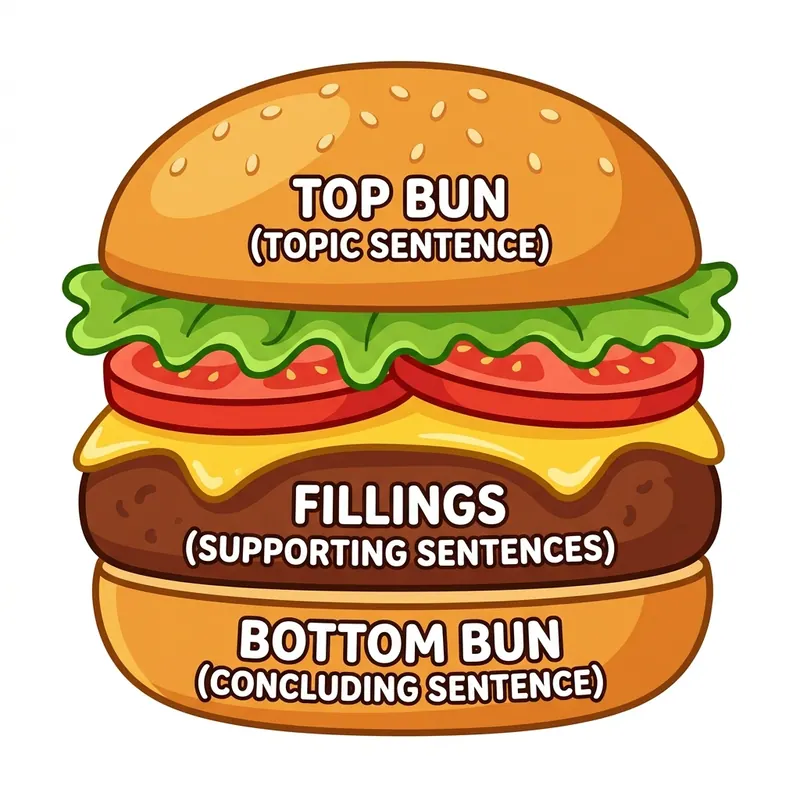
To help young writers visualize a paragraph, educators use the **Hamburger Paragraph Method**. It divides writing into easy-to-digest layers:
- The Top Bun (Topic Sentence): Hooks the reader and states the main point.
- The Fillings (Supporting Details): Provides 3 sentences of evidence, descriptions, or facts.
- The Sauce (Transitions): Words like 'consequently', 'furthermore', or 'nevertheless' that connect details.
- The Bottom Bun (Concluding Sentence): Summarizes the main idea and locks it in.
4. The PEEL Method (Brief Introduction)
As students enter middle school, paragraph writing shifts from narrative descriptions to argumentative structures. We introduce the **PEEL Method**:
- P - Point: State the main argument.
- E - Evidence: Back it up with a fact, statistic, or observation.
- E - Explanation: Explain how the evidence proves the point.
- L - Link: Conclude and link back to the main thesis.
FREE Paragraph Writing Workbook
Master the Hamburger method and PEEL structures with 30 printable sheets, checklists, and trackers.
- Hamburger Template
- 30 Lined Practice Sheets
- Transitions Builder
- Peer Assessment Checklist
5. Step-by-Step Writing Process
To write a paragraph, kids should follow a structured step-by-step process:
- Brainstorm: Choose a topic and write down 5 related keywords.
- Topic Sentence: Draft the hook sentence (Top Bun).
- Supporting Outlines: Write down three details (Lettuce, Tomato, Meat).
- Connect: Link sentences using transition words (The Sauce).
- Conclude: Draft a concluding sentence (Bottom Bun).
- Revise: Read the paragraph aloud to check flow and syntax.
6. Age-Wise Guidance (Grades 3–8)
Writing expectations evolve as children grow. Here are standard writing goals by grade levels:
- Grades 3–4: Focus on simple Hamburger structures, descriptive adjectives, and basic punctuation. Length: 4–5 sentences.
- Grades 5–6: Integrate basic transition words, compound sentences, and narratives with clear chronological pacing. Length: 5–7 sentences.
- Grades 7–8: Apply the PEEL method, complex sentence transitions, evidence-based opinions, and peer-to-peer editing checklists. Length: 6–8 sentences.
7. Common Writing Mistakes to Avoid
Keep an eye out for these structural mistakes:
- The Wandering Topic: Introducing unrelated ideas (e.g., describing a dog in a paragraph about a bicycle).
- The Abrupt Climax: Ending the paragraph immediately after the main event without a concluding sentence.
- Sauceless Sentences: Lack of transition words, resulting in fragmented reading flows.
8. Paragraph Writing Examples
Narrative Example (Grades 4-5)
Persuasive Example (Grades 7-8 - PEEL style)
9. Structured Practice Activities
Use these three simple activities to build structural paragraph writing flow:
- The Color Coding Challenge: Have the student highlight the Topic Sentence in green, Supporting Details in yellow, and Concluding Sentence in red.
- The Transition Scavenger Hunt: Give kids a list of transition words (e.g., 'meanwhile', 'however') and ask them to write a paragraph using at least three of them.
- The Bun Match Game: Write a Topic Sentence and ask the child to compose a matching Concluding Sentence that restates the main idea.
10. Guidance for Parents & Teachers
Writing is a marathon, not a sprint. Celebrate small structural wins:
- Parents: Set aside 10 minutes of quiet writing time daily. Focus on structural coherence before correcting spelling or grammatical details.
- Teachers: Use graphic organizers (like a physical worksheet outline) before students draft. Peer review exercises teach students how to read critically.
Free Download: The Young Author's Story & Writing Kit
Take your child from basic paragraph structures to complete stories with our printable Plot Mountain Worksheets, Character Matrices, and 100+ Sensory Word Banks.
Get Free PDF Toolkit11. Frequently Asked Questions
Paragraph writing for kids is the process of putting related thoughts together in a structured block. A single paragraph holds one main topic sentence, followed by supporting sentences with evidence, and wraps up with a concluding sentence.
The Hamburger Method is a visual framework. The Top Bun represents the Topic Sentence (the hook). The Fillings (lettuce, cheese, tomato, meat) represent the Supporting Details that explain the main idea. The Bottom Bun represents the Concluding Sentence that locks in the paragraph.
PEEL stands for Point, Evidence, Explanation, and Link. It is a formal paragraph writing structure used to write persuasive essays and academic articles where students state their argument, back it up with evidence, explain its importance, and link it back to the core theme.
A standard paragraph for elementary school children contains 4-5 sentences, while middle school paragraphs stretch to 6-8 sentences to accommodate advanced transition words and explanations.