Standing before classmates and teachers to deliver a speech on "My Aim in Life" is one of the most exciting public speaking milestones in middle school. For a Class 6 student, this assignment is much more than a routine English classroom exercise. It is a creative opportunity to reflect on personal passions, practice vocal modulation, and share a story that connects with an audience.
However, many 11 and 12-year-olds struggle when asked to write this speech. They often copy adult essays filled with complicated jargon, memorize text robotically, or finish abruptly without leaving a lasting impression. If you are a student preparing for a school assembly or competition, a parent helping at the dinner table, or a teacher guiding a classroom, this comprehensive guide will teach you step-by-step how to write, structure, practice, and deliver an outstanding speech.
1. What Does "My Aim in Life" Mean?
Before picking up a pen, it is important for a Class 6 student to understand what an "aim" truly represents. At age 10 to 12, children often confuse a short-term wish with a long-term aim.
A wish is temporary and passive—such as wanting a new video game or wishing for a rainy day off from school. An aim, on the other hand, is an active target rooted in curiosity, values, and dedication. It represents a direction you wish to explore and a way you hope to contribute to society.
In school public speaking programs, exploring an aim in Class 6 nurtures a growth mindset. It helps students understand that skills are developed through effort, curiosity, and persistent practice. When a student speaks about their aim, they are not signing a lifelong contract; they are exercising their voice, clarifying their values, and learning how to express their dreams with confidence.
2. How to Write a Speech on My Aim in Life for Class 6
To write a clear, engaging speech that keeps listeners attentive, students need a simple mental roadmap. An easy framework developed for this guide is the VFF AIM-UP Framework. This step-by-step memory tool helps Class 6 students organize their thoughts logically without feeling overwhelmed:
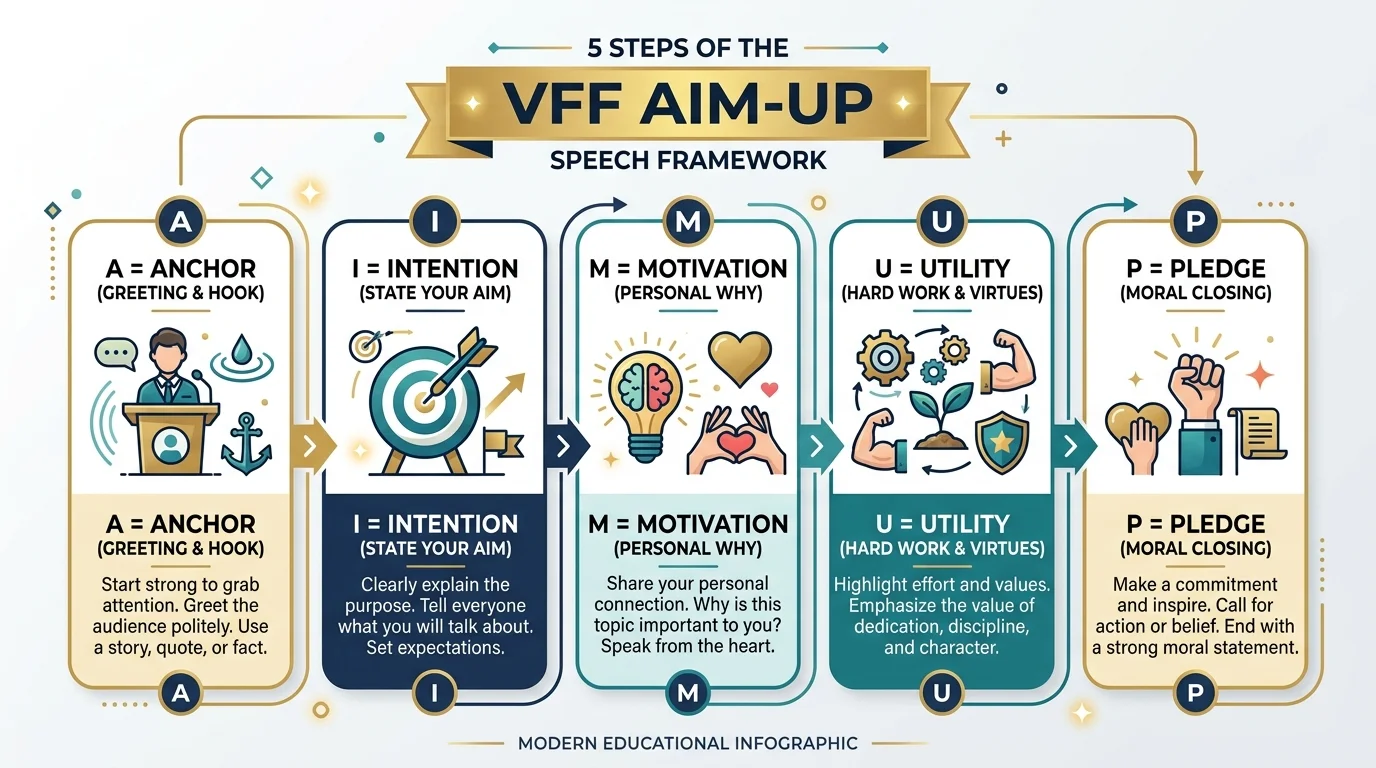
An easy 5-stage blueprint designed specifically for middle school public speaking practice:
Greeting & Title Hook
State Your Aim
Why You Chose It
Action & Hard Work
Moral Closing
- Anchor Hook: Start with a warm greeting to your audience followed by an interesting question or statement.
- Intention: Declare your chosen aim clearly in one direct, confident sentence.
- Motivation: Share a personal story or reason—a moment, book, or person that inspired your interest.
- Utility & Virtues: Explain how you plan to achieve this goal through daily effort, subject focus, and character traits like patience or discipline.
- Pledge & Moral: End with a strong moral takeaway that shows how your aim will serve others, concluding with a sincere thank you.
3. Simple Speech Format for Class 6
When speaking on stage, Class 6 students should avoid holding a dense sheet of paper written in tiny handwriting. Staring down at a page breaks eye contact and makes the speech sound robotic. Instead, transfer your speech onto a small 5-part index cue card using key bullet points:
5-Part Cue Card Structure
- Card Section 1 (0:00–0:15): Greeting + Hook Sentence (e.g., "Good morning everyone. What makes a dream come alive?")
- Card Section 2 (0:15–0:30): The Announcement (e.g., "My aim in life is to become a teacher.")
- Card Section 3 (0:30–1:00): Personal Inspiration (e.g., "My Grade 4 science teacher taught me that curiosity changes lives.")
- Card Section 4 (1:00–1:30): Effort & Required Qualities (e.g., "To achieve this, I read books daily, practice patience, and help classmates.")
- Card Section 5 (1:30–2:00): Moral Message & Closing (e.g., "Knowledge grows when shared. Thank you for listening.")
If you are looking to calculate exact speaking speeds or timing for different speech lengths, explore our interactive Speech Length Calculator tool to test how word counts translate into spoken minutes.
4. My Aim in Life Speech for Class 6 — Short Version
This 1-minute version (~140 words) is ideal for daily school morning assemblies or quick classroom turns where time is strictly limited.
Have you ever thought about what turns an ordinary day into an exciting journey? It is having a purpose. Today, I am proud to share that my aim in life is to become a dedicated teacher.
Teachers do not just cover chapters in a textbook; they build curiosity, kindness, and confidence in young minds. Whenever I help my classmates solve a tricky math problem, I feel immensely happy. To achieve my dream, I focus on reading regularly, improving my communication skills, and practicing patience.
I firmly believe in the moral: "Knowledge is a treasure that increases when shared with others." By becoming a teacher, I hope to light the candle of education in many lives. Thank you, and have a wonderful day ahead!
It begins with an engaging question, uses clear vocabulary suitable for an 11-year-old, states the aim directly, explains the personal motive, and ends with an inspiring moral quote.
5. My Aim in Life Speech for Class 6 — 2-Minute Version
This 2-minute version (~260 words) provides a balanced tempo for standard classroom speech assessments, allowing time for natural pauses and emotional warmth.
Every morning, as the sun rises, it brings a fresh opportunity to learn something new. But to make our learning meaningful, we must have a clear direction. Today, I stand before you to talk about my aim in life, which is to become a doctor.
My desire to pursue medicine began two years ago when I saw how tenderly doctors cared for my elderly grandmother in the hospital. I realized that a doctor does not merely prescribe medicines; they give comfort, hope, and relief to people in pain.
To fulfill this aim, I know I must work hard every single day. I am focusing deeply on science and mathematics, building my concentration, and learning to stay calm under pressure. More importantly, I am learning empathy—because a doctor must care with their heart as much as with their mind.
The moral that inspires me every day is: "The highest purpose of human life is to serve others with compassion." I do not wish to become a doctor for money or title, but to ensure that fewer families suffer from illness.
Thank you all for your kind attention, and I hope each of you finds a goal that inspires your heart!
It incorporates a relatable personal memory (grandmother's care), emphasizes both academic subject effort and emotional qualities (empathy), and delivers a selfless moral takeaway.
6. My Aim in Life Speech for Class 6 — Longer Version
This fuller 3-minute version (~420 words) is crafted for inter-house speech competitions or annual function presentations where students need deeper storytelling, persuasive hooks, and stage impact.
Imagine standing near a vast blue ocean and watching plastic bottles float across the water. That single image, which I saw during a family trip last summer, broke my heart. It was the moment I realized what I want to do with my life. My aim in life is to become an Environmental Scientist.
Our planet Earth has given us lush green forests, clean freshwater rivers, and fresh air to breathe. Yet today, climate change, pollution, and deforestation are threatening our environment. As young students, we cannot simply sit back and watch. We must take action.
As an environmental scientist, my goal will be to research eco-friendly alternatives to single-use plastics, create methods to clean our rivers, and protect endangered wildlife. I want to build solutions that help humans and nature thrive together in harmony.
Achieving this aim will not be easy. It requires years of dedicated study in biology, chemistry, and environmental science. Right now, in Class 6, I am taking small steps. I have started a green club at home, I practice waste segregation, and I spend time reading science magazines.
Many people ask me, "Can one young person really save the planet?" My answer is simple: every giant forest begins with a single tiny seed.
The moral guide of my life is: "We do not inherit the Earth from our ancestors; we borrow it from our children." It is our moral duty to protect nature so that future generations can enjoy a clean and healthy world.
Let us all pledge today to set a high aim, work with honesty, and make our world a better place. Thank you!
It opens with a vivid visual scene, addresses a global contemporary issue (climate change), outlines immediate Class 6 action steps, handles a rhetorical question confidently, and closes with an impactful environmental moral.
Ready to Build Real Speaking Confidence?
Structured speaking practice can help children organise ideas, improve delivery, and become more confident on stage.
Explore Public Speaking Classes for Kids7. Examples of Different Aims
There is no single "best" aim in life. Teachers and judges are not looking for prestige titles; they are looking for genuine passion, clear reasoning, and personal commitment. Here are 9 diverse career examples that Class 6 students can explore:
1. Doctor
Core Focus: Healing illness, relieving pain, and medical research.
Sample Moral: "Service to suffering humanity is service to God."
2. Teacher
Core Focus: Spreading literacy, building character, and mentoring youth.
Sample Moral: "Knowledge multiplies when shared with kindness."
3. Scientist
Core Focus: Curiosity, space exploration, and inventing solutions.
Sample Moral: "Questions open the door to discovery."
4. Software Engineer
Core Focus: Problem-solving, coding apps, and technological innovation.
Sample Moral: "Technology is best when it connects and helps people."
5. Defense Officer
Core Focus: National security, discipline, bravery, and patriotism.
Sample Moral: "Courage and duty come before self."
6. Writer / Journalist
Core Focus: Storytelling, expressing truth, and inspiring readers.
Sample Moral: "The pen has the power to enlighten the world."
7. Entrepreneur
Core Focus: Creating job opportunities, ethical leadership, and innovation.
Sample Moral: "True leadership is about empowering others to succeed."
8. Environmentalist
Core Focus: Protecting nature, wildlife conservation, and sustainability.
Sample Moral: "Protecting nature today preserves our tomorrow."
9. Sportsperson
Core Focus: Physical fitness, resilience, teamwork, and national pride.
Sample Moral: "Victory lies in discipline and never quitting."
8. How to Add a Moral to the Speech
The word "moral" simply means the underlying truth, value, or message of your speech. In a speech on aim in life, the moral explains why your goal matters to the world beyond your personal desire.
Avoid forcing an artificial moral into every single paragraph. Instead, introduce your moral naturally in the closing section (the "Pledge" stage of the AIM-UP framework). Here are 6 age-appropriate moral statements you can adapt:
- On Effort: "An aim without hard work is like a car without fuel—it takes you nowhere."
- On Compassion & Service: "The true test of any achievement is how many lives it uplifts."
- On Perseverance: "Mistakes are not failures; they are steps on the ladder of learning."
- On Knowledge: "Knowledge is the only wealth that grows when shared freely."
- On Discipline: "Daily discipline turns small habits into extraordinary results."
- On Humility: "Great accomplishments begin with humble, quiet dedication."
If you are looking for additional speech topics or extempore practice ideas, visit our Extempore Speech Topics for Class 5 to 8 guide or generate fresh custom prompts using our Speech Topic Generator tool.
9. How to Make the Speech Sound Natural
Writing a great speech is only half the battle; delivering it naturally on stage is what wins audience applause. Middle school students often feel nervous, leading to robotic delivery. Here are 6 proven stage presence techniques:
Stage Delivery Master Techniques
- Eye Contact (The Triangle Method): Do not stare at your shoes or the back wall. Divide the audience into three sections (Left, Center, Right) and gently shift your focus between them every 10 seconds.
- Voice Modulation: Avoid speaking in a flat, monotone voice. Raise your voice slightly when sharing exciting points and soften your tone during reflective memories.
- Strategic Pauses: Insert a 2-second pause after asking a question or delivering your moral message. This gives listeners time to digest your words.
- Upright Posture: Stand tall with your feet shoulder-width apart. Avoid swaying side to side or fidgeting with your clothing.
- Natural Speaking Rate: Aim for approximately 120 to 130 words per minute. Speaking too fast signals nervousness; speaking deliberately signals confidence.
- Concept-Based Memory: Instead of memorizing exact sentences word-for-word, remember the ideas of your speech. If you forget one word, replace it naturally without stopping.
If stage fright is a major hurdle for your child, read our specialized guide on How to Stop Stage Fright in 10-Year-Olds for gentle, stress-free confidence exercises.
10. Common Mistakes Class 6 Students Make
When reviewing school speech rehearsals, educators frequently spot 7 common pitfalls. Knowing these mistakes helps students correct them early:
- Copying Adult Vocabulary: Using complex terms like "utilizing multifaceted methodologies" sounds unnatural for an 11-year-old. Use clear, direct 6th-grade English.
- Racing Through Words: Speaking rapidly to get off stage quickly renders the speech unintelligible. Practice slow, rhythmic breathing.
- Skipping the Introduction: Jumping directly into "I want to be a doctor" without greeting teachers or stating your name makes the delivery seem rushed.
- Glued Eye Contact: Staring fixedly at a sheet of paper breaks the human connection with listeners. Use small cue cards with key trigger words instead.
- Unrealistic Motives: Stating that your aim is solely to "buy expensive cars" sounds greedy. Frame your goals around skill mastery, passion, and service.
- Rote-Memorization Panic: Freezing when a single memorized word slips your mind. Focus on remembering concepts rather than verbatim scripts.
- Abrupt Ending: Ending with a sudden "That's all, thanks." Conclude with a strong moral sentence before expressing your final appreciation.
11. Easy Practice Method
To build effortless delivery, students can follow this 7-step home practice routine over three days:
Catch awkward phrases
Learn section ideas
Write 5 key bullet points
Listen on smartphone
Adjust speed & pauses
Check body posture
Perform at dinner table
12. Tips for Parents
Parents play a crucial role in helping children develop genuine confidence. Here are non-intrusive ways to guide your Class 6 child:
- Listen Without Interrupting: Let your child deliver their practice run completely before offering suggestions. Interrupting mid-speech causes hesitation.
- Praise Specific Effort: Avoid generic compliments like "That was nice." Instead say, "I loved how clearly you pronounced your moral sentence" or "Your eye contact was very steady."
- Keep Rehearsals Short: Practice in 10-minute sessions. Prolonged drills tire young voices and create unnecessary performance anxiety.
- Encourage Authentic Choice: If your child wants to aim to be an animator or game designer, support their interest. Do not force them to choose a traditional career title just for the speech.
To explore comprehensive live mentoring programs designed for middle schoolers, visit our dedicated Public Speaking Classes for Kids page.
13. Tips for Teachers
Educators can turn the "My Aim in Life" speech module into an inclusive, empowering classroom activity:
- Use Small-Group Pods First: Allow introverted or shy students to present in groups of 4 before standing in front of the entire class.
- Implement 2-Plus-1 Peer Feedback: Ask listening classmates to share two positive observations and one gentle suggestion for improvement.
- Evaluate Sincerity Over Perfection: Award marks for logical structure, effort, and vocal clarity rather than flawless word-for-word memorization.
- Explore Pillar Resources: Access structured classroom frameworks in our master Public Speaking Pillar Guide.
14. Quick Checklist Before the Speech
Review this handy checklist on the morning of your presentation:
Final Pre-Speech Checklist
Explore additional educational materials and downloadable activity kits on our official VFF Resources page.
15. Frequently Asked Questions
Q1: How long should a speech on my aim in life be for Class 6?
For daily school assemblies or quick classroom turns, 1 to 2 minutes (~130 to 260 words) is ideal. For formal inter-school speech competitions, a 3-minute speech (~350 to 420 words) allows room for deeper storytelling and an impactful moral closing.
Q2: How do I start a speech about my aim in life?
Begin with a respectful greeting to your audience, followed by a hook sentence or thoughtful question. For example: "Respected Principal, teachers, and my dear friends, good morning. Have you ever wondered what gives purpose to our daily effort? Today, I am excited to share my aim in life."
Q3: What moral can I add to a speech on aim in life?
Select a moral that connects with your chosen ambition. Examples include: "An aim without hard work is like a car without fuel," "True achievement lies in serving humanity," or "Discipline turns everyday effort into extraordinary success."
Q4: Should a 6th grader memorize the whole speech word-for-word?
No. Verbatim memorization often leads to panic if a single word is forgotten. Students should memorize the 5 core concept steps of the VFF AIM-UP framework and use index cue cards with key trigger words to speak naturally.
Q5: What if I get nervous on stage during the speech?
Take two slow, deep belly breaths before stepping up to the microphone. Pause for 3 seconds, smile at the audience, and scan the room using three points (left, center, right) slightly above eye level.
Q6: Can I choose any aim, even if it is non-traditional?
Yes. Whether your dream is to become an environmental scientist, author, teacher, software designer, or athlete, teachers and competition judges evaluate genuine passion, effort, and clear reasoning over conventional job titles.
Q7: How can I make my Class 6 speech stand out from classmates?
Make your speech unique by sharing a true personal inspiration story (a specific moment that sparked your interest), incorporating deliberate vocal pauses, and closing with an original moral takeaway rather than a standard summary.