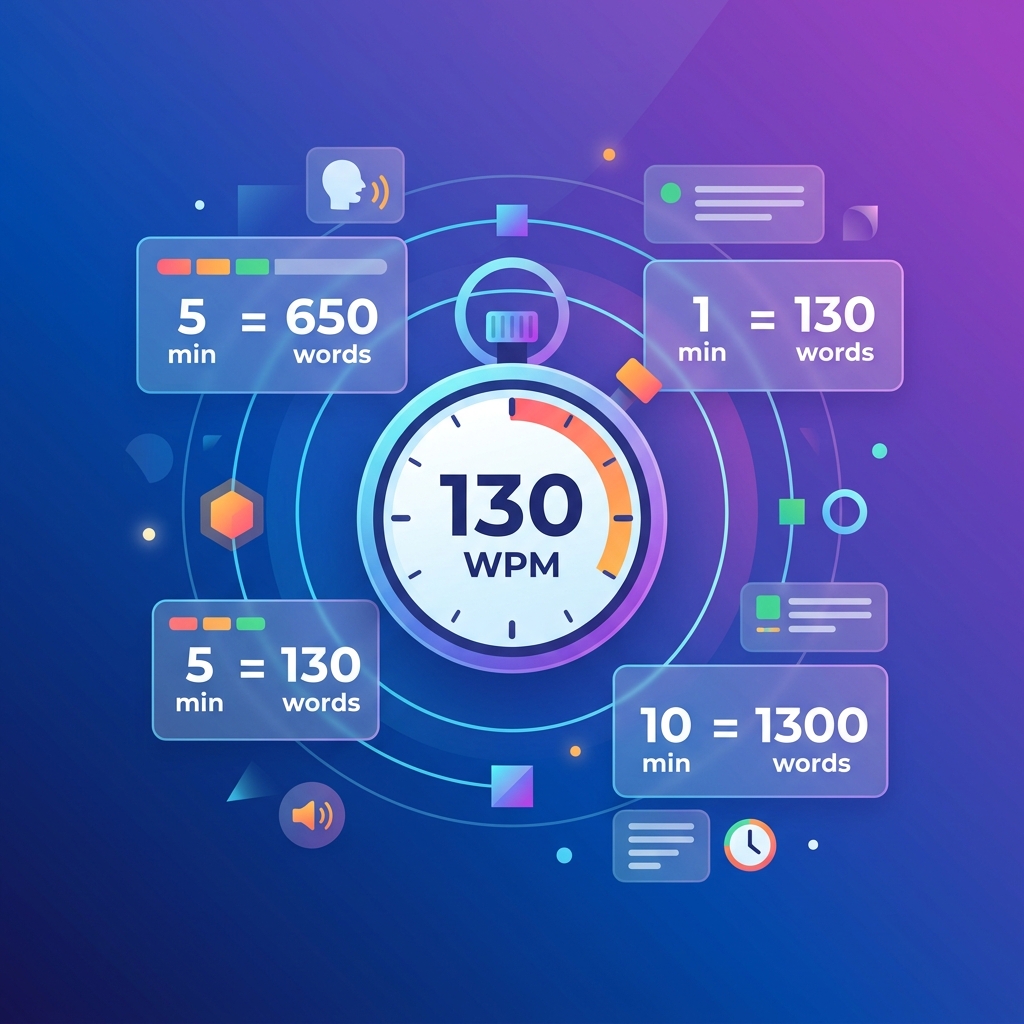
What is Speech Timing & Why Does It Matter?
Speech timing aligns word count, WPM, pauses, and visual transitions within an allocated time limit — the foundation of confident public speaking.
Builds Speaker Confidence
Knowing your exact speech length eliminates the fear of running out of time or finishing too early on stage. Confidence comes from preparation.
Maximizes Audience Comprehension
Pacing at an appropriate WPM allows the listener's brain to absorb complex concepts without cognitive overload or disconnection.
Wins Competitions & Marks
Judges penalize speeches that run under or over allotted time limits in school contests and elocution exams. Timing = marks.
Master Speech Timing Reference Chart
Complete word count lookup table from 1 to 20 minutes across 5 standard speaking speeds.
| Speech Time | 100 WPM Relaxed |
110 WPM Slow |
130 WPM Normal ★ |
150 WPM Fast |
170 WPM Rapid |
|---|---|---|---|---|---|
| 1 Minute | 100 words | 110 words | 130 words | 150 words | 170 words |
| 2 Minutes | 200 words | 220 words | 260 words | 300 words | 340 words |
| 3 Minutes | 300 words | 330 words | 390 words | 450 words | 510 words |
| 5 Minutes | 500 words | 550 words | 650 words | 750 words | 850 words |
| 7 Minutes | 700 words | 770 words | 910 words | 1,050 words | 1,190 words |
| 10 Minutes | 1,000 words | 1,100 words | 1,300 words | 1,500 words | 1,700 words |
| 15 Minutes | 1,500 words | 1,650 words | 1,950 words | 2,250 words | 2,550 words |
| 20 Minutes | 2,000 words | 2,200 words | 2,600 words | 3,000 words | 3,400 words |
★ 130 WPM = recommended standard for most student speakers
Recommended Speaking Speeds by Profile
Target WPM ranges tailored to different speaker groups and learning stages.
| Speaker Group | Target WPM | Key Pacing Objective |
|---|---|---|
| Primary Students (Grades 1–4) | 100 – 110 WPM | Focus on clear vowel pronunciation and vocal loudness over speed. |
| Middle School (Grades 5–8) | 115 – 130 WPM | Build vocal variation, eye contact, and smooth sentence transitions. |
| High School & College | 130 – 145 WPM | Master debate argumentation, dramatic pauses, and rhetorical cadence. |
| Teachers & Mentors | 120 – 135 WPM | Maintain classroom engagement and check for comprehension. |
| TEDx & Keynote Orators | 135 – 155 WPM | Combine dynamic storytelling with strategic audience interaction pauses. |
The 7-Step Speech Timing Practice Process
Follow these proven steps from first draft to final delivery for perfect timing every time.
Write your complete speech script without worrying about word count limits. Let your ideas flow freely.
Paste your script into our free Speech Length Calculator to check total words and estimated duration.
Read aloud with a stopwatch at your natural conversational speed to find your baseline WPM.
If your speech runs over time, trim repetitive examples until word count matches your target WPM slot.
Insert double slashes (//) where you intend to pause for emphasis, breath, or dramatic effect.
Record yourself on a smartphone to detect filler words ("um", "like") or rushing patterns.
Practice in front of a mirror or family member to solidify eye contact, gestures, and timing confidence.
Printable Speech Practice Checklist
Check off each item before stepping on stage or delivering a classroom presentation:
Educator & Parent Guidance
Practical tips to help students improve speech timing in classroom and at home.
Teacher & Classroom Tips
- Establish a strict ±30 second window for speech grading rubrics.
- Use a visual green/yellow/red timer card system during student presentations.
- Have students analyze their WPM scores to teach self-correction habits.
Parent Practice Tips
- Create a stress-free environment at home — praise effort over perfection.
- Have your child present to family members before school speech day arrives.
- Encourage deep belly breaths if your child starts rushing during practice.
Access the Free Speech Length Calculator
Ready to test your speech script? Use Victory Fluent Forum's free online tool to calculate word count, WPM duration, pause time, and readability grade — live as you type.
Frequently Asked Questions
Everything you need to know about speech timing, WPM, and pacing for public speaking.
Related Resources & Articles
Explore more tools, guides, and worksheets from the Speech Timing cluster.