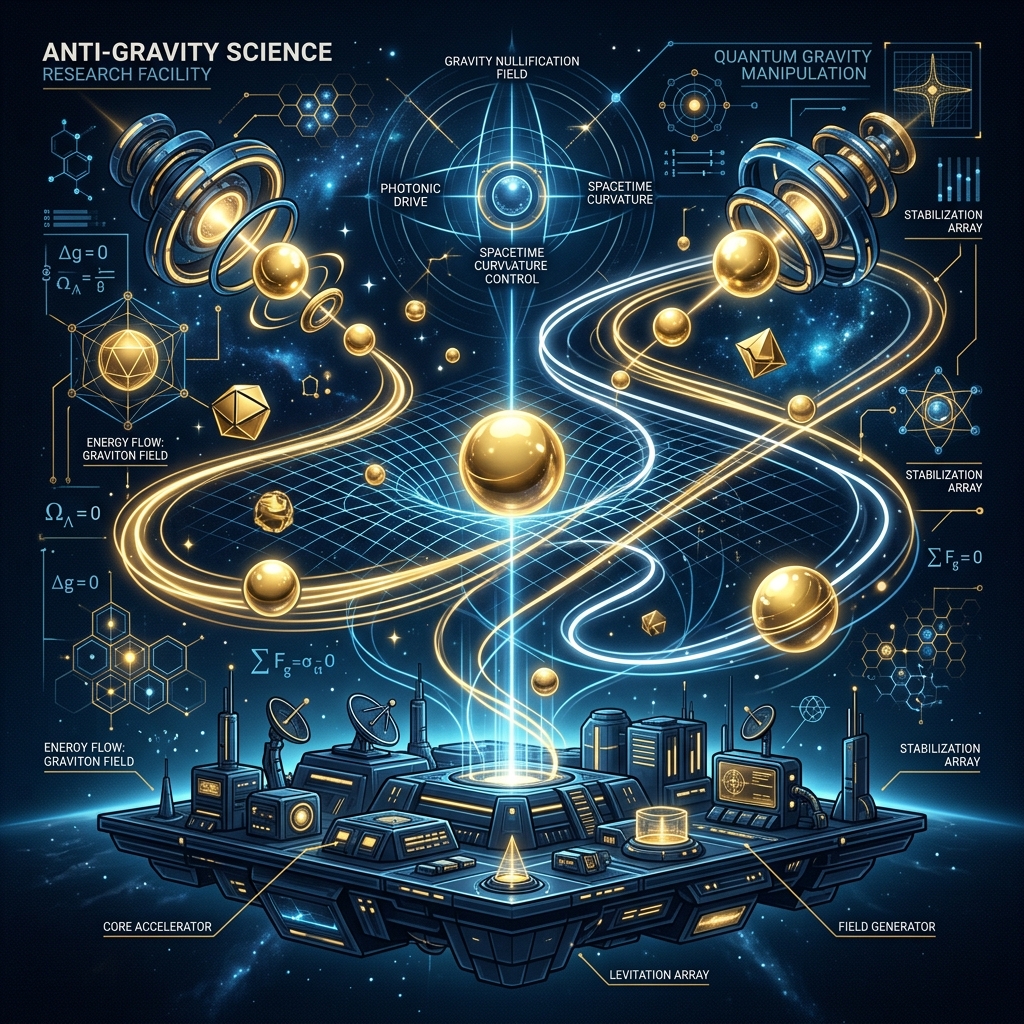
Imagine a world where massive hyper-loops float silently above the ground, spacecraft launch into orbit without combustion engines, and cities hover in the clouds. In science fiction, these concepts are routinely dismissed as standard "anti-gravity" technology. But is anti-gravity actually possible, or is it merely an imaginative dream that violates the fundamental laws of nature? To separate science fiction from physical reality, we must dive deep into theoretical physics, investigate the quantum structure of space, and look at how researchers are testing gravity limits today.
For students, young scientists, and public speakers, understanding anti-gravity science is not just an academic exercise. It represents a fantastic window into how scientific theories evolve. By examining the transition from classical physics to quantum mechanics, we learn how humanity handles the seemingly impossible. Let’s explore the history, the mathematics, the laboratory breakthroughs, and the practical implications of gravity manipulation.
1. The Foundation of Gravity: From Newton's Pull to Einstein's Fabric
Before we can define "anti-gravity," we must first ask: how does gravity work in the first place? Our understanding of this force has undergone two major shifts in the history of science, and each shift changes how we view the possibility of manipulating it.
Classical Mechanics: Isaac Newton’s Gravitational Pull
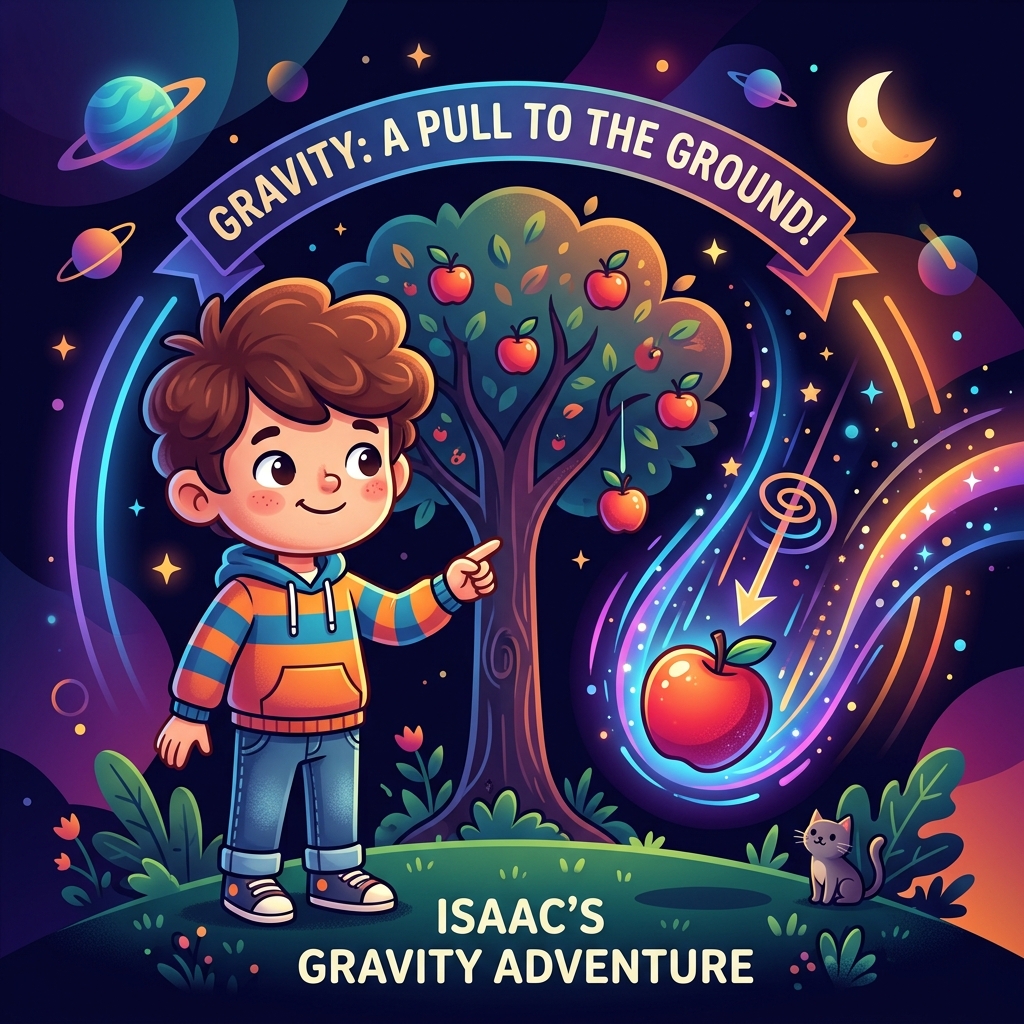
In 1687, Sir Isaac Newton published his Law of Universal Gravitation. He described gravity as a universal pulling force that exists between any two objects with mass. According to Newton’s formula, the force of attraction is directly proportional to the product of their masses and inversely proportional to the square of the distance between them. In this classical framework, mass is always positive. Because there is no such thing as "negative mass" in classical mechanics, gravity can only be attractive. Consequently, under Newton's laws, true anti-gravity is a mathematical impossibility.
General Relativity: Albert Einstein’s Curvature of Spacetime
In 1915, Albert Einstein completely revolutionized the field by introducing General Relativity. He proposed that gravity is not an active pulling force at all. Instead, it is the geometric warping of the fabric of spacetime caused by mass and energy. Think of spacetime as a stretched rubber trampoline. If you place a heavy bowling ball (representing a star or planet) in the center, the fabric warps and curves downward. If you roll a smaller marble (representing a moon or spacecraft) nearby, it rolls toward the bowling ball because of the curvature, not because of an invisible pulling cord.
Under Einstein's general relativity space curvature model, creating "anti-gravity" would require bending the trampoline fabric in the opposite direction—upward rather than downward. Mathematically, this would require a source of negative energy density or negative mass. While Einstein's equations do not explicitly forbid negative energy, finding or creating it is one of the greatest challenges in modern physics.
2. Core Theoretical Anti-Gravity Concepts
While we cannot build an anti-gravity machine today, theoretical physicists have identified several mathematical concepts and natural phenomena that mimic the effects of gravity manipulation.
Negative Mass: The Repulsive Element
In quantum mechanics and cosmological math, researchers often play with the concept of negative mass. If positive mass attracts everything, negative mass would theoretically repel positive mass, acting as a natural repulsive agent. However, negative mass introduces bizarre physical paradoxes. For example, if you push a negative mass, Newton’s second law implies it would accelerate toward your hand rather than away from it. Despite these paradoxes, physicists continue to study negative mass equations to understand the limits of Einstein’s field equations.
Dark Energy: The Cosmic Repulsion
In the late 1990s, astrophysicists measuring distant supernovae discovered something shocking: the expansion of the universe is not slowing down; it is accelerating. Galaxies are flying away from each other at ever-increasing speeds. The force driving this acceleration is known as "Dark Energy." Acting as a form of cosmic repulsive gravity, dark energy accounts for roughly 68% of the universe's total energy budget. While we cannot harness dark energy in a laboratory, it is the only scientifically confirmed form of "anti-gravity" operating on a grand cosmic scale.
The Casimir Effect: Quantum Negative Pressure
Can negative energy exist in a laboratory? Yes, on a microscopic scale. According to quantum field theory, "empty" space is not truly empty; it is filled with virtual particles that pop in and out of existence. In 1948, Dutch physicist Hendrik Casimir proposed that if you place two uncharged metal plates extremely close together in a vacuum, the space between them will restrict the wavelengths of virtual particles. This creates a lower energy density between the plates compared to the space outside them. The result is a measurable negative pressure that pulls the plates together. This Casimir effect proves that negative energy states are physically real and measurable under strict laboratory conditions.
3. Testing the Impossible: Modern Scientific Experiments
To ensure that anti-gravity concepts transition from whiteboard formulas to empirical reality, scientists have designed highly complex experiments to test how gravity interacts with exotic matter.
Antimatter and Gravity: The CERN ALPHA-g Experiment
One of the most persistent questions in modern physics has been: does antimatter fall up or down? Antimatter particles have the same mass as regular matter but opposite electric charges. Some theorists hypothesized that antimatter might possess negative gravitational mass, meaning it would fall "up" in the presence of Earth's gravity field.
To test this, the ALPHA collaboration at CERN (the European Organization for Nuclear Research) built the ALPHA-g apparatus. In late 2023, they released their historic findings. By trapping antihydrogen atoms in a vertical magnetic field and releasing them, scientists observed that approximately 80% of the antimatter fell downward, behaving exactly like regular hydrogen. This confirmed Einstein’s Weak Equivalence Principle, proving that antimatter does not exhibit natural anti-gravity behavior. While this was a disappointment for science fiction enthusiasts, it was a massive triumph for the consistency of general relativity.
Electromagnetic and Superconducting Claims
In the 1990s, Russian researcher Eugene Podkletnov claimed to have created a "gravity-shielding" device. He reported that objects placed above a rotating, superconducting ceramic disc lost up to 2% of their weight. The claim caused a sensation in the aerospace industry, prompting institutions like NASA and Boeing to investigate. However, subsequent attempts to replicate the Podkletnov experiment under controlled conditions failed to produce any weight reduction. This case serves as a vital reminder of the scientific method: extraordinary claims require extraordinary evidence and independent replication.
4. The Future of Space Travel: Warp Drives and Propulsion
If we could somehow master gravity manipulation, space exploration would change overnight. Modern spacecraft rely on chemical reaction engines, which require massive amounts of fuel to escape Earth's gravity. Gravity-control systems would render these obsolete.
The Alcubierre Warp Drive
In 1994, Mexican physicist Miguel Alcubierre proposed a mathematical model for a "warp drive" that allows faster-than-light travel without violating general relativity. The Alcubierre Warp Drive works by compressing the fabric of spacetime in front of a spacecraft and expanding it behind it. The ship sits inside a "warp bubble" of flat space, riding the wave of warped spacetime. To achieve this expansion, the drive requires a ring of negative energy density. While the math is solid, the engineering remains impossible because we do not have a way to generate the required amount of exotic matter.

Gravity Assist and Conventional Tech
Until we can warp spacetime, humanity relies on "gravity assists" (using the gravitational pull of planets to slingshot spacecraft across the solar system) and electric propulsion systems (like ion thrusters). While these are not anti-gravity, they demonstrate our ability to intelligently utilize gravitational fields to navigate the cosmos.
5. Student Corner: How to Present "Anti-Gravity" in Public Speaking
For students at Victory Fluent Forum, presenting complex scientific topics like anti-gravity is an excellent way to develop elite public speaking and science communication skills. When speaking about advanced physics, the challenge is not just knowing the facts—it is keeping your audience engaged and translating complex mathematics into simple, memorable concepts. Our Public Speaking Programs are designed to help K-12 students master these skills. Visit our Homepage to learn more. In the modern world, understanding technology and communication is more crucial than ever. To see how these skills interact, read our guides on Why Speaking Well Is a Superpower in the Age of AI and how it fits into the Future of Classrooms with AI Tutors. Additionally, learning to debate and present complex topics helps in Teaching Kids AI Critical Thinking from an early age.
Here are three presentation strategies to use in your next school speech or science fair:
- Start with a Pop-Culture Hook: Begin your speech by referencing famous sci-fi movies. Ask your audience: "How close are we to riding Marty McFly’s hoverboard from Back to the Future?" This instantly captures attention and builds a bridge between fiction and reality.
- Use the "Trampoline Metaphor": Instead of explaining complex Einsteinian tensor calculus, use visual analogies. Bring a piece of stretchy fabric and a heavy ball to show how gravity curves space. Your audience will understand the concept in seconds.
- Implement Structured Rhetoric: Organize your argument using the Ethos, Pathos, and Logos framework. Show the logic (Logos) of CERN's experiments, establish your credibility (Ethos) by citing peer-reviewed papers, and build excitement (Pathos) about the future of space exploration.
6. Conclusion: The Horizon of Gravity Control
True anti-gravity remains, for now, on the theoretical horizon. While classical physics deemed it impossible, quantum mechanics and modern cosmology show that space is far more malleable than we once thought. Experiments at CERN and observations of dark energy continue to push the boundaries of what is possible. As we search for a unified theory of quantum gravity, we may one day unlock the secrets to bending spacetime, turning the dreams of science fiction into the reality of tomorrow.
Explore Future Skills and Communication Programs at Victory Fluent Forum
Whether your child is presenting scientific concepts, debating, or building stage presence, professional guidance makes all the difference. Visit our Homepage to learn about our curriculum.
Book a Free Assessment today to evaluate your child's communication skills and begin their journey!
Empower Your Child to Explain Complex Science with Confidence
Public speaking isn't just about reading words on a page; it is about communicating grand ideas clearly. At Victory Fluent Forum (VFF), we help K-12 students master complex scientific presentation techniques, debate frameworks, and creative storytelling.
VFF is a premium, elite live communication academy incubated under the prestigious Symbiosis Launchpad 30 startup incubation (SSPU Pune). Under the guidance of Lead Mentor Mrs. Simran Bagwan (M.A. English, M.Ed), we turn anxious observers into confident STEM leaders.
Active Pricing Structure (Mon–Fri Daily Classes):
1:5 Group Plan
1:1 Essential Plan
1:1 Intensive Plan
7-Day Dedicated Learning & Commitment Policy
To protect our mentors' premium time, refund claims under our satisfaction policy are strictly conditional. Claims are only valid if the student maintains 100% attendance in the first week and submits all daily creative assignments on time. Serious learners only.