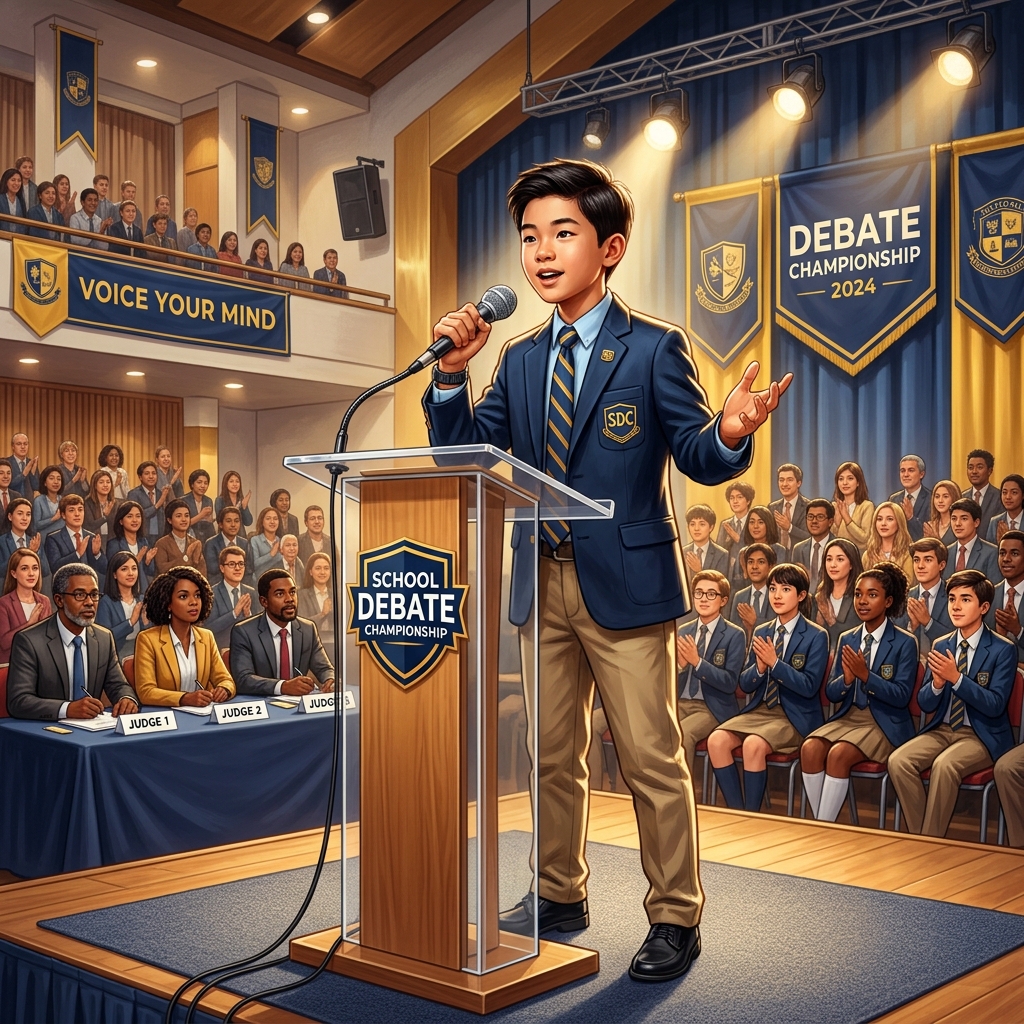
AI Quick Overview for Busy Parents & Coaches
The Core Problem: 90% of children begin inter-school debate speeches with predictable, flat greetings ("Good morning judges, today my topic is..."), causing judges to tune out within 5 seconds.
The Solution: Teach kids to flip the script by delivering a high-impact hook sentence FIRST, followed immediately by formal debate protocol greeting and stance statement.
- Learn the 3-step opening sequence used by inter-school trophy winners.
- Master 7 fill-in-the-blank hook sentence templates (Rhetorical, Statistic, Scenario, Contrast, Myth-Buster, Challenge, & Future Vision).
- Download the printable PDF cheat sheet featuring 15 hook templates & first-minute delivery checklist.
The auditoriums at inter-school debate tournaments are notoriously cold. Not because of the air conditioning, but because of the silence. Picture a 10-year-old girl named Aaradhya standing behind a mahogany podium that reaches up to her chin. She holds index cards in her left hand; her fingers are trembling so noticeably that the cards rustle like dry autumn leaves.
The chief adjudicator leans back, pen hovering over the score sheet. Aaradhya takes a sharp breath and whispers into the microphone: "Good morning respected judges, teachers, and my dear friends. Today, the topic given to me is 'Should plastic bags be banned entirely?'"
You could almost feel the energy drop in the room. The judge didn't even write down a single note. He simply drew a small checkmark under "Standard Opening" and glanced down at his timer. Aaradhya had spent three weeks researching plastic degradation, microplastics in groundwater, and marine biology. Yet, before she could utter a single line of her hard-earned argument, she had already surrendered the most valuable piece of real estate in public speaking: the first seven seconds.
— Senior Debate Adjudicator, Inter-School Rhetoric Championship
Three months later, after coaching Aaradhya through Victory Fluent Forum's opening hook framework, she stood in front of the exact same judging panel. This time, she didn't say "Good morning" first. She walked out, paused for three full seconds, looked directly into the chief judge's eyes, and spoke with unwavering clarity:
"By the time I finish speaking my opening sentence, another 100,000 plastic bags will have been dumped into our oceans forever."
The room went dead silent. The chief judge snapped his head up, clicked his pen, and began writing furiously. That single change in sequence transformed her from another polite participant into an authoritative finalist.
Why Traditional Greetings Fail (And What Judges Look For)
When children prepare for debate competitions, well-meaning parents and teachers often drill them on politeness: "Make sure you greet everyone nicely first!" While politeness is essential in debate etiquette, starting with a generic greeting is a psychological mistake.
Inter-school debate judges score speakers on three core categories: Matter (the logic of arguments), Manner (vocal control, body language, and hook delivery), and Method (speech structure and time management). The opening 30 seconds dictate how judges perceive all three categories.
The Psychology of the 7-Second Rule
When a debater opens with a bland greeting, the judge's brain categorizes the speaker as "script-dependent." But when a child opens directly with a bold statement or startling statistic, the judge's brain registers high executive confidence and verbal mastery, elevating their baseline score across the entire rubric.
The 3-Step Winning Sequence for Debate Openings
To win inter-school debates, kids don't need to skip formal etiquette—they simply need to rearrange it. Every competition-winning debate opening for kids must follow this exact 3-step blueprint:
- Step 1: The Hook Sentence (0–8 Seconds) — Fire an attention-grabbing statement, question, or scenario directly at the audience before any greetings.
- Step 2: The Protocol Greeting (8–15 Seconds) — Acknowledge the debate floor with formal respect: "Respected judges, timekeeper, and esteemed opponents..."
- Step 3: The Stance & Motion Declaration (15–30 Seconds) — Clearly declare team position (Affirmative or Negative) and state the core motion.
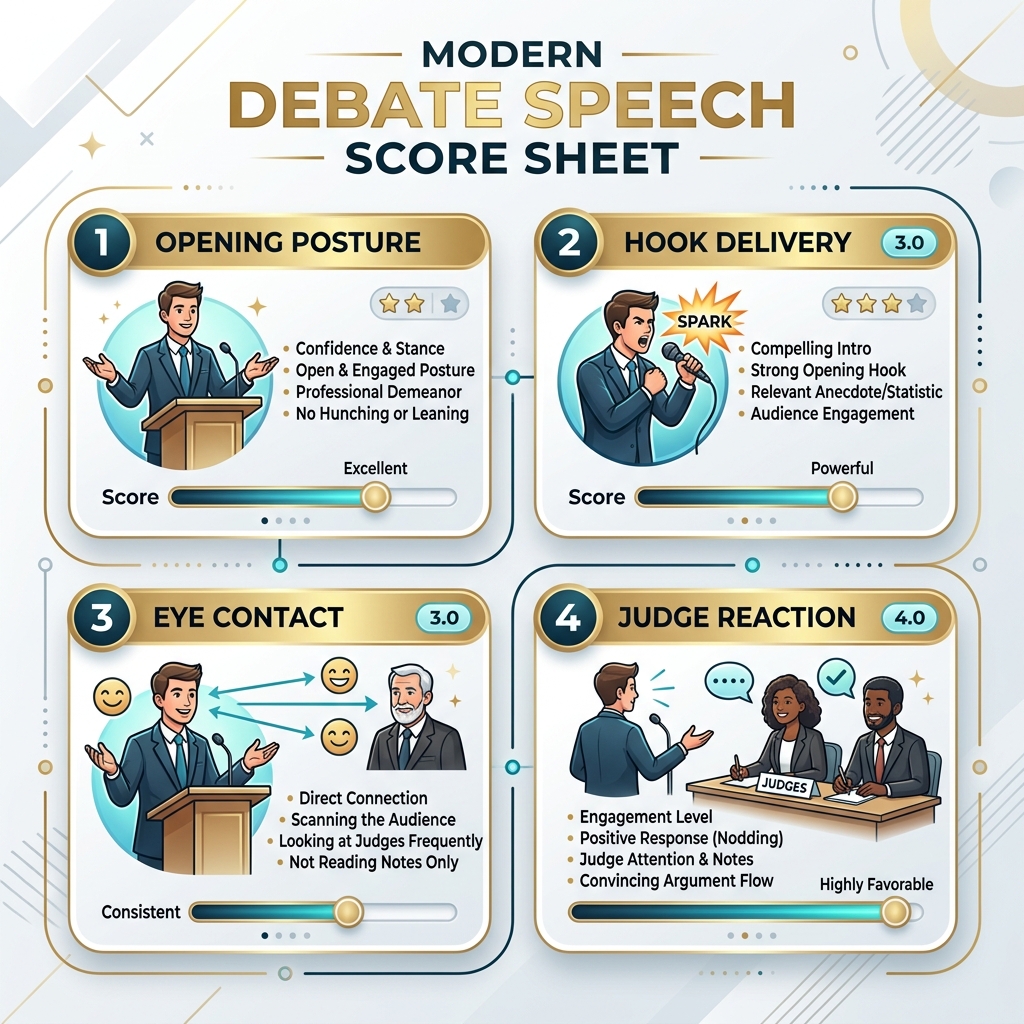
7 High-Impact Debate Hook Sentences for Kids (With Templates)
Here are seven battle-tested debate hook categories that kids aged 8 to 14 can use immediately. Each template includes a fill-in-the-blank formula and a real classroom example.
This hook uses numerical shock value to make an abstract debate topic feel urgent and real.
Real Example (Topic: Screen Time for Children):
"Did you know that children under 12 spend more time staring at digital glass than they spend speaking to their own parents? Respected judges, timekeeper, and opponents..."
A powerful rhetorical question forces the judges to mentally participate in your speech from sentence one.
Real Example (Topic: Artificial Intelligence in Classrooms):
"Have you ever wondered what happens when a machine writes a child's essay, but no human child learns how to think? Respected judges..."
Scenario hooks engage sensory imagination, transporting the audience into a vivid story.
Real Example (Topic: Banning Homework in Elementary Schools):
"Picture an 8-year-old child rubbing exhausted eyes at 10 PM over a stack of worksheets, crying instead of sleeping. Respected judges, today Team Affirmative stands to put an end to this cycle."
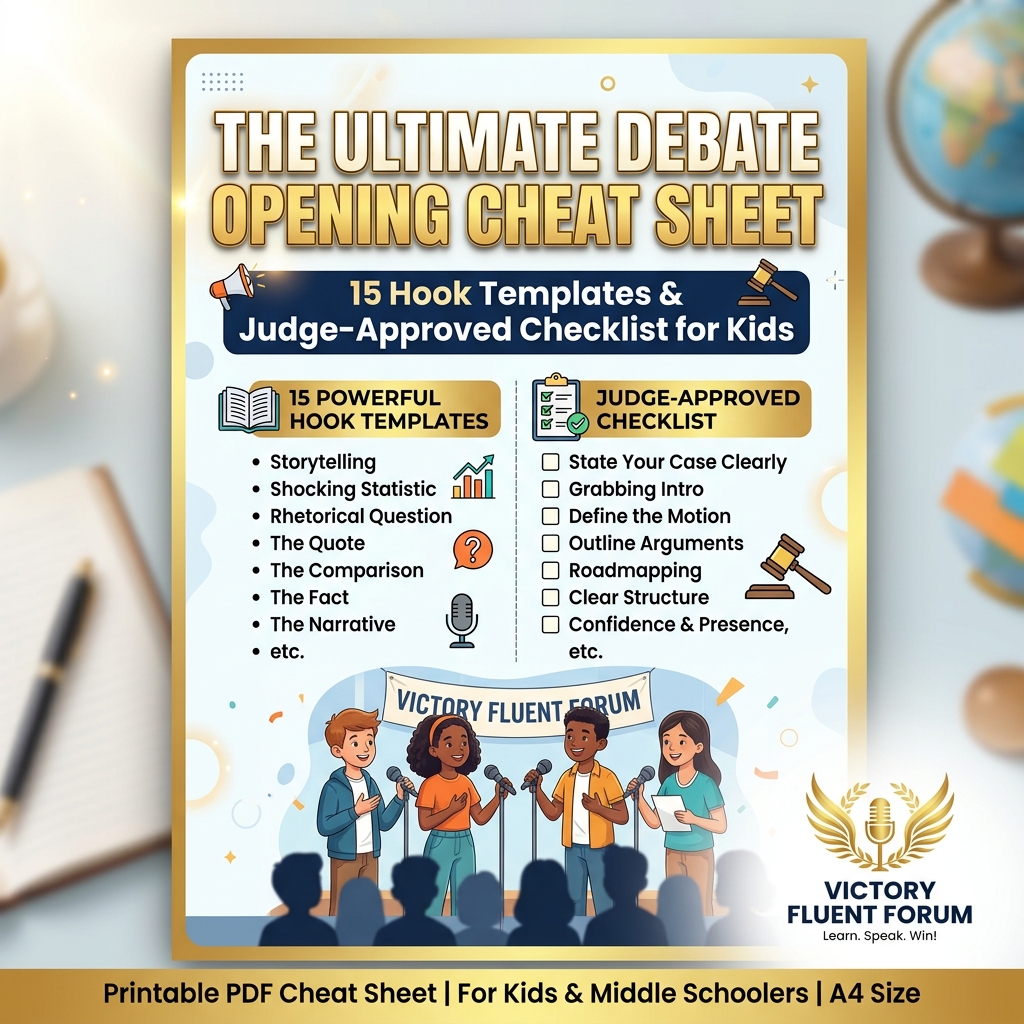
The Ultimate Debate Opening Cheat Sheet
Get instant access to 15 Fill-in-the-Blank Hook Templates (Affirmative & Negative positions), the First-Minute Delivery Checklist, and our Persuasive Power Word Bank.
View & Print Cheat Sheet PDFContrast hooks create immediate ideological tension between Team Affirmative and Team Negative.
Real Example (Topic: School Uniforms):
"On one side lies total conformity that stifles creativity; on the other lies a canvas for self-expression and identity. Respected judges, Team Negative chooses self-expression."
Debaters use this hook when speaking on the Negative side to instantly disarm the proposition's arguments.
Real Example (Topic: Social Media Bans):
"The opposition wants you to believe that banning apps creates safe children. Reality proves it only creates secretive children. Respected judges..."
This hook radiates fearlessness and places the burden of proof squarely on the opposing team.
Real Example (Topic: Junk Food Ban in Canteens):
"I challenge anyone in this auditorium to give me a single logical reason why schools should profit from selling diabetes to 10-year-olds. Respected judges..."
Future vision hooks appeal to long-term impact and moral responsibility.
Real Example (Topic: Environmental Protection Policies):
"Ten years from today, when our children ask what we did to save our forests, we must have an answer beyond excuses. Respected judges, Team Affirmative..."
Side-by-Side Comparison: Traditional vs. Champion Debate Openings
| Debate Opening Element | Traditional Opening (Scores 5/10) | Champion Hook Opening (Scores 9.5/10) |
|---|---|---|
| First Sentence | "Good morning everyone, my name is Samar and my topic is..." | "Over 80% of children surrender their curiosity before age 12." |
| Judge Reaction | Glances at clock, passive listening mode. | Immediately looks up, clicks pen, takes detailed notes. |
| Greeting Placement | Delivered immediately at 0 seconds. | Delivered strategically after the hook at 8 seconds. |
| Perceived Confidence | Moderate to low (sounds like a memorized class poem). | High authority & persuasive command. |
Parent & Coach Perspective: How to Practice Debate Hooks at Home
Teaching a child to deliver a powerful hook isn't about memorization; it's about vocal posture and physical grounding. Here are three quick home coaching techniques used at Victory Fluent Forum:
3-Step Home Practice Ritual for Parents
- The 3-Second Stare: Before your child speaks their hook, have them stand still, count silently "1... 2... 3..." in their head while making eye contact, then deliver sentence one.
- The Volume Knob Game: Have your child practice the hook sentence at whisper volume, medium classroom volume, and auditorium projection volume without shouting.
- The Record-and-Replay Exercise: Video record your child's opening 15 seconds on a smartphone. Watch it together with the sound muted to check body language and eye contact.
frequently Asked Questions (FAQs)
Q1: How do you start a debate speech for kids?
A strong debate speech opening for kids follows three simple steps: (1) The Hook: Start immediately with a bold statement, rhetorical question, or surprising fact; (2) The Greeting: Respectfully acknowledge the judges, timekeeper, and audience; (3) The Stance: Clearly state your motion and position (whether speaking FOR or AGAINST).
Q2: What are good debate hook sentences for students?
Good hook sentences create curiosity or emotion immediately. Key examples include: Rhetorical Questions ("Have you ever wondered what our world would look like if..."), Startling Statistics ("Did you know that over 80% of students today..."), and Scenario Hooks ("Close your eyes and picture a world where...").
Q3: Should kids greet the judges before or after the hook sentence?
Kids should deliver their hook sentence first before greeting the judges. Opening directly with a hook captures attention and creates dramatic impact. Greeting the judges immediately after maintains proper debate etiquette while keeping the audience engaged.
Q4: How long should a debate speech opening be for kids?
An effective opening should last 20 to 30 seconds (roughly 2 to 4 sentences). It should cover the hook, formal greeting, and a clear statement of position without taking time away from the main arguments.
Ready to Help Your Child Master Public Speaking & Debate?
Download our free PDF cheat sheet or book a personalized 1-on-1 live debate demo class with expert communication coaches at Victory Fluent Forum.