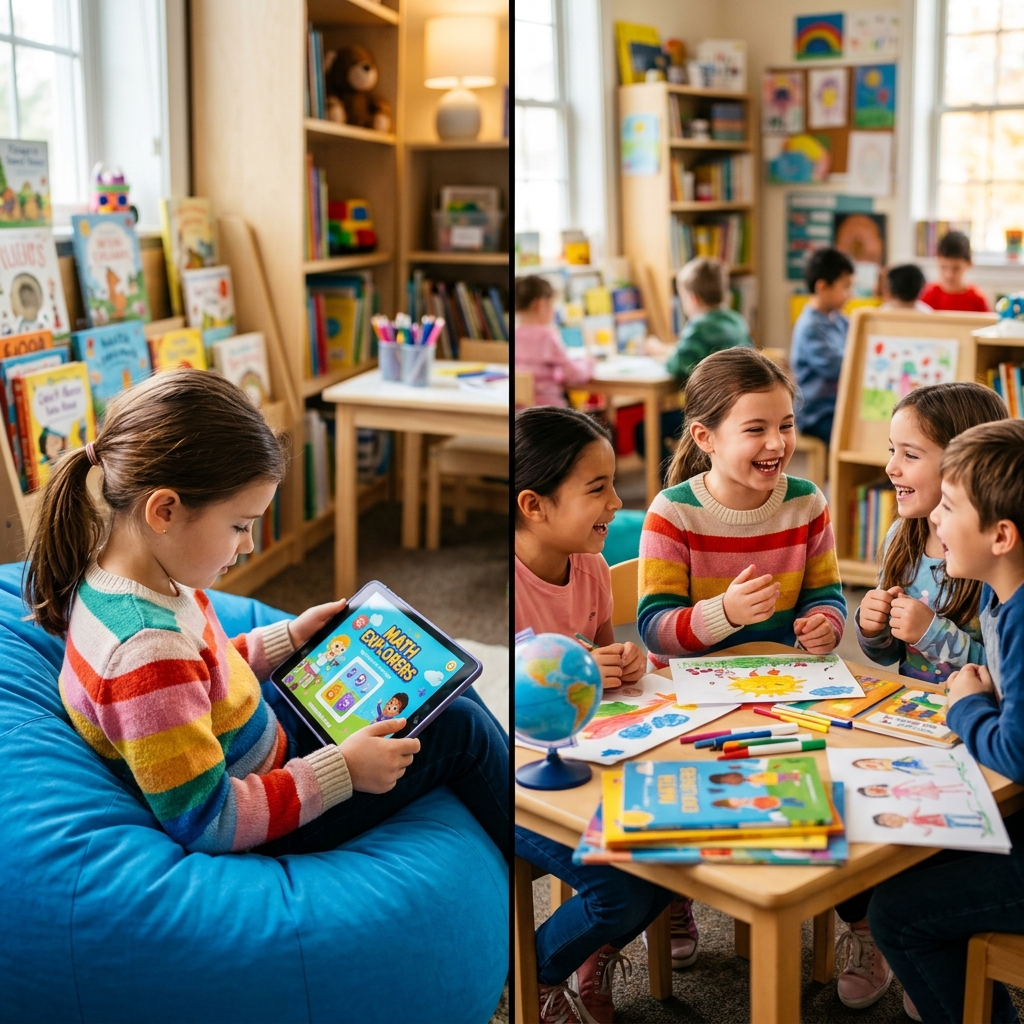
Executive Summary: The AI Classroom Shift
What are AI Tutors in K-12 Classrooms? Artificial Intelligence tutors are software systems powered by Natural Language Processing (NLP) and speech-recognition engines that deliver personalized, 1:1 conversational instruction, real-time auditory feedback, and adaptive pacing to students. Unlike traditional passive video lectures or written worksheets, voice-first AI tutors mandate active verbal responses, effectively solving the speaking gap in large K-12 classrooms.
Voice-First Engagement
Shifts screen-time into speak-time by requiring physical vocal articulation during practice.
Zero-Judgment Space
Eliminates stage fright and peer anxiety by offering private, infinite repetition for shy students.
Accent Adaptability
Recognizes diverse regional Indian English accents without penalizing natural vocal inflection.
Teacher Synergy
Frees human educators from repetitive drills so they can focus on rhetoric, emotion, and mentorship.
The global K-12 educational framework is undergoing its most profound structural transformation since the industrial revolution. For decades, traditional classrooms faced an inescapable constraint: high student-to-teacher ratios that prioritized written evaluation over spoken articulation. In a typical school cohort of 40 to 50 students, an individual child receives less than 60 seconds of direct vocal speaking time per week. The quietest children naturally retreat to the back of the classroom, allowing communication apprehension and stage fright to solidify during critical developmental years.
To overcome this systemic limitation, voice-first AI technology and adaptive conversational tutors are stepping in—not as replacements for human mentors, but as high-frequency verbal practice engines. By combining acoustic analysis, natural language processing, and personalized feedback loops, AI voice tutors are democratizing elite communication training across metropolitan hubs as well as Tier-2 and Tier-3 cities.
1. What Are AI Tutors in Modern K-12 Education?
Core Definition: AI Tutor
An AI Tutor is an intelligent educational system capable of natural language interaction, automated skill diagnostics, and real-time scaffolding. In speech and public speaking pedagogy, a voice-first AI tutor listens to a child's spoken response, analyzes vocal parameters (pace, volume, pitch, filler words, pronunciation), and dynamically adjusts its conversational prompts to guide the learner toward verbal mastery.
Modern AI tutors differ fundamentally from older Computer-Aided Instruction (CAI) programs. Traditional software relied on rigid multiple-choice buttons or static text inputs. In contrast, generative AI tutors utilize deep learning speech models capable of processing open-ended verbal answers. When a student speaks to a voice tutor, the system executes a three-part real-time processing loop:
- Acoustic & Phonetic Parsing: Converts raw audio input into phonetic representations, accounting for pitch variations, vocal timbre, and regional accent variations.
- Semantic & Syntactic Analysis: Evaluates vocabulary complexity, sentence structure, logical coherence, and grammatical accuracy using Natural Language Processing (NLP).
- Adaptive Conversational Scaffolding: Formulates an immediate vocal or textual response that prompts the student to expand their ideas, correct mispronunciations, or refine their pacing.
By conducting this loop in under 500 milliseconds, voice AI tutors simulate the experience of a dedicated 1-on-1 rhetoric coach, making continuous verbal practice accessible to every child regardless of school budget constraints.
2. The Evolution & Future of AI in Classrooms (2020–2026+)
Educational technology has evolved through distinct technological waves. Understanding this evolution highlights why conversational voice AI is succeeding where earlier digital tools struggled:
- Wave 1: Static Digital Repositories (2010–2018): Digitized textbooks, downloadable PDFs, and recorded video lectures. While these tools expanded access to information, they remained entirely passive, requiring zero vocal interaction or critical engagement from the student.
- Wave 2: Multiple-Choice & Text Chatbots (2018–2022): Gamified learning apps and automated text chatbots. While interactive, these tools reinforced finger-tapping and screen scrolling rather than verbal articulation.
- Wave 3: Generative Voice & Conversational Tutors (2023–2026+): Voice-first multimodal AI agents capable of active listening, real-time vocal feedback, emotional tone recognition, and adaptive storytelling.
According to global EdTech benchmarks, interactive voice learning increases verbal retentiveness by up to 40% compared to passive reading. When children physically articulate concepts in their own words, neural pathways governing long-term memory and oral fluency are strengthened exponentially.
3. The Speaking & Confidence Gap in Traditional Classrooms
In traditional K-12 education, academic evaluation leans heavily toward written examinations. While students spend years memorizing syntax rules and writing essays, they rarely practice spoken presentation. This structural imbalance produces high-performing students who experience severe anxiety when required to deliver group presentations, participate in Ivy League interviews, or lead team discussions.
Consider the mathematical reality of a standard 45-minute classroom session with 40 students:
- Teacher Instruction & Administrative Overhead: 30 minutes
- Classroom Discussion Time Remaining: 15 minutes
- Average Speaking Time Per Student: 22.5 seconds per day (~1.8 minutes per week)
Furthermore, when a child mispronounces a word or hesitates in front of 40 peers, public correction can trigger social embarrassment. This negative reinforcement cycle causes hesitant speakers to withdraw permanently. AI voice tutors directly eliminate this barrier by offering unlimited, private speaking time.
4. Key Benefits of Voice-First AI Tutors for K-12 Learners
Integrating voice-first AI models into student routines yields distinct pedagogical advantages:
A. Zero-Judgment, Low-Stakes Practice Environment
An AI tutor possesses infinite patience. A student struggling with vocal projection or accent-induced hesitation can repeat a speech twenty times without feeling rushed or judged. This safe environment allows shy and introverted children to experiment with vocal expression before taking the physical stage.
B. Accent-Adaptive Speech Recognition
Historical speech engines were trained almost exclusively on standard Western dialects, leading to frequent transcription errors when evaluating Indian English. Modern accent-adaptive NLP engines accommodate diverse regional Indian linguistic patterns (spanning Tamil, Hindi, Marathi, Bengali, and Punjabi phonetics). Children are understood clearly without having their natural identity penalized.
C. Real-Time Acoustic & Rhetorical Analytics
AI tutors track essential vocal parameters during practice sessions:
- Speech Pacing (WPM): Identifies whether a child is speaking too rapidly (>160 WPM) or haltingly (<100 WPM).
- Filler Word Density: Counts instances of "um," "ah," "like," and "you know," training kids to embrace confident pauses.
- Vocal Modulating Dynamics: Measures pitch variation to eliminate monotone delivery and encourage expressive storytelling.
For detailed strategies on combining vocal clarity with written logic, explore our guide on Creative Story Writing & Narrative Formatting for Kids.
5. Teacher vs. AI Tutors: Comprehensive Comparison Matrix
A common misconception is that AI tutors aim to replace human educators. The table below illustrates how human mentors and AI voice tutors fulfill complementary roles in a balanced educational ecosystem:
| Pedagogical Dimension | Human Educator / Mentor | Voice-First AI Tutor |
|---|---|---|
| Emotional Intelligence & Empathy | Deep emotional connection, encouragement, and understanding of student background. | Simulated empathy; excellent at neutral encouragement without human warmth. |
| Repetition Capacity | Limited by classroom schedule and energy constraints. | Infinite 24/7 repetition without fatigue or frustration. |
| Rhetorical & Storytelling Coaching | Teaches persuasion, emotional nuance, audience reading, and authentic presence. | Analyzes structural grammar, vocabulary breadth, and acoustic pacing metrics. |
| Feedback Timing | Delayed (after class or during scheduled speech reviews). | Instantaneous (sub-second acoustic and semantic feedback). |
| Classroom Scalability | 1 Teacher to 30-50 Students (Splits attention). | 1:1 Dedicated coaching ratio for every student simultaneously. |
| Ideal Role | Inspiration, Leadership Mentorship, Deep Communication Strategy. | High-Frequency Practice Engine, Pronunciation Auditing, Vocabulary Scaffolding. |
6. The Hybrid Model: Human Mentors + AI Voice Technology
The most effective educational institutions do not choose between human teachers and AI; they adopt the Hybrid Synergy Model. In this architecture, AI handles repetitive acoustic diagnostics and vocabulary drilling at home, while human mentors focus on high-impact public speaking instruction in live sessions.
When students arrive at live coaching sessions having already practiced their vocal delivery with an AI tutor, live mentors spend zero time correcting basic mispronunciations. Instead, mentors dedicate class time to high-level skills: stage posture, eye contact, persuasive debate rebuttal, and emotional resonance. To learn how structured live mentorship accelerates public speaking confidence, read our master guide on Public Speaking for Kids: The Complete 2026 Guide.
7. Real Classroom Implementation & Regional Case Studies
The application of voice AI extends beyond elite international academies. It is actively democratizing quality education across diverse regional tiers in India:
Case Example 1: Bridging the Tier-2 & Tier-3 Regional Divide
In cities like Nashik, Jaipur, and Pimpri-Chinchwad, students often possess strong written academic records but struggle with English conversational fluency due to limited local practice opportunities. By deploying smartphone-accessible AI voice tutors, students practice conversational English in private routines, building fluency before stepping into competitive national exams and university interviews.
Case Example 2: Supporting Neurodiverse & Introverted Learners
Students with social anxiety or speech hesitations frequently experience extreme stress when forced to present at a podium. AI voice tutors allow these students to practice speeches in a safe home environment. Over an 8-week structured program, introverted students increase their average vocal volume and decrease filler word density by up to 50%, enabling them to transition smoothly to live group stages.
8. Ethical Considerations, Student Data Privacy & Bias Mitigation
As AI tools become embedded in educational environments, safeguarding student privacy and maintaining ethical guardrails is paramount:
- Data Security & DPDP Compliance: Educational AI platforms must strictly comply with India's Digital Personal Data Protection (DPDP) Act 2023 and international child privacy standards (such as COPPA). Voice recordings should be processed as ephemeral audio streams, encrypted end-to-end, and never monetized or sold to third-party advertisers.
- Algorithmic Fairness & Bias Prevention: Speech models must be continuously trained on diverse socio-economic and regional audio datasets to prevent systemic bias against non-standard accents or developing speech patterns.
- Healthy Screen-Time Balance: Voice-first interfaces should minimize passive visual distraction. The goal of educational technology is to convert passive screen viewing into active verbal communication.
9. Future Trends Shaping AI Classrooms (2026–2030)
Looking toward the next decade, several emerging technologies will redefine how children learn to communicate:
- Multimodal Conversational Avatars: AI tutors will combine voice interaction with expressive spatial avatars capable of reading facial micro-expressions and providing feedback on eye contact and body language.
- Virtual Reality (VR) Public Speaking Stages: Students wearing lightweight headsets will practice speeches in front of simulated audiences—ranging from a quiet classroom to a 1,000-person auditorium—with real-time biofeedback monitoring heart rate and vocal tremor.
- Real-Time Dialect Neutralization & Global Accent Translation: Voice engines will assist students in developing clear global articulation while preserving their authentic regional identity.
For more insights on preparing young learners for an AI-driven future, explore our comprehensive analysis on Public Speaking & Rhetoric Mastery for Next-Gen Leaders.
10. The VFF Practical Framework: The "Daily Voice Diary" Exercise
Parents and educators can implement voice-first learning immediately without purchasing expensive software. The **Victory Fluent Forum Daily Voice Diary** relies on native voice dictation tools available on standard smartphones:
Step-by-Step 10-Minute Home Routine
- Step 1: The 60-Second Unscripted Prompt (2 Mins): The child selects an engaging daily topic (e.g., "If you could design a city on Mars, what three rules would you establish?"). They open a notes app, tap the microphone dictation icon, and speak continuously for 60 seconds. Typing or manual editing is forbidden.
- Step 2: The Acoustic Transcription Audit (3 Mins): Parent and child review the automatically generated text transcript. They highlight words that were mis-transcribed or omitted by the speech engine. These transcript errors pinpoint exact locations where the student mumbled, dropped vocal projection, or spoke too rapidly.
- Step 3: Targeted Pronunciation Re-try (3 Mins): The child isolates the mis-transcribed vocabulary words, practicing proper enunciation and diaphragm projection.
- Step 4: The Flawless Final Delivery (2 Mins): The child repeats the 60-second speech until the voice dictation engine transcribes their speech with over 95% accuracy.
11. Frequently Asked Questions (FAQs)
Explore authoritative answers to common questions regarding AI tutors, voice-first learning, and communication pedagogy:
What is an AI tutor in K-12 education?
An AI tutor is an educational software system powered by Natural Language Processing (NLP) and speech recognition that provides personalized, 1:1 conversational practice, instant feedback, and adaptive learning paths tailored to an individual student's pace.
Will AI tutors replace human teachers in schools?
No. AI tutors do not replace teachers. They act as high-frequency practice tools that handle repetitive drills, acoustic analytics, and initial vocabulary building, freeing human educators to focus on emotional intelligence, mentorship, rhetoric, and creative storytelling.
How does voice-first learning improve public speaking skills?
Voice-first learning mandates active vocal articulation rather than passive screen scrolling. By speaking answers aloud, students build vocal muscle memory, practice pace management, reduce filler words, and overcome speech hesitation in a judgment-free environment.
Can AI speech recognition understand Indian regional accents?
Yes. Modern accent-adaptive speech recognition engines are trained on diverse Indian acoustic datasets spanning North, South, East, and West phonetic variations, ensuring students are evaluated accurately without accent penalty.
What is the speaking gap in traditional classrooms?
In a standard classroom of 40 to 50 students, an individual child receives less than 60 seconds of direct vocal practice per week. This lack of frequency contributes to public speaking anxiety and stage fright.
How do AI tutors help introverted or shy students?
AI tutors offer a completely private, zero-judgment environment. Shy students can practice delivering speeches dozens of times without fear of peer ridicule, building core confidence before speaking in public.
Is student voice data safe when using AI tutors?
Compliant educational platforms adhere to child data privacy laws and India's DPDP Act 2023. Audio streams are anonymized, encrypted, and strictly excluded from third-party advertising databases.
What age group benefits most from voice AI tutoring?
Children aged 6 to 16 experience significant benefits as vocal neural plasticity and language acquisition pathways are highly adaptable during these formative years.
How does voice AI feedback differ from grammar worksheets?
Worksheets evaluate written mechanics passively. Voice AI evaluates active vocal articulation, speaking pace (WPM), filler word usage, and vocal pitch dynamics in real-time.
What is the "Daily Voice Diary" exercise?
Developed by VFF, the Daily Voice Diary is a 10-minute home exercise where students speak a 60-second prompt into a voice dictation engine, audit the transcript for errors, and re-try difficult words until achieving 95%+ accuracy.
How do AI tutors democratize education beyond metro cities?
By delivering high-quality voice coaching via standard smartphones, AI tutors provide students in Tier-2 and Tier-3 cities access to premier communication training previously limited to expensive metro academies.
What future EdTech trends will emerge by 2030?
Key trends include 3D spatial avatar tutors, VR immersive public speaking stages, real-time biofeedback stress monitoring, and hyper-personalized multimodal learning curricula.
For Parents: Empower Your Child's Voice Today
Transform your child's communication confidence with Victory Fluent Forum's live interactive programs and cutting-edge rhetoric curriculum.
1:5 Group Plan
1:1 Essential Plan
1:1 Intensive Plan
Schedule a live 1-on-1 communication assessment with our expert mentors to evaluate your child's articulation, pacing, and confidence score.
Book Pre-Qualification AssessmentFor Schools & Educational Institutions
Interested in integrating speech-analytics frameworks or teacher training workshops into your school curriculum? Partner with the Victory Fluent Forum Academic Research Team.
Explore Institutional Resources