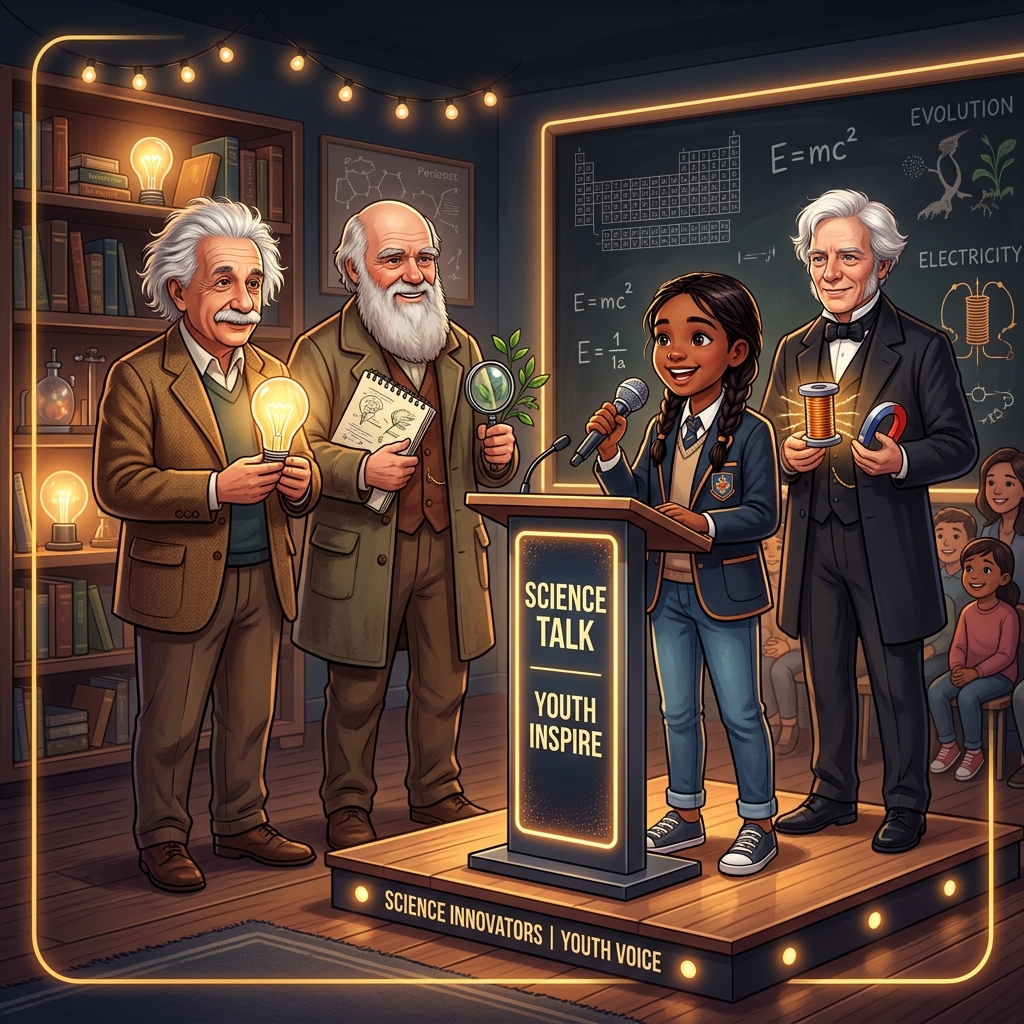
Imagine standing before a crowded auditorium. The spotlight hits your face, dozens of eyes fixate on you, and suddenly, your throat goes dry, your palms sweat, and your mind goes completely blank. For many children—and adults—this is a terrifying reality known as glossophobia, or the fear of public speaking. In fact, research indicates that up to 75% of the population experiences some form of stage anxiety, making it one of the most common psychological fears on earth.
For parents guiding introverted or anxious K-12 students, it is easy to assume that public speaking is an innate talent—something you are either born with or lack. But science and history tell a completely different story. Many of the greatest, most revolutionary thinkers in human history were absolutely petrified of public speaking. Yet, they developed clever strategies to manage their nervous systems and deliver their ideas to the world. By exploring their struggles and breakthrough cures, we can build deep empathy for our children and teach them that stage fright is not a permanent barrier—it is simply a biological response that can be managed.
1. Charles Darwin: Paralyzed by Public Scrutiny
Charles Darwin, the legendary naturalist who formulated the theory of evolution by natural selection, was notoriously reclusive and suffered from severe, chronic anxiety. For much of his adult life, Darwin experienced debilitating physical symptoms—such as intense nausea, trembling, and panic attacks—whenever he was faced with public scrutiny or social pressure.
In 1858, when his groundbreaking papers on natural selection were first presented to the Linnean Society of London, Darwin was not even in the room. He was at home, physically ill from the sheer dread of public exposure. He relied on his close friends and scientific allies, such as Thomas Henry Huxley (who became known as "Darwin's Bulldog"), to stand on stage, speak, and defend his evolutionary concepts in fierce public debates.
His Breakthrough Cure: High-Trust Peer Support
Darwin did not "cure" his stage fright by forcing himself onto massive stages. Instead, he managed it by creating a supportive, high-trust circle of close scientific peers. He shared his drafts in letters, discussed his theories around intimate dinner tables at Down House, and let trusted advocates handle the loud public arenas. This allowed him to refine his ideas in a safe environment, showing that communication confidence starts with finding a small, supportive group where you feel safe to speak your mind.
2. Sir Isaac Newton: The Professor Who Lectured to Empty Walls
Sir Isaac Newton, one of the greatest mathematicians and physicists of all time, was famously introverted, highly reclusive, and deeply anxious about public confrontation. As the Lucasian Professor of Mathematics at Cambridge University, Newton was required by university statutes to deliver public lectures. However, the prospect of facing a room full of critical students filled him with dread.
To avoid the pressure, Newton developed a bizarre habit: he would announce his lectures but make the content so dry, dense, and unengaging that students quickly stopped showing up. Reports from the era reveal that Newton would often stand at the lectern and read directly from his dense manuscripts to completely empty rooms, leaving immediately when the time was up. Later in life, during his time as a Member of Parliament, he reportedly spoke only once in several years—and that was to ask the usher to close a drafty window!
His Breakthrough Cure: Structured Outlines & Indirect Influence
Newton bypassed his intense fear of public speaking by channeling his voice into meticulously structured written treatises (like the Principia Mathematica) and letting his written logic do the heavy lifting. When he did have to address others, he relied on clear, pre-written outlines to keep his thoughts grounded. This shows that students who struggle with spontaneous speaking can build incredible confidence by mastering structural models like the PREP framework (Point, Reason, Example, Point) to organize their thoughts before they ever open their mouths.
3. Michael Faraday: Rehearsing Speaking as an Experimental Science
Michael Faraday, the pioneer of electromagnetism, is remembered as one of the most brilliant and engaging scientific lecturers in history. But he was not born that way. Faraday grew up in absolute poverty, had a severe speech impediment as a child (struggling to pronounce the letter 'R'), and received almost no formal education. The idea of standing before London’s elite classes was highly intimidating. Understanding how he systematically dismantled his own fear of public speaking can guide modern students.
A critical turning point occurred at the Royal Institution. His colleague, the inventor Charles Wheatstone, was scheduled to give a major public lecture. But minutes before the event, Wheatstone suffered a sudden, paralyzing panic attack and literally fled the building. Faraday was forced to step on stage, face the audience, and improvise the entire lecture. This unexpected trial-by-fire pushed him to conquer his fears once and for all.
His Breakthrough Cure: Systematic Practice & Visual Demos
Faraday decided to study public speaking exactly like an experimental science. He read classical books on logic, attended lectures specifically to write down what made other speakers successful, kept a detailed notebook of effective gestures, and practiced speaking in front of a mirror. Most importantly, he designed stunning visual demonstrations. By filling his lectures with physical, sparks-flying experiments, he shifted the audience's direct attention away from himself and onto the science props, calming his nervous system and creating the legendary Christmas Lectures for children.
4. Thomas Edison: Letting the Inventions Do the Talking
Thomas Edison, the creator of the phonograph, the motion picture camera, and the practical lightbulb, was a master businessman but a reluctant public speaker. Edison's hearing loss significantly amplified his underlying fear of public speaking on big stages. He struggled to hear audience questions, feared misinterpreting his listeners, and felt highly self-conscious about his vocal delivery on stage.
His Breakthrough Cure: The Power of Props & Casual Dialogue
Edison cured his presentation anxiety by turning his speeches into demonstrations. Instead of standing behind a wooden podium reading a dry script, Edison would let his inventions do the talking. He would flip a switch to light up a dark room or play a recorded voice on a phonograph. By focusing the audience's eyes on a physical prop, the intense spotlight was removed from his face. When he did speak, he spoke casually and conversationally about the object in his hands, transforming a high-pressure performance into a comfortable show-and-tell.
5. Albert Einstein: The Mumbling Scholar Who Embraced Childlike Simplicity
Albert Einstein, the Nobel Prize-winning physicist who rewrote our understanding of space and time, struggled with verbal communication early in life. Einstein was a late talker as a child, not speaking in complete sentences until he was around five years old, and he had a habit of repeating sentences silently under his breath to ensure they were correct before saying them aloud. Throughout his life, Einstein disliked the formal, clinical atmosphere of academic lectures, which made him feel anxious and out of place.
His Breakthrough Cure: Shifting from Performance to Conversation
Einstein overcame his anxiety by shifting his perspective on public speaking. Einstein proved that you can overcome a deep-seated fear of public speaking by adopting a conversational mindset. He stopped viewing a presentation as a formal performance where he had to prove his intelligence. Instead, he treated it as a casual, friendly conversation about ideas he loved. He stripped away dense academic jargon and used simple, childlike analogies—like elevators moving through space or trains passing by light rays. By focusing on his audience's natural curiosity and keeping his tone warm and conversational, Einstein turned lecturing into a joyful, stress-free experience.
Overcoming Fear of Public Speaking: Lessons from Great Minds
Looking back at the stories of Charles Darwin, Isaac Newton, Michael Faraday, Thomas Edison, and Albert Einstein, we realize that glossophobia is not a barrier to greatness. In fact, many other famous people afraid of public speaking have sat in the exact same position of anxiety before they left their mark on the world. The history of science is filled with brilliant scientists with stage fear who initially struggled to share their work with peers or the public, yet managed to find practical, life-changing solutions. From legendary politicians to quiet inventors, stage anxiety has affected people across every sector of human achievement.
The lesson here is simple: stage fright is a natural biological reaction, not a reflection of your intellect or capability. By shifting the focus away from performance anxiety toward systematic practice, physical props, and visual demonstrations, anyone can master public communication. Grounding your somatic system and structuring your ideas are the foundational keys to overcoming fear of public speaking. For parents and educators, early training provides the tools necessary to turn social anxiety into expressive power. Rather than forcing children onto stressful platforms, we should help them cultivate their speaking skills in supportive environments.
At Victory Fluent Forum, we utilize these historical strategies to guide students through structured confidence building exercises. By creating high-trust environments where introverted children can practice, we help them develop strong verbal presence. If you want to learn more about reducing academic anxiety, read our guide on overcoming fear of public speaking. For specialized strategies focused on shyer personalities, explore our resource on confidence building for introverted students. By breaking down communication into simple, daily steps, we help every child find their voice and present their ideas to the world with absolute clarity.
In one of our live interactive batches at Victory Fluent Forum, we welcomed a 9-year-old student named Kabir. Kabir was highly intelligent but suffered from severe glossophobia. Whenever his name was called, he would instantly turn off his camera, mute his microphone, and occasionally break into tears. Forcing him to stand and deliver a standard speech would have only reinforced his fear.
Instead, we introduced Kabir to the Faraday Method. For his next session, we asked him to bring his favorite toy spaceship to class. We did not ask him to give a speech; we simply asked him to show the toy to the camera and explain how the wings folded. With his hands occupied and his focus directed at the toy, Kabir's somatic system relaxed, and he began speaking fluently without even realizing he was "public speaking."
Once he felt safe, we taught him our Three-Second Sensory Check to ground his breathing before answering questions. Within six weeks, Kabir transitioned from a silent observer into a confident student leader who regularly initiates group discussions. Just like Faraday, Darwin, and Einstein, Kabir proved that confidence is not a genetic trait—it is a trained muscle.
Summary Matrix: How Great Minds Conquered Stage Anxiety
For quick reference, here is how these iconic scientists transformed their speaking weaknesses into professional communication strengths:
FAQs: Mastering Stage Fright & Public Speaking
Empower Your Child to Conquer Stage Fright Today
Do not let public speaking anxiety hold back your child's brilliant ideas. At Victory Fluent Forum (VFF), we turn anxious observers into confident global speakers and creative thinkers through structured, daily live classes.
VFF is a premium communication academy Incubated under the prestigious Symbiosis Launchpad 30 startup incubation (SSPU Pune). Led by Lead Academic Mentor Mrs. Simran Bagwan (M.A. English, M.Ed), we build elite real-world speaking authority.
Active Pricing Structure (Mon–Fri Daily Classes):
1:5 Group Plan
1:1 Essential Plan
1:1 Intensive Plan
7-Day Dedicated Learning & Commitment Policy
To protect our mentors' premium time, refund claims under our satisfaction policy are strictly conditional. Claims are only valid if the student maintains 100% attendance in the first week and submits all daily creative assignments on time. Serious learners only.