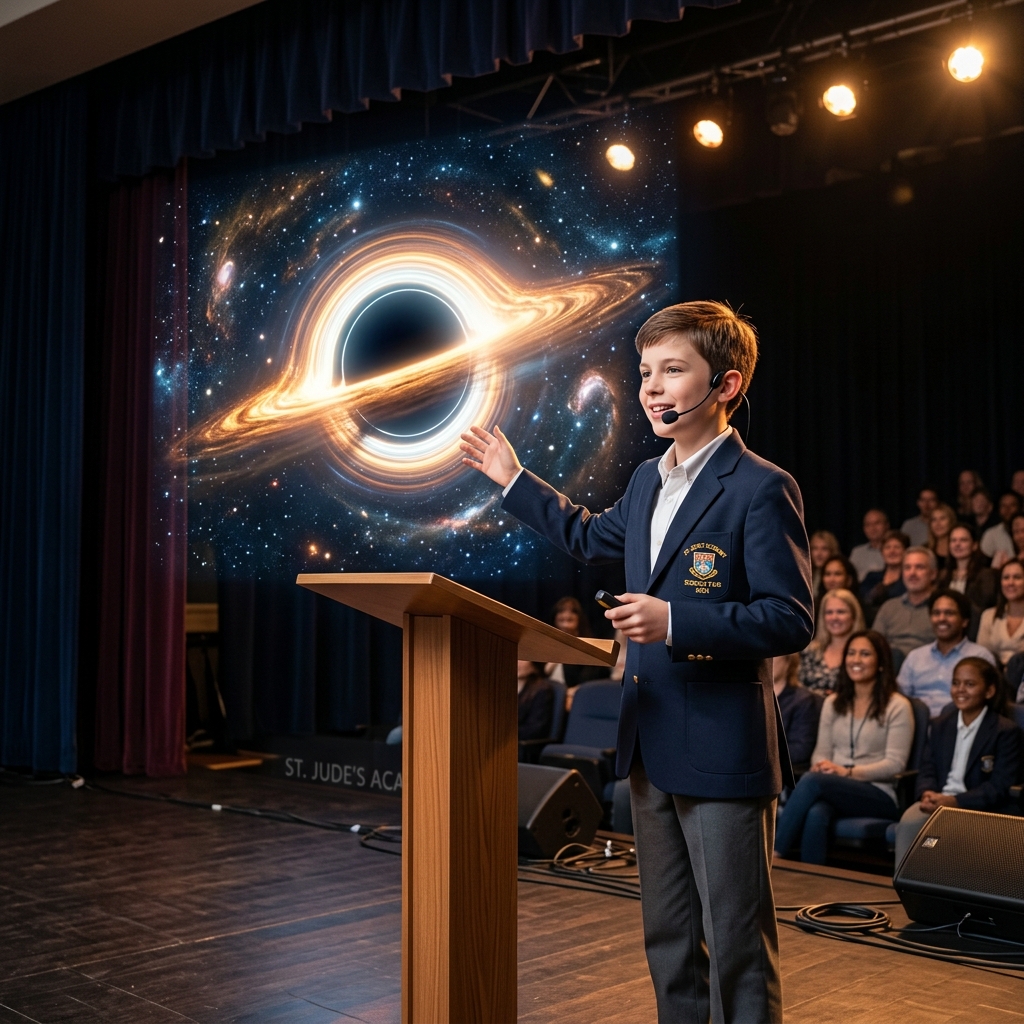
In a rapidly changing world dominated by algorithms, every parent wants to know how to improve public speaking for their child. Standard technical memorization is no longer the definitive separator in K-12 education. Instead, the ultimate academic superpower is modern articulation—the unique human capacity to take a heavy, complex mathematical or scientific concept and translate it clearly for an audience. If you want your child to develop lasting verbal authority, the solution is not to hand them a dry script to recite. Instead, the secret lies in turning them into a science communicator, using the awe-inspiring canvas of astrophysics to build real confidence.
How can kids learn how to improve public speaking through space topics?
Kids can learn how to improve public speaking by presenting complex space topics like black holes. Because space requires translating abstract mathematics into simple analogies, children must focus on audience understanding, which builds key presentation skills, structured thinking, and speaking confidence.
How Can Explaining Space Help Kids Learn How to Improve Public Speaking?
Explaining space concepts helps children learn how to improve public speaking by moving them away from dry script recitation. When a student explains a black hole using a household trampoline or a vacuum cleaner, they are forced to engage their audience visually and speak conversationally, which dramatically boosts their verbal confidence and communication skills.
Welcome to our comprehensive guide, designed to walk parents and educators through the step-by-step methodology of using cosmic science to cultivate elite presentation skills, vocal projection, and logical structuring. By turning the challenge of explaining black holes into a fun, interactive speaking playground, we bridge the gap between STEM knowledge and emotional intelligence.
Table of Contents
- 1. The Cosmic Sandbox: Shifting the Spotlight
- 2. The Pedagogy of Simplicity: Einstein's Golden Rule
- 3. Explaining Black Holes Simply: 3 Visual Analogies
- 4. The STEM Presentation Toolkit (PREP & S.T.A.R.L.)
- 5. Parent Guide: The Faraday Method at Home
- 6. Victory Fluent Forum Experience Block
- 7. Common Pitfalls in Science Communication
🏆 Book a Free Diagnostic Demo Class
Help your child conquer public speaking anxiety with active learning. Book a 30-minute evaluation session.
Why Space is the Perfect Topic to Learn How to Improve Public Speaking
The core barrier to confident speaking in front of an audience is self-consciousness. When children stand on stage, they typically focus on their own physical vulnerabilities: "Are they laughing at me? What if I stutter? Do I look strange?" This self-focus triggers the amygdala, initiating a fight-or-flight response that results in mumbling and physical shaking. To bypass this barrier, researchers at the American Psychological Association (APA) suggest shifting the speaker's focus away from themselves and onto a subject that inspires absolute wonder. This shift is a key foundation for discovering new methods on how to improve public speaking.
Space acts as the ultimate externalizer. When a child talks about massive dying stars, wormholes, or spacecraft traveling at light speed, their own self-consciousness is overwhelmed by curiosity. They stop worrying about their clothes or posture and start trying to make the audience feel the same excitement they feel. Shifting from self-focus to subject-focus is how children build authentic speaking confidence. It turns an anxiety-inducing performance into a shared adventure of exploration, laying a strong foundation for future leadership.
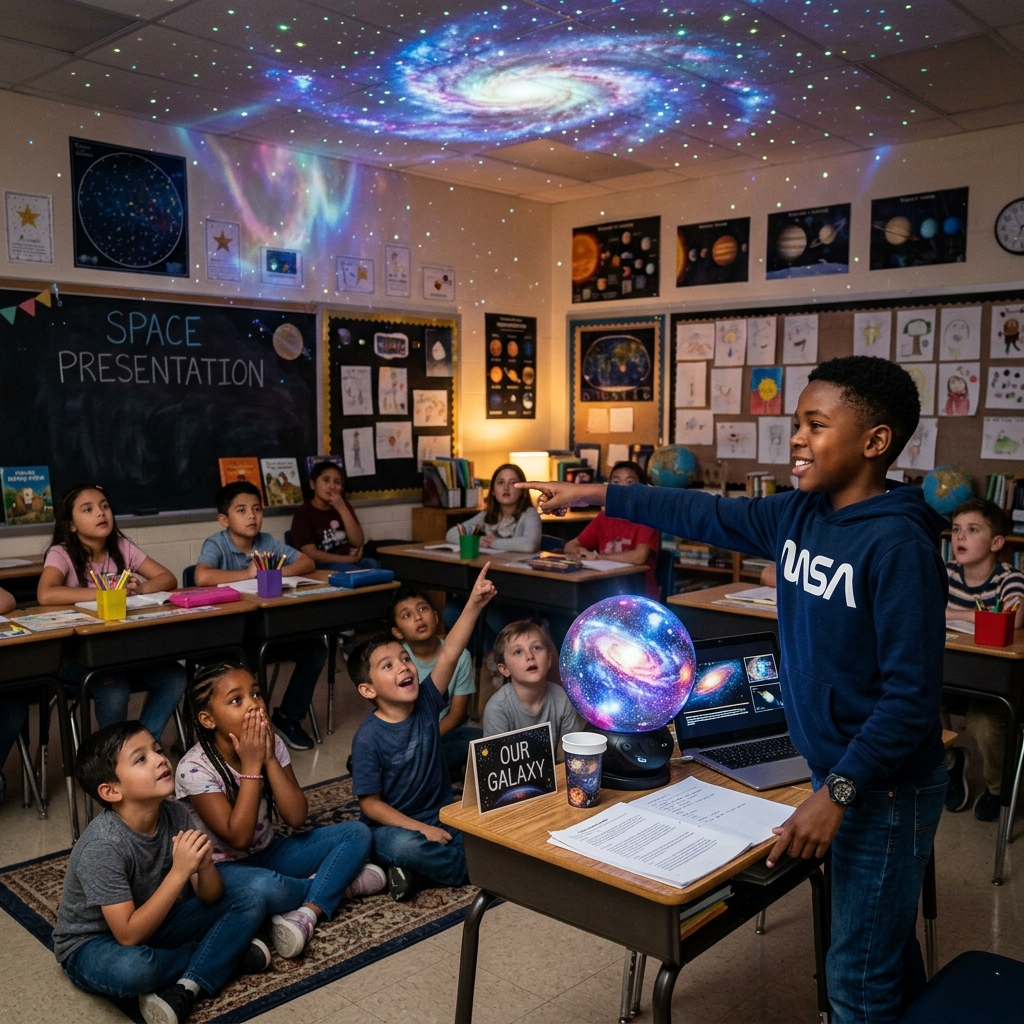
By using astronomy as a vehicle, kids learn to employ physical storytelling, wide-open gestures, and vocal variety. Instead of lecturing, they are explaining. This shift in posture from a passive test-taker to an active science guide is crucial when teaching students how to improve public speaking.
The Pedagogy of Simplicity: Einstein's Golden Rule
The legendary physicist Albert Einstein famously noted: "If you can't explain it to a six-year-old, you don't understand it yourself." This simple principle is the core of effective presentation skills. A weak speaker hides behind heavy academic jargon and dry lists of dates or statistics. A truly skilled speaker understands the target material so deeply that they can explain it using basic, clear concepts. When children practice explaining space concepts, they are training their minds in this exact pedagogical skill.
According to research from the Stanford Graduate School of Education, children who explain complex concepts using physical analogies show up to a 40% increase in conceptual retention and a significant drop in communication anxiety compared to peers who rely on rote reading.
For example, instead of explaining a black hole by saying, "It is a region of spacetime exhibiting gravitational acceleration so strong that nothing, including light, can escape," a student might say, "It is a point in space where gravity is packed so tightly that even the fastest light beam gets trapped like a toy in a sticky spiderweb." By making this translation, the child is not just memorizing; they are actively conceptualizing. This cognitive work builds deep communication skills, making the child's speaking voice sound natural and flexible rather than robotic.
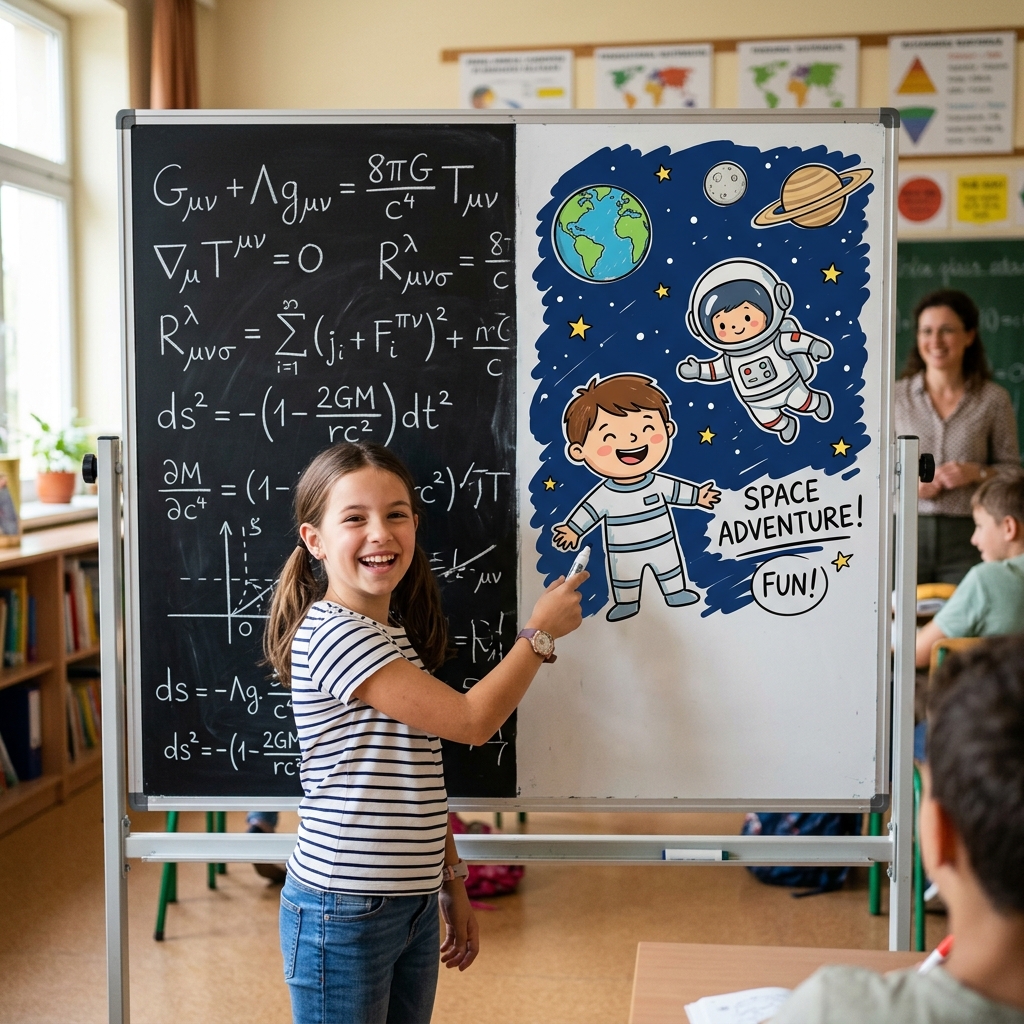
Furthermore, learning to explain science simply helps build audience engagement. When children look at their audience and see eyes lighting up because they finally understand a difficult topic, it provides a massive boost to their speaking confidence. They experience the real joy of sharing knowledge, which is the ultimate cure for stage fright.
Explaining Black Holes Simply: 3 Visual Analogies
To give you a practical blueprint, let's explore three powerful visual analogies that can turn any presentation on black holes into an engaging event, which is a key technique for kids learning how to improve public speaking. Each analogy takes an abstract scientific fact from authoritative institutions like NASA or the European Space Agency (ESA) and turns it into a concrete visual story:
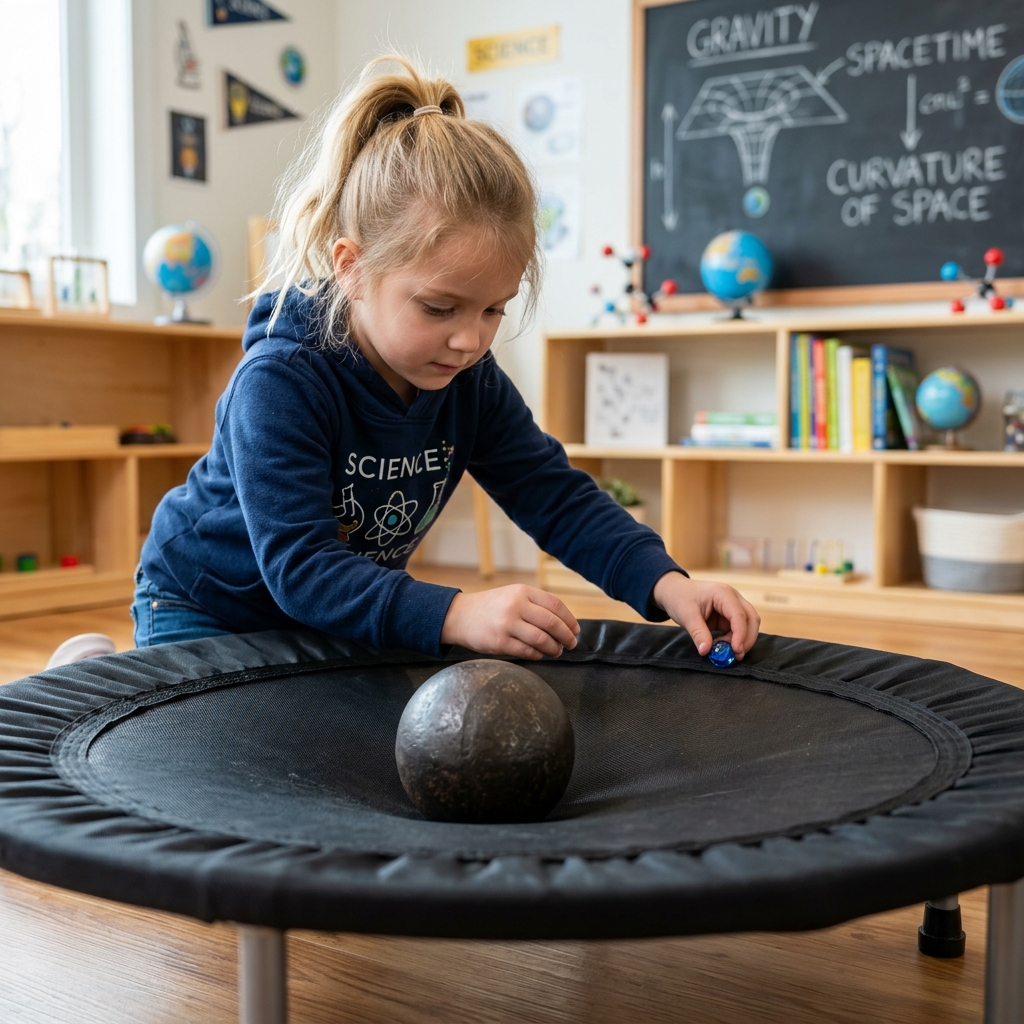
1. The Trampoline Spacetime Warping Analogy
Instead of explaining how gravity curves space according to Einstein's General Relativity, have the child describe a flat trampoline. Imagine placing a heavy bowling ball in the middle. The fabric bends downward, creating a deep funnel. If you roll a tiny marble across the trampoline, it will curve and circle around the heavy ball. If the ball is heavy enough, the marble falls right into the center. This visual prop immediately makes gravity understandable to the audience, transforming a cold equation into an active story.
2. The Cosmic Vacuum Cleaner Analogy
A common myth is that black holes are like gigantic vacuums in space, actively sweeping up everything in their path. Help your child correct this misconception by explaining that if our Sun were replaced by a black hole with the exact same mass, the Earth wouldn't get sucked in. Instead, we would keep orbiting it just like we do today, because the gravitational pull remains the same—it is just packed into a much smaller space. This "Myth vs. Fact" structure is highly engaging for listeners and showcases advanced presentation skills.
3. The Event Horizon Waterfall Analogy
The "Event Horizon" is a difficult boundary concept. Have your child compare it to a rapid river heading toward a massive waterfall. Imagine a fish swimming in the river. As long as the fish stays far away from the edge, it can swim against the current. But once it passes a certain point, the water flows faster than the fish can swim. Even if it is the strongest fish in the world, it will get carried over the waterfall. In a black hole, that point of no return is the Event Horizon, where the "current" of gravity is faster than the speed of light.
For more insights on explaining science topics through dynamic models, you can read our guide on anti-gravity concepts in physics, which demonstrates similar structural explanation methods for classroom settings.
The STEM Presentation Toolkit: Structuring Complex Ideas
To deliver these analogies effectively, kids need structure. Without a roadmap, a child is likely to wander or forget their place, which increases speaking anxiety. We teach children to use logical frameworks to hold their speeches together, which is a vital framework for anyone studying how to improve public speaking.
The PREP Framework
The PREP model is a powerful tool to organize thought on the fly. It prevents rambling and ensures the speaker makes a clear point. Here is how a child can use it to structure a speech about black holes:
- P (Point): "Black holes are not dangerous cosmic vacuums; they are curved pockets of space."
- R (Reason): "They only pull you in if you cross their boundary, because gravity behaves like a funnel."
- E (Example): "If you replace the Sun with a black hole of the same weight, Earth would orbit it safely without falling in."
- P (Point): "Therefore, understanding black holes is about studying the shape of space, not fearing a giant vacuum."
The S.T.A.R.L. Method
When sharing a scientific story or a personal learning experience, we use the S.T.A.R.L. model to build a clean narrative arc:
S (Situation): Describe the cosmic setting (e.g., a dying star).
T (Task): Explain the gravitational collapse.
A (Action): Describe the compression into a singularity.
R (Result): The creation of a black hole.
L (Learning): What this tells us about the shape of space.
Here is a comparison table to help children translate complex jargon into simple, crowd-friendly analogies during their speeches:
Practical Exercises: How to Improve Public Speaking at Home
To bridge the gap between classroom science and domestic training, parents can use targeted exercises at home to guide them on how to improve public speaking using physical props. We refer to this technique as the **Faraday Method**, named after the pioneer Michael Faraday, who systematically used stunning visual props to shift audience attention and calm his own voice.
Give your child a flashlight and a toy globe. Have them stand in a darkened room, shine the light on the globe, and explain how the Sun illuminates different continents. By holding physical props, their hands are kept busy, which reduces fidgeting, channels nervous energy, and builds a natural conversational flow.

When practicing at home, make sure the speaking space is warm and encouraging. Never interrupt a child to correct their grammar or pronunciation mid-speech. Let them finish their entire thought, praise their energy and structure, and then suggest one small adjustment for the next attempt. This positive feedback loop is crucial for building lasting speaking confidence.
For parents of quiet children, you can find additional guidance in our specialized guide on confidence building for introverted students, which provides tailored encouragement strategies.
Victory Fluent Forum Experience Block
At **Victory Fluent Forum (VFF)**, we regularly see the power of science communication in action. One of our students, a Grade 5 learner at Victory Fluent Forum, loved astrophysics but struggled with severe public speaking anxiety. Whenever they stood up to speak, they would speak rapidly, mumble, and look down at their shoes to avoid eye contact.
Rather than forcing them to give standard speeches, our mentors decided to channel their love for space. We asked them to present a brief showcase on black holes. They brought a small black cloth and a marble to their online camera. With their hands busy and their mind focused on explaining the trampoline analogy, they spoke clearly and projected their voice. This transformation shows how a child can learn **how to improve public speaking** by talking about their favorite science concepts. Today, they regularly lead debate groups and speak with absolute confidence.
Common Pitfalls in Science Communication
When children present science topics, they often fall into standard traps that can hurt their presentation skills. Here are the most common pitfalls to watch for:
1. **Jargon Stuffing**: Memorizing complex terms like "Schwarzschild radius" without understanding them. Ensure your child can explain every term they use in simple words.
2. **Reading Slides**: Staring at a script or presentation slides. Encourage them to use simple bullet points or physical props instead of reading text word-for-word.
3. **Rushing**: Speaking rapidly to get the presentation over with. Teach them to use pauses after major points to let the information sink in.
Avoiding these traps is a vital step toward mastering communication. In the modern era, where written text is abundant, the human connection is the differentiator. You can read more about why authentic voice and verbal skills matter in the digital landscape in our article on communication in the age of AI.
Conclusion: The Future-Proof Speaker
Ultimately, learning how to improve public speaking is about finding topics that spark a child's natural curiosity. By encouraging your child to explain the vast mysteries of space, you are not just helping them ace a science project; you are building cognitive frameworks and speaking habits that will support them for the rest of their lives. In an automated world, the ability to stand up and explain complex ideas with clarity is the ultimate future-proof skill. Start practicing these space analogies at home today and watch your child's voice command the room.
If you'd like to explore how other historical figures built their speaking skills from scratch, check out our piece on scientists who feared public speaking, which outlines the communication pathways of Michael Faraday, Isaac Newton, and Albert Einstein.
FAQs: Explaining Science & Space Simply
Empower Your Child with the Superpower of Expression
Conquer public speaking anxiety and build elite communication skills today. At Victory Fluent Forum (VFF), we offer highly interactive online public speaking, creative writing, and confidence-building classes.
VFF is a premium communication academy incubated under the prestigious Symbiosis Launchpad 30 startup incubation (SSPU Pune). Led by Lead Academic Mentor Mrs. Simran Bagwan (M.A. English, M.Ed), we turn anxious observers into confident leaders.
Active Pricing Structure (Mon–Fri Daily Classes):
1:5 Group Plan
1:1 Essential Plan
1:1 Intensive Plan
7-Day Dedicated Learning & Commitment Policy
To protect our mentors' premium time, refund claims under our satisfaction policy are strictly conditional. Claims are only valid if the student maintains 100% attendance in the first week and submits all daily creative assignments on time. Serious learners only.
Topic Cluster & Future Reading
Explore related communication topics to continue building your child's speaking and writing authority:
Related Blog Ideas:
- How to Structure a School Debate on Solar System Colonization
- Explaining Quantum Physics to Elementary Students: Analogy Guide
- 5 Science Show-and-Tell Topics to Conquer Childhood Stage Fright
- The Power of Visual Metaphors in K-12 Science Fairs
- Turning Science Class Projects into Public Presentations
Supporting Cluster Topics:
1. Visual aid design for K-12 presenters. • 2. Speech breathing and vocal projection for classrooms. • 3. Logical persuasion frameworks for children. • 4. Active listening habits for peer-to-peer classroom setups. • 5. Managing adrenaline and nervous systems before speaking.