

Table of Contents
- 1. What Are Public Speaking Activities?
- 2. Activity-Selection Matrix
- 3. How to Run a Speaking Activity (7 Steps)
- 4. 5-Minute Classroom Speaking Routine
- 5. Quick Warm-Up Activities (1-5)
- 6. Speaking Games for Kids (6-10)
- 7. Classroom Speaking Activities (11-15)
- 8. Public Speaking Group Exercises (16-20)
- 9. Activities for Shy or Hesitant Speakers (21-25)
- 10. Middle School Activities (26-30)
- 11. High School Activities (31-35)
- 12. At-Home Speaking Activities (36-40)
- 13. Improvisation & Confidence Games (41-45)
- 14. Speech Structure & Delivery (46-50)
- 15. Deep-Dive: Group Exercises (Pairs to Class)
- 16. Deep-Dive: Middle Schoolers (Grades 6–8)
- 17. Deep-Dive: High School Students (Grades 9–12)
- 18. Deep-Dive: Low-Prep At-Home Activities
- 19. Scaffolded Support for Shy Speakers
- 20. Teacher & Parent Troubleshooting Guide
- 21. Play-Way Pedagogy & VFF Observations
- 22. Frequently Asked Questions
What Are Public Speaking Activities? (And How They Build Real Speech Confidence)
When most people hear the phrase public speaking, they picture a nerve-wracking podium, an imposing auditorium, and a memorized script delivered under intense evaluation. For children, teenagers, and even seasoned adults, that traditional high-stakes setting is often the quickest path to speech anxiety and stage fright.
Public speaking activities turn that paradigm upside down. They are structured, low-stakes communicative exercises designed to help learners develop oral presentation, vocal control, impromptu thinking, and active listening in an encouraging environment. Rather than grading an imperfect speech, speaking activities focus on the process of expressing ideas clearly, using gestures with purpose, and connecting authentically with listeners.
These activities are designed for versatility across multiple learning environments: classroom teachers looking to ignite morning meetings or subject discussions; parents at home wanting screen-free dinner-table bonding; speech coaches and debate club leaders seeking dynamic drills; and students themselves practicing collaboratively with study partners or siblings.
How Activities Help Students Practise Speaking Without Fear
Traditional public speaking assignments demand multiple complex cognitive skills at once: research, organization, memorization, vocal projection, eye contact, and stage presence. When a child falters on one, the entire performance feels compromised. Public speaking activities and games isolate these competencies into bite-sized, playful challenges:
- Lowering the Affective Filter: Games shift focus from self-conscious evaluation to collective laughter and creative problem-solving, dramatically lowering cortisol levels and speech inhibition.
- Building Rapid Neural Retrieval: Impromptu games train the brain to connect ideas under gentle time constraints, making extempore speaking feel natural rather than terrifying. If your child is working on spontaneous topics, explore our curated guide on extempore speech topics for class 5 to 8 with sample answers.
- Cultivating Physical Grounding: Vocal exercises and posture games teach children how diaphragmatic breath support and relaxed shoulders create projection naturally, without straining their vocal cords.
- Normalizing Trial and Error: When making a mistake is celebrated as a fun plot twist in a storytelling game, students stop dreading mistakes and start taking healthy communicative risks.
Activities vs. Games vs. Exercises: What Is the Difference?
While often used interchangeably, understanding the distinction between activities, games, and exercises helps educators and parents select the ideal tool for their instructional goal:
- Public Speaking Activities: Goal-oriented communicative tasks designed to practice a specific rhetorical or delivery skill. Examples include preparing a 60-second opinion stand, delivering a 2-minute personal story, or fielding audience questions. For speech inspiration, browse our directory of 100 best speech topics for kids.
- Public Speaking Games: Playful, rule-governed interactions featuring turns, unpredictability, role-play, or friendly competition. The primary goal is eliminating self-consciousness and having fun while talking (e.g., Gibberish Translator, Sound Ball, or Tongue Twister Relay). Check out our focused collection of public speaking games for kids at home.
- Public Speaking Exercises: Focused technical drills targeting specific physical, vocal, or pacing mechanics. Examples include diaphragmatic breath control, pen-in-teeth articulation drills, and volume modulation exercises. When practicing timed speeches, our interactive speech length calculator helps students calibrate their word count to exact speaking minutes.
Quick Activity-Selection Matrix
Use this handy reference table to choose the perfect public speaking activity based on your setting, group size, available time, and targeted communication skill:
| Activity Name | Best For | Group Size | Time | Primary Speaking Skill |
|---|---|---|---|---|
| Tongue Twister Relay | Quick warm-ups & articulation | Pairs or Small Teams | 3–5 min | Vocal Agility & Enunciation |
| The 1-Minute Impromptu | Quick thinking & fluency | Solo, Pairs, or Class | 5–8 min | Spontaneous Structure |
| Super Hero Stance | Shy or hesitant speakers | Solo or Pairs | 3–5 min | Physical Grounding & Posture |
| Peer Interview & Intro | Classroom icebreakers | Pairs | 8–10 min | Active Listening & Synthesis |
| Triad Story Spine | Middle school storytelling | Groups of 3 | 10–12 min | Narrative Arc & Transitions |
| Team Pitch Tank | High school persuasion | Teams of 4–5 | 15–20 min | Persuasion & Collaboration |
| Dinner Table Headline | Casual family practice at home | Family (2–5) | 5 min | Concise Summarization |
| The 60-Second Opinion | High school debate prep | Pairs or Class | 5–10 min | Thesis & Evidence-Based Claims |
| The Whispering Giant | Soft-spoken students | Pairs across a room | 5–7 min | Acoustic Projection |
| The Volume Slider | Monotone voice modulation | Solo or Pairs | 5 min | Dynamic Vocal Range |
| Four Corners Stance | Middle school opinion sharing | Whole Class | 10–15 min | Spontaneous Defense |
| The Pause Command | Rushing or nervous speakers | Solo or Pairs | 5 min | Pacing & Breath Control |
How to Run a Public Speaking Activity (The 7-Step Facilitation Framework)
Facilitating speaking games requires a different pedagogical approach than grading a formal essay or speech. Whether you are leading a classroom of thirty or sitting on the living room rug with your child, follow this research-backed 7-step facilitation framework:
Explain the Task Clearly
State the objective and boundary rules in simple, concrete language. Avoid overly complex multi-step instructions—keep the initial rules under 60 seconds so students understand exactly what is expected.
Model One Example Yourself
Never ask students to do what you have not demonstrated. Step forward first, show genuine vocal enthusiasm, and intentionally demonstrate how having fun matters more than being flawless.
Give Preparation Time (The Thinking Pause)
Give students 30 to 60 seconds of silent thinking time. Rushing students into immediate speech triggers fight-or-flight panic. A brief quiet pause gives their working memory time to arrange thoughts.
Let Students Speak Without Interruptions
Protect the speaker's floor fiercely. Do not correct grammar, point out filler words, or finish their sentences while they are talking. Unbroken speaking time builds psychological safety.
Give One Positive Observation First
Anchor feedback in immediate positive reinforcement. Point out a specific authentic victory: "I loved how you planted your feet firmly" or "Your opening question immediately hooked my attention."
Give One Practical Improvement Point
Offer exactly one constructive refinement. Giving five corrections overwhelms young speakers. One actionable pointer—like taking a breath at the period or looking up at the back wall—is immediately applicable.
Repeat With a Small Challenge
Immediate repetition locks in confidence. Run the exercise once more with a playful micro-challenge: add a deliberate hand gesture, eliminate a filler word, or speak for 15 seconds longer.
The 5-Minute Daily Classroom Speaking Routine
Many teachers hesitate to introduce public speaking activities because of tight curriculum schedules. You do not need a full 45-minute period to transform student verbal confidence. This structured 5-minute routine can be executed at the start of any class, energizing students and improving verbal participation across every academic subject:
- Minute 1: Physical & Vocal Reset (Whole Class). Have all students stand beside their desks. Lead three deep diaphragmatic breaths (inhale for 3 counts through the nose, exhale with a soft "shhh" for 4 counts). Finish with a quick shoulder roll and two vocal sirens (humming from low to high pitch) to warm up the vocal cords.
- Minutes 2–4: Paired Quickfire Share (Student Pairs). Project a thought-provoking prompt of the day on your board (you can easily use our interactive online whiteboard to display prompts and a digital countdown timer). Partner A speaks for 45 seconds while Partner B listens actively. Then switch: Partner B speaks on the prompt for 45 seconds while Partner A listens. The remaining 30 seconds are spent sharing one positive observation with each other.
- Minute 5: Spotlight Reflection & Appreciation (Whole Class). Invite one volunteer to share their partner's best insight in two sentences. The entire class gives two synchronized claps. The transition to academic coursework is now primed with active, engaged brains.
Category 1: Quick Warm-Up Activities (Activities 1–5)
Warm-up activities gently activate the vocal mechanism, loosen facial muscles, and transition the mind from passive listening to active verbal expression. Run these before any speaking task or presentation.
- Tongue Twister Relay: Place a card with a classic tongue twister (e.g., "She sells seashells on the seashore" or "Red leather, yellow leather") in front of the group. Participants take turns reciting the phrase three times, gradually increasing speed while keeping every consonant crisp. This exercise awakens articulation muscles and normalizes playful stumbles.
- Vocal Warm-up Sirens: Mimic the pitch glide of a gentle emergency siren, gliding your voice smoothly from a low, warm hum up to a high pitch and back down on an "ooo" or "ahh" sound. This safely stretches vocal range, clears phlegm, and prevents vocal strain during long presentations.
- Sound Ball: Form a circle and toss an imaginary ball across the room while making a distinct, spontaneous sound (e.g., "Whoosh!", "Ping!", or "Zzzap!"). The receiver catches the ball, mimics the sound, and immediately hurls it to another peer with a brand-new vocal sound. This builds spontaneous responsiveness and acoustic energy.
- Mirror Mirror: Stand face-to-face with a partner. Without speaking, one partner moves their face, hands, and posture while the other mirrors them synchronously. After 60 seconds, swap roles. This drill builds deep non-verbal awareness and helps self-conscious speakers become comfortable with physical movement.
- The Breath Control Candle: Hold up an index finger as an imaginary birthday candle. Students take a deep diaphragmatic breath through the nose and exhale a slow, steady stream of air to make the "flame flicker without blowing it out." This trains sustained subglottic breath support essential for long sentences.
Category 2: Public Speaking Games for Kids (Activities 6–10)
Elementary students learn best through narrative curiosity, tactile objects, and character role-play. These games eliminate performance anxiety by framing speaking as imaginative play.
- Show and Tell with a Twist: Instead of bringing a favorite toy, grab a completely random household object (e.g., an ordinary wooden spoon or an empty cardboard tube). The student presents it to the family as a revolutionary, high-tech invention, explaining what problem it solves and why everyone needs one.
- Alien Landing: The facilitator pretends to be an extraterrestrial alien who has just arrived on planet Earth and knows nothing about human culture. The child must explain a basic everyday concept (like a toaster, a toothbrush, or homework) clearly, concisely, and without assuming any prior knowledge.
- The Mystery Box: Place four random items inside an opaque shoe box or cloth bag. The child reaches inside, selects one item without looking, pulls it out, and must instantly begin delivering a 45-second speech about its backstory and magical hidden history.
- Story Dice: Roll three dice featuring icons, animals, or numbers (or draw three picture cards from a deck). The student has 30 seconds to connect all three random elements into a coherent 90-second mini-narrative with a clear beginning, middle, and end.
- Sound Effect Challenge: Read a short story passage aloud, but replace all commas with a gentle tongue click and all periods with a dramatic "Ta-Da!" mouth sound. This physicalizes punctuation and teaches young speakers where to pause naturally during reading and speaking.
Category 3: Classroom Speaking Activities (Activities 11–15)
Classroom environments require structured activities that manage noise, ensure equal speaking opportunities, and integrate seamlessly with academic learning.
- The News Reporter: Provide students with a fun classroom headline (e.g., "Cafeteria Discovers New Pizza Recipe" or "Classroom Guinea Pig Solves Math Puzzle"). The student steps forward with an imaginary microphone, delivers a 60-second broadcast report, and signs off with a professional news anchor tagline.
- Fortunately / Unfortunately: Build a collaborative story in alternating turns across the classroom. Person A begins: "Fortunately, our class won a trip to Mars." Person B continues: "Unfortunately, the spaceship ran out of fuel halfway there." Person C: "Fortunately, we discovered an alien refueling station." This develops rapid cognitive agility and narrative transitions.
- The Word Filter (Eliminating Filler Words): Have a student speak on a familiar topic (like their favorite sport or animal) for 60 seconds. A designated peer listener rings a soft desk bell or gently taps the desk whenever the speaker says "um," "uh," "like," or "you know." The goal is simply noticing speech pauses and replacing fillers with silent breaths.
- Two Truths and a Lie: Each student prepares three statements about their life, hobbies, or experiences—two true, one invented. They present their three statements with confident vocal tone and steady eye contact. Classmates must analyze vocal cues and body language to deduce which statement is the fiction.
- The Expert Panel: Select three students to act as a panel of world-renowned specialists on a whimsical or academic subject. Classmates ask curious audience questions, and the panelists must provide structured, authoritative answers using introductory phrases like "According to our latest field research..."
Category 4: Public Speaking Group Exercises (Activities 16–20)
Group exercises leverage positive peer energy, lowering individual anxiety while practicing collaborative conversation, turn-taking, and active listening.
- Alphabet Story Chain: Form a circle of 4 to 8 students to build an imaginative collaborative story. Each speaker adds exactly one sentence, and each consecutive sentence must start with the next letter of the alphabet (Player A: "Alligators love ice cream." Player B: "Because it keeps them cool." Player C: "Crocodiles prefer spicy chips.").
- The Compliment Circle: Students sit in a circle, look a peer directly in the eyes, state their name clearly, and offer one specific, authentic compliment regarding their contribution or character. This fosters positive eye contact, intentional vocal tone, and a supportive classroom atmosphere.
- Yes, And... Collaborative Improv: Rooted in foundational improvisational theater, Partner A makes a premise statement (e.g., "We are building a robot to do our chores"). Partner B must respond starting with "Yes, and..." before adding another constructive layer. This teaches speakers to build on others' ideas rather than dismissing them.
- The Debate of the Century: Divide students into lighthearted debate teams to argue whimsical dilemmas (e.g., "Are cats better than dogs?" or "Should weekends be three days long?"). Teams have 3 minutes to organize their claims and 1 minute per speaker to present evidence. For opening lines that grab attention, explore our guide on debate speech openings and hook sentences.
- The Impromptu Slide-deck: Project random, unrelated stock photos or humorous illustrations on a screen. A student steps up and must present the slides as if they were carefully prepared keynote graphics for a serious conference, inventing rational connections on the fly.
Category 5: Activities for Shy or Hesitant Speakers (Activities 21–25)
Gentle, supportive, and non-confrontational activities allow hesitant speakers to build comfort gradually without high-pressure spotlight anxiety.

- Super Hero Stance: Stand tall with feet shoulder-width apart, hands placed firmly on the hips, and chest lifted for 60 seconds before speaking. Taking up space physically stimulates feelings of grounded stability, calming racing heartbeats before speaking. For more tailored strategies, see our specialized guide on public speaking activities for shy kids.
- The Whispering Giant: Two partners stand on opposite sides of a spacious room. Speaker A must whisper a short sentence with such precise lip articulation and breath control that Speaker B can accurately decipher every word. This proves that clarity stems from enunciation, not straining volume.
- Balloon Breathing: Place one hand flat against the lower abdomen. Breathe in deeply through the nose, feeling the belly push outward like an inflating balloon, then exhale slowly through pursed lips. Practicing this 4 times before speaking resets heart rate variability and eases physical muscle tension.
- Praise the Mistake: An intentional de-sensitization game. A student stands up, delivers a short speech, and intentionally makes a silly mistake or mispronunciation. The student dramatically takes a bow, while the audience erupts in enthusiastic applause. This removes the toxic fear of perfectionism.
- The Echo Game: The instructor or a peer partner speaks a sentence with rich, varied vocal inflection and pitch. The hesitant student simply echoes the line back, matching the exact rhythm and warmth. This allows the student to experience expressive speaking without the burden of inventing content.
Category 6: Activities for Middle School Students (Activities 26–30)
Middle schoolers (Grades 6–8, ages 11–14) face self-consciousness as peer awareness peaks. These activities channel their analytical thinking and humor into structured expression.
- The 1-Minute Impromptu: Write everyday nouns (e.g., "Bicycles," "Rainy Days," "Smartphones") on slips of paper. The student draws one slip, takes a 30-second breath, and speaks for 60 continuous seconds using a simple 3-part framework: What is it, why does it matter, and one personal story.
- The Object Commercial: Hand the student an ordinary object (a water bottle, a notebook, or a mechanical pencil). The student has 2 minutes to plan and 60 seconds to pitch the item to their classmates as an indispensable lifestyle upgrade, using persuasive adjectives and a compelling call-to-action.
- The Advice Columnist: Hand the student an imaginary, humorous problem letter (e.g., "Dear Counselor, my cat refuses to let me do my homework because she wants to sleep on my keyboard. What should I do?"). The student delivers an authoritative 90-second spoken advice segment with practical, structured steps.
- The Pitch Rollercoaster: Have the student read a neutral sentence (e.g., "We are walking to the park this afternoon") while altering their vocal pitch to match a wavy hand motion—moving from deep low register to bright high register. This breaks monotonous delivery habits common in adolescent speech.
- Word Emphasis Shift: Take the seven-word sentence: "I did not say you stole my money." Have the student recite the sentence seven consecutive times, shifting the verbal stress to a different word each time. Discuss how altering vocal stress completely transforms the implied meaning.
Category 7: Activities for High School Students (Activities 31–35)
High schoolers (Grades 9–12, ages 14–18) prepare for college interviews, debate competitions, and capstone presentations. These drills emphasize structure, vocal mechanics, and rhetorical poise.
- The Hero's Journey Pitch: Outline a 2-minute personal speech using Joseph Campbell's narrative arc: a comfortable status quo, an unexpected challenge, a mentor or tool that helped, and the transformed insight gained. This transforms personal experiences into compelling personal statement speeches.
- Pen-in-Teeth Articulation: Place a clean pen horizontally between the premolars (teeth) and read a formal paragraph aloud for 90 seconds, forcing the tongue and lips to work twice as hard. When the pen is removed, speech instantly sounds remarkably crisp, resonant, and effortless.
- The Volume Slider: While delivering a 2-minute speech on an academic or social topic, an audience partner signals volume levels using hand height (1 = intimate whisper, 5 = conversational boardroom, 10 = auditorium projection). The speaker adjusts projection dynamically without losing breath support.
- The Pause Command: Read a speech passage where every comma requires a mandatory 1-second pause, and every period demands a full 2-second silent breath. Rushing speakers realize that silence conveys authority, commands attention, and allows the audience to absorb complex points. To calibrate timing, refer to our comprehensive analysis on how many words is a 3-minute speech.
- Character Voice Acting: Deliver a standard informative paragraph (like a scientific explanation of photosynthesis) in the voice and demeanor of three distinct characters: a dramatic movie trailer narrator, an energetic sports commentator, and a calm late-night radio host. This broadens expressive vocal comfort.
Category 8: Public Speaking Activities at Home (Activities 36–40)
Parents can effortlessly weave communication practice into everyday family life without worksheets, pressure, or formal speech scripts.
- The Silly Interview: Conduct a humorous job interview where the child applies for an absurd role—such as "Chief Cloud Inspector" or "Head Dessert Quality Officer." The parent asks serious interview questions, and the child must defend their qualifications with straight-faced composure.
- Crazy Conjunctions: Pick two entirely unrelated words (e.g., "Waffles" and "Submarines"). The player has 20 seconds to construct a coherent, grammatically sound sentence connecting both concepts using coordinating or subordinating conjunctions (like "because," "although," or "nevertheless").
- Word Association Speed-run: The parent calls out a word (e.g., "Forest"), and the child must immediately respond with the first related word that comes to mind, continuing in rapid-fire volley for 60 seconds without hesitating or repeating terms. This stimulates verbal retrieval pathways.
- The Emotions Hat: Write five emotions (e.g., excited, skeptical, mysterious, joyful, bored) on slips of paper in a bowl. Draw an emotion and recite a mundane shopping list in that exact emotional tone. This builds vocal coloring and emotional range.
- Punctuation Beats: Read a storybook together at bedtime. Whenever a comma appears, tap your knees; when a question mark appears, shrug your shoulders and tilt your head; when an exclamation mark appears, open your hands wide. This connects visual text with physical and vocal punctuation.
Category 9: Improvisation and Confidence Games (Activities 41–45)
Digital formats and improvisational role-play meet modern students where they are, developing on-camera poise and digital presentation readiness.
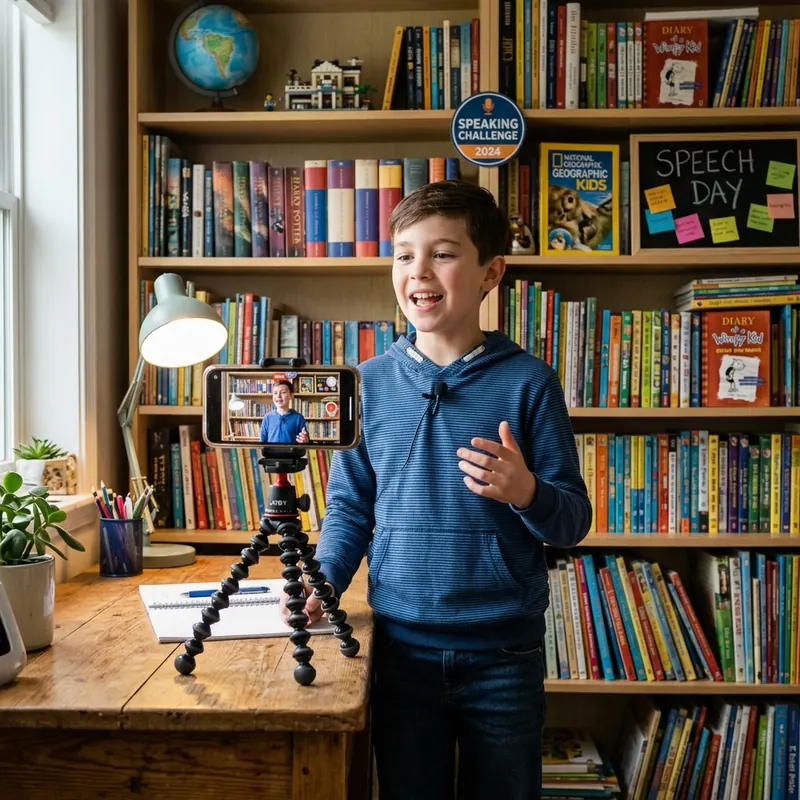
- The Vlogger Challenge: Have your child use a smartphone or tablet to record a 90-second "vlog" reviewing their favorite book, hobby, or science experiment. Watch the replay together, celebrating positive energy, clear eye contact with the lens, and expressive voice.
- Zoom Newsroom: Set up a family video call across different rooms in the house. The child presents a short weather or family news broadcast using the camera, practicing digital gaze alignment (looking into the webcam rather than down at the screen).
- Audiobook Narrator: Use a voice memo app to record a student narrating a children's storybook. Encourage distinct character voices, theatrical pauses, and sound effects. Listening back to their own clear audio recording builds immediate vocal pride.
- The Podcast Interview: Place a microphone (or even a wooden spoon) on the table and record a 5-minute podcast episode where parent and child take turns as host and guest, asking open-ended questions and practicing reflective active listening.
- Gibberish Translator: One speaker delivers a 45-second speech entirely in made-up gibberish sounds, using animated facial expressions, hand gestures, and vocal pitch. A partner acts as the professional translator, translating the gibberish sentence-by-sentence for the audience.
Category 10: Speech Structure and Delivery Activities (Activities 46–50)
Advanced speaking requires organized thinking frameworks that enable students to build cohesive arguments on the fly.
- Digital TED Talk (Micro-Keynote): Have students prepare a 3-minute presentation on a topic they are genuinely passionate about. They must utilize the classic keynote formula: Hook the audience, reveal the central problem, share a personal insight, and leave the audience with a memorable call-to-action.
- AI Speech Coach: Open a voice-to-text dictation document on a phone or computer. Have the student read or speak a 1-minute passage clearly. Checking the transcription highlights whether consonants were clear enough for speech recognition software to transcribe accurately.
- Green Screen Storytelling: Use a simple video editing app or virtual background to transport the speaker into a setting related to their topic (e.g., ancient Rome or the Amazon rainforest). The student must interact physically with their virtual environment while speaking.
- Emoji Story Synthesis: Select 5 random emojis on a screen (e.g., 🚀, 🍕, 🌧️, 🎸, 🏆). The student has 60 seconds to craft a spontaneous oral story that incorporates all five emojis logically into the narrative sequence.
- Unboxing Video Product Review: Place an everyday item inside a taped cardboard box. The student unboxes the item live on camera, describing its tactile texture, weight, aesthetic design, and utility using rich descriptive adjectives.
Deep-Dive: Public Speaking Group Exercises (Pairs, Triads, Teams, Whole Class)
Group speaking exercises eliminate the isolation of solo podium presentations. By working in pairs, triads, small teams, and whole-class formats, students practice collaborative rhetoric, active listening, and audience awareness. Below are four structured group exercises complete with full pedagogical parameters:
1. Peer Interview & Spotlight Introduction
Objective: Develop active listening, synthesis, and presenting another person with warmth and dignity.
Instructions: Students pair up with someone they do not know well. Partner A has 3 minutes to interview Partner B using three questions: (1) What is a project or hobby you love? (2) What is a challenge you overcame this year? (3) What is one fun fact people would never guess about you? Then swap roles. After the interview, each student takes the floor to introduce their partner to the class in 60 seconds, speaking in the third person with pride.
2. The Triad Story Spine (Hook, Body, Moral)
Objective: Practice narrative cohesion, clean structural hand-offs, and pacing across multiple speakers.
Instructions: Form groups of three. Assign each member a structural role: Speaker 1 delivers the Hook & Exposition (setting the scene and central obstacle in 45 seconds). Speaker 2 delivers the Rising Action & Climax (the turning point and greatest tension in 45 seconds). Speaker 3 delivers the Resolution & Moral (how the conflict resolved and what lesson was learned in 45 seconds). The presentation must flow seamlessly without awkward pauses between transitions.
3. Team Pitch Tank: Classroom Innovation Challenge
Objective: Practice collaborative persuasive speaking, dividing speaking roles, and handling audience questions.
Instructions: Teams receive a real-world problem (e.g., "How can our school reduce cafeteria food waste?" or "How can students manage screen fatigue during exam week?"). Teams have 8 minutes to devise an invention or campaign. During the 3-minute pitch, every team member must deliver a dedicated segment: (1) Problem statement, (2) Solution mechanism, (3) Budget/Feasibility, (4) Call to action. The audience then asks two spontaneous questions that team members must field cooperatively.
4. The Whole-Class Opinion Continuum
Objective: Practice spontaneous defense of personal opinions, active listening to opposing views, and respectful rebuttal.
Instructions: Designate one wall of the room as "Strongly Agree" and the opposite wall as "Strongly Disagree," with the center representing "Neutral." The teacher reads an engaging claim (e.g., "Social media has done more good than harm for youth" or "School uniforms improve student focus"). Students position themselves physically along the continuum. The teacher calls on random students along the spectrum to deliver a 30-second justification of their position. Students may physically change their position if an argument persuades them.
Deep-Dive: Public Speaking Activities for Middle Schoolers (Grades 6–8)
Middle school (ages 11 to 14) is a critical developmental window. As adolescent social awareness heightens, students become acutely sensitive to peer judgment. Public speaking activities for middle schoolers must provide enough structure to feel safe while offering enough creative agency to keep them genuinely engaged. These seven activities target middle school communication milestones:
1. Storytelling: The 3-Act Personal Anecdote
Middle schoolers love sharing personal experiences when given a safe framework. Teach the 3-act spine: "Once upon a time... Until one day... And ever since that day..." Students have 2 minutes to share a real-life micro-story (like getting lost in a supermarket or trying a bizarre food). The structure keeps the narrative moving and prevents rambling.
2. Describing Objects: Sensory Mystery Inspection
Place an everyday item in a closed paper bag. The student inspects it using only their sense of touch, then delivers a 60-second description focusing entirely on sensory vocabulary: weight, texture, temperature, and edges—without naming what they think the object is. The class guesses the identity based solely on the rich adjectives used.
3. Explaining a Process: The How-To Demonstrator
Explaining an intricate process is essential for scientific and technical presentations. Students choose an everyday task they excel at (making the ultimate toasted cheese sandwich, tying a climbing knot, or solving a Rubik's cube) and deliver a 90-second instructional speech using clear transition signposts: "First... Next... The critical step that most people overlook is... Finally..."
4. Opinion Sharing: Four Corners Stance & Defense
Label the four corners of your room: Strongly Agree, Agree, Disagree, Strongly Disagree. Read a thought-provoking prompt (e.g., "Video games should be recognized as an Olympic sport"). Students walk to their chosen corner. Each corner nominates an impromptu spokesperson to present their 45-second group rationale, fostering spontaneous argumentation without individual vulnerability.
5. Role Play: Historical Figure Press Conference
Students adopt the persona of a figure from history, literature, or science (e.g., Galileo Galilei, Joan of Arc, or Marie Curie). Classmates act as investigative journalists asking challenging questions about their discoveries, controversies, and decisions. The student must field questions while staying fully in character and defending their historical choices.
6. Short Presentations: The 2-Minute Spotlight Talk
The 2-minute spotlight teaches concise idea packaging. Students present on a focused personal passion (their favorite musical artist, an endangered marine species, or an ancient civilization) using exactly three talking points: Background, Core Wonder, and Future Outlook. For students writing and refining speeches, our creative writing classes for kids offer step-by-step guidance in crafting compelling narratives.
7. Question-and-Answer Practice: The Hot Seat Inquisitor
Fielding unscripted questions is often more intimidating than delivering the main presentation. After a student delivers a short talk, they take the "Hot Seat" for 60 seconds. Two classmates ask spontaneous follow-up questions. The speaker practices the three-part Q&A formula: (1) Acknowledge the question graciously ("That is an insightful question..."), (2) State the direct answer, and (3) Provide a brief concrete example.
Deep-Dive: Public Speaking Activities for High School Students (Grades 9–12)
High school students (ages 14 to 18) require sophisticated rhetorical training. College admissions interviews, competitive Model UN, debate tournaments, and scholarship presentations demand critical analysis, persuasive reasoning, and acute audience awareness. These eight advanced activities hone high school oratory skills:
1. Opinion Speaking: The 60-Second Stance (Thesis & Warrants)
High schoolers frequently default to emotional claims without structural backing. In this drill, students receive a current affairs or ethical prompt and must deliver a 60-second impromptu speech strictly following classical rhetorical argumentation: Claim (clear assertion), Warrant (logical reasoning), and Impact (why this matters to society). No filler, just razor-sharp logic.
2. Persuasive Speaking: Monroe's Motivated Sequence Micro-Pitch
Monroe's Motivated Sequence is the gold standard of persuasive oratory. In this 3-minute exercise, students pitch a tangible change (e.g., shifting high school start times later or implementing student mental health days) using the five steps: Attention → Need → Satisfaction → Visualization → Action. This teaches students how to guide listeners from passive agreement to active commitment.
3. Evidence and Examples: The Claim-Data-Warrant Drill
Presenting factual evidence without putting listeners to sleep is an art. In this exercise, students take a single factual statistic or scientific study and have 90 seconds to explain it using the "Data & Story Duo" technique: state the statistic cleanly, immediately translate the raw number into a human story, and explain its broader significance.
4. Debate Preparation: Lincoln-Douglas Cross-Examination Sprint
Divide students into affirmative and negative pairs on an ethical resolution (e.g., "Resolved: Artificial intelligence in creative arts causes more societal harm than benefit"). Each side has 2 minutes to cross-examine their opponent with direct, closed-ended questions designed to expose logical gaps, teaching high schoolers active listening, composure under scrutiny, and precise cross-examination etiquette.
5. Impromptu Speaking: The PREP Framework Sprint
Extempore speeches can easily degenerate into rambling. Train students to use the PREP framework whenever called upon unexpectedly:
- Point: State your core message in one sentence.
- Reason: Explain the primary logic supporting your point.
- Example: Share a real-world illustration, historical precedent, or personal anecdote.
- Point: Reiterate your opening message with elevated conviction.
6. Presentation Openings: The 3-Hook Hook-Off
The first 30 seconds dictate whether an audience engages or tunes out. Students practice three distinct presentation openers for the exact same topic: (1) The Provocative Question, (2) The Jarring Statistic, and (3) The In-Media-Res Anecdote. The group votes on which hook created the highest immediate psychological curiosity.
7. Conclusion Practice: The Memorable Clincher
Most high schoolers conclude presentations by muttering, "Um, so yeah, that's basically all I have." In this drill, students practice delivering powerful conclusions without ever saying "in conclusion." They learn to synthesize their core thesis, link back to their opening hook, and deliver a lasting rhetorical clincher that resonates in the room.
8. Audience Awareness: The Chameleon Speech
A master orator adapts their delivery to who is in the seats. In this exercise, a student is given one topic (e.g., "The Importance of Cybersecurity") and must explain it in three consecutive 45-second rounds to three radically different audiences: first to a class of 7-year-old elementary students, second to their high school peer group, and third to a board of corporate investors. This builds sophisticated rhetorical empathy and tonal flexibility.
Deep-Dive: Low-Prep Public Speaking Activities at Home (5–15 Minutes)
Parents often believe building public speaking confidence requires enrolling in expensive programs or purchasing specialized software. In reality, the living room and dinner table offer the most natural, relaxed stage a child will ever have. These five activities require zero paid equipment, zero preparation, and only 5 to 15 minutes of screen-free family time:
- The Dinner Table Headline (5 Minutes): Instead of asking the generic "How was your day?" (which reliably generates a one-word "Good"), have everyone at the dinner table share one "News Headline" of their day. The child has 60 seconds to report on a funny observation, a new scientific fact learned, or an interesting playground event as if delivering the evening news.
- The Family Product Pitch (10 Minutes): Grab an everyday item from the kitchen—a potato peeler, a wooden spatula, or a spice jar. Give your child 2 minutes to inspect it, then have them deliver a 90-second "Shark Tank" commercial convincing the family why this item is a revolutionary must-have. Celebrate humorous exaggerations and enthusiastic body language!
- The Living Room Weather Caster (5 Minutes): Have your child stand near the window and deliver an impromptu 2-minute weather broadcast. They describe the cloud formations, temperature, wind, and forecast for tomorrow's family outings, using descriptive adjectives and hand gestures pointing to imaginary weather maps.
- Bedtime Story Swap (10 Minutes): During bedtime reading, read two pages aloud, then pause and pass the book to your child. Their challenge is not just to read, but to act as the audio narrator—giving distinct voices to characters and pausing dramatically at cliffhangers.
- The Echo Chamber Projection Game (5 Minutes): Stand in separate rooms of the house (e.g., kitchen and hallway). Practice speaking phrases clearly across the distance. The rule is no screaming or straining the throat—sound must carry through diaphragmatic breath support and crisp consonant enunciation.
Dedicated Guidance: Activities for Shy or Hesitant Speakers
It is vital to recognize that hesitation or quietness in a child is not a limitation or a character flaw. Many quiet children are deep, thoughtful observers who possess rich internal worlds. Forcing a shy student to stand alone before an audience without preparation can trigger intense emotional freeze responses. Instead, our goal is to build gradual, low-pressure pathways where their voices are welcomed and celebrated on their own terms:
Core Principles for Hesitant Speakers:
- Low-Pressure Participation: Never force an immediate public solo. Begin with choral speaking (whole group together), then partner speaking, and finally voluntary small-group sharing.
- Gradual Speaking Ladders: Scaffold the vocal volume and duration. Start with a 10-second whisper to a trusted partner, progress to a 30-second conversational share, and gently expand over weeks.
- Choice of Topic: When children speak on assigned, unfamiliar topics, cognitive load doubles. Allowing hesitant students to talk about their personal passion (a favorite video game, an art project, or their family pet) activates natural enthusiasm that overrides hesitation.
- Pair Practice Before Group Sharing: Always have students practice sharing their idea with one peer before asking anyone to speak to the broader room. Knowing their partner validated their idea gives hesitant students immense confidence.
- Positive Feedback Loops: Never critique a hesitant speaker's delivery errors early on. Celebrate the courage of speaking up: "Thank you for sharing that thought—your voice was so clear and thoughtful."
- Predictable Repetition: Anxiety diminishes when routines become familiar. Running the same 5-minute warm-up daily allows hesitant speakers to master the rules and relax into participation.
The Partner Whisper-to-Speak Ladder
Instructions: Partner A and Partner B sit side-by-side. Step 1: Partner A whispers a favorite memory to Partner B for 30 seconds. Step 2: Partner A repeats the memory in a quiet conversational voice. Step 3: Partner A stands up and shares the memory at normal speaking volume while Partner B smiles and nods. This step-by-step acoustic ladder de-escalates fear gently.
Teacher and Parent Troubleshooting Guide: Solutions for 7 Common Speaking Hurdles
Even with great activities, students encounter common communication hurdles. Here is how educators and parents can troubleshoot these moments with constructive pedagogical grace:
1. When Students Refuse to Speak or Freeze
The Fix: Never cajole, shame, or force a frozen student in front of their peers. Drop the spotlight immediately: "No problem, take a moment to think—I'll check back with you after Alex." Alternatively, allow them to participate non-verbally first (e.g., holding a prop or pointing to a slide) or share their idea quietly with one trusted neighbor.
2. When Students Speak Too Softly (Mumbling)
The Fix: Do not repeatedly yell "Speak up!"—this only makes self-conscious students withdraw further. Instead, place a friendly peer or parent at the back of the room and make it a game: "Let's see if your voice can gently reach Leo in the back corner." Practice the "Whispering Giant" game to demonstrate that clear mouth shaping carries sound effortlessly.
3. When Students Memorise Every Word (Robotic Delivery)
The Fix: Ban full-sentence scripts during speaking activities. Replace written sheets with a single index card containing exactly three bullet points or simple drawn icons. If a student loses their place, prompt them: "Tell me in your own everyday words what happens next." This breaks script dependence and builds conversational resonance.
4. When Students Rush (200+ Words Per Minute)
The Fix: Racing is a physiological defense mechanism to escape the spotlight as quickly as possible. Use the "Pause Command" exercise: have the student pause, plant both feet flat on the floor, and take a deliberate inhale after every single sentence. Model how powerful speakers like Barack Obama or Steve Jobs utilize long, deliberate silences.
5. When Students Give Shallow One-Word Answers
The Fix: Teach the "Why + Example" Ladder. Whenever a student gives a brief answer (e.g., "I like soccer"), prompt them gently with the two magic connecting words: "Because..." followed by "For example...". This simple mental scaffold instantly prompts them to generate two additional sentences of explanation.
6. When Students Interrupt Others
The Fix: Introduce a physical "Speaker's Baton" or talking object (like a soft foam ball or decorative microphone). Only the individual holding the baton has permission to speak; all other listeners are in "Active Listening Mode," tasked with identifying one specific compliment to share when the speaker finishes.
7. When Students Fear Making Mistakes
The Fix: Play "Praise the Mistake." In this warm-up, students intentionally deliver a line with a funny error or mispronunciation, dramatically take a theatrical bow, and receive thunderous applause from everyone in the room. When mistakes are de-stigmatized, communicative freedom flourishes.
Play-Way Pedagogy: The Science of Experiential Speaking
At Victory Fluent Forum, our speech methodology is grounded in experiential play-way pedagogy. Neuro-educational research demonstrates that when children engage in gamified communication challenges, dopamine levels rise while amygdala threat-detection responses diminish. Instead of triggering flight-or-flight freeze reflexes, game-based speaking activates creative problem-solving pathways in the prefrontal cortex.
Victory Fluent Forum Classroom Observations
Over thousands of teaching hours working with students across diverse age groups in our online public speaking classes for kids, our instructional team has tracked distinct developmental patterns:
- The 3-Session Breakthrough: Students who participate in daily 5-minute micro-games demonstrate a 60% reduction in physical fidgeting and nervous hand-wringing within three sessions.
- Peer Validation Effect: Hesitant students show significantly greater speaking willingness when positive peer feedback precedes any adult critique.
- Screen-Free Kinesthetic Grounding: Incorporating physical gestures (like the Super Hero Stance or Punctuation Beats) increases vocal projection and reduces filler-word frequency by over 40%.
Empower Your Child to Speak Confidently
Is your child hesitant to raise their hand in class or nervous before school presentations? Our expert speech coaches help students transform speech anxiety into polished, captivating eloquence through engaging live small-group classes.
Book a Free Assessment Class